Bones, Gardens & Gates: The Lambeth Riverside
From a medieval churchyard full of secrets to England's most storied palace gatehouse
London · 10 stops · 4.7 km · ~1.6 h · 34 min audio · Generated · Unlocked for everyone by someone who walked here
-
1. St Mary's Gardens
St Mary's Gardens, Lambeth Palace Road, London SE1 7JU
Look around you. This quiet patch of green feels almost accidental... and that's because it IS. St Mary's Gardens was originally part of the old road that led up to the site of the original Lambeth Bridge of eighteen sixty-two. When that bridge was replaced by a new one further to the south, this leftover wedge of land was laid out as a small public garden by Lambeth Borough Council in nineteen thirty-two to thirty-three.
But let me take you back further... much further. The site of Lambeth Bridge has long been an important Thames crossing, with records of a horse ferry operated by the Archbishop of Canterbury dating back to medieval times. For centuries, this very ground you're standing on was part of the busy route down to the river. The first modern bridge here was a suspension bridge designed by Peter W. Barlow, sanctioned by the Lambeth Bridge Act of eighteen sixty-one, and it opened as a toll bridge on the tenth of November, eighteen sixty-two. But here's the thing... Doubts about its safety, coupled with its awkwardly steep approaches deterring horse-drawn traffic, meant it soon became used almost solely as a pedestrian crossing. The bridge was basically a failure from day one.
By nineteen ten, it was closed to vehicular traffic entirely, severely corroded and tilting. And then came the great Thames flood of nineteen twenty-eight, which devastated the Millbank area and delayed the replacement even further. The current Lambeth Bridge, a five-span steel arch designed by Sir George Humphreys, was finally opened on the nineteenth of July, nineteen thirty-two, by King George the Fifth.
And that is what created this garden. When the new bridge was built slightly south of the old one, the old approach road became redundant... and this odd triangular space was born.
Now, look just beyond the garden. There has been a church on the neighbouring site since at least ten sixty-two — a thousand years of worship. A wooden church was built here by Goda, sister of Edward the Confessor. And beneath that church, in twenty sixteen, workers made an astonishing discovery. A hidden vault beneath the chancel was found containing up to thirty lead coffins, including as many as five Archbishops of Canterbury. Contractors had lifted a loose stone in the floor and revealed a staircase descending into darkness. Among those believed to be buried there is Archbishop Bancroft, who died in sixteen ten after overseeing the translation of the King James Bible.
And there's one more delicious detail. Local Lambeth legend states that if the Tradescant tomb nearby is danced around twelve times while Big Ben strikes midnight... a ghost appears. Whether you believe that or not... in a place where lost roads, hidden crypts, and nearly a thousand years of the dead lie just beneath your feet, it doesn't seem entirely impossible, does it?
-
2. The Front Churchyard — Wild Garden of the Dead
Garden Museum, 5 Lambeth Palace Road, London SE1 7LB
Take a breath. You're standing in a place where the living and the dead share the earth beneath your feet.
Over twenty-six thousand people are estimated to be buried on this site, and the sheer weight of all those burials has actually raised the ground level over the centuries. That soft earth you're walking on... is not just soil. Nearly sixteen thousand of those burials happened in just two decades, between seventeen ninety and eighteen ten, when Lambeth was exploding in population.
But this place is far older than that. In ten sixty-two, a wooden church was built right here by Goda, sister of Edward the Confessor. By the end of the twelfth century, Lambeth Palace was built next door, and Saint Mary's graduated from a humble parish church into the Archbishop of Canterbury's palace church.
Now look around at these weathered gravestones rising among the wild grasses. The front garden you see today was designed by Christopher Bradley-Hole as part of the museum's twenty seventeen redevelopment. But beneath this gentle wildness lie some extraordinary people. There's the Grade Two star listed tomb of Captain William Bligh, best known for the mutiny on HMS Bounty in seventeen eighty-nine. It's a fine chest tomb made of Coade stone, topped by a carved breadfruit... a nod to the mission that defined his life.
And then there's one of the most astonishing discoveries in recent London history. During renovation works, contractors lifted some flagstones to even out the floor... and found a staircase descending into darkness. They attached a phone to a long stick and filmed the vault below. They were shocked to discover it was crammed with thirty lead coffins. One of them had a red and gold pointed hat perched upon it... the mitre of an Archbishop. Those coffins held the remains of five Archbishops of Canterbury, including Richard Bancroft, who oversaw the creation of the King James Bible. Everyone had assumed the Victorians cleared out all the burials in eighteen fifty-one. They were wrong.
And the ghost? Well, according to local Lambeth legend... if you dance around the Tradescant tomb twelve times while Big Ben strikes midnight, a ghost appears. Nobody has confirmed it, of course. But standing here, among these ancient stones and swaying meadow flowers, with twenty-six thousand souls beneath you... you might not want to test it.
-
3. Morton's Tower — The Gatehouse of Power
Morton's Tower, Lambeth Palace, London SE1 7JU
Photo: Google
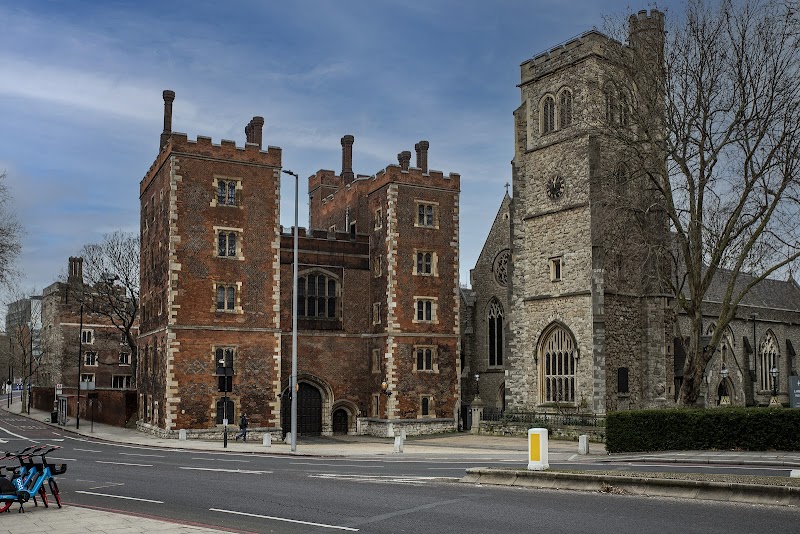
Look up at this magnificent wall of Tudor red brick rising five storeys above you. This is Morton's Tower, the formal entrance to Lambeth Palace, built in fourteen ninety by Cardinal John Morton. Over five hundred years old... and still the only way in.
Now, Cardinal Morton was no ordinary churchman. Born around fourteen twenty in Dorset, he was a cleric and civil lawyer who navigated the bloody chaos of the Wars of the Roses, serving under Henry the Sixth, Edward the Fourth, and finally Henry the Seventh, who made him Lord Chancellor, Archbishop of Canterbury, and cardinal. A survivor in an age when backing the wrong king meant losing your head.
And here's what makes this gatehouse so fascinating. Look at its design... it sits right at that moment in history when outright castles were becoming less necessary, and powerful men aspired to grand houses with expensive glass-filled windows. But they weren't quite certain things had calmed down, so military features remain... just to be safe! Those battlements up top? Not just decorative. They're a hedge against uncertainty.
Now, look closely at the south tower on your right. On the ground floor, there's a small cell that was used for imprisonment in the sixteenth century. Two iron rings can still be found fixed to the wall. Even an archbishop's palace needed its own little prison.
But Morton's Tower also had a Gentler purpose. The Lambeth Dole... a daily offering of bread, broth, and money, first started by Archbishop Winchelsea in the thirteenth century... was handed out from this very tower until eighteen forty-two. Charity and confinement, separated by just a few feet of brick.
And there's a connection here to one of England's most famous figures. In fourteen ninety, a twelve-year-old boy named Thomas more was sent to Lambeth to be educated in a gentleman's household. He served as one of Cardinal Morton's pages. Can you imagine? The future author of Utopia, running errands through this very archway as a child. More later included a glowing portrait of Morton in his famous book.
Oh, and one more thing. Ever heard the expression Morton's Fork? Traditionally, Morton has been known as the inventor of this devious dilemma, imposed on rich and poor alike to extort funds for the crown. The rich were told they could afford to contribute, and the poor were accused of having concealed wealth. You spend lavishly? Clearly you can pay more tax. You live frugally? Then you must have savings! Either way... the king gets his money. Though historians note this story was actually Francis bacon's invention, written over a century later.
Now look above the arch. The gateway still bears lead rain-water heads with a "tun" device... that's Cardinal Morton's Rebus, a visual pun on his name. A falcon, known as a "mort," perched on a cask, or "tun." Mort... tun. Morton. Tudor wordplay, hiding in plain sight for five centuries.
-
4. The Pedlar's Window — A Dog, a Deed and a Stained-Glass Legend
Garden Museum nave, 5 Lambeth Palace Road, London SE1 7LB
Look at this small, jewel-like window on the south wall. A man with a pack on his back... a faithful dog at his heels... and behind them, the unmistakable outline of County Hall. This is the Pedlar's Window, and it tells one of Lambeth's strangest and most enduring legends.
The story goes that a pedlar and his dog were sheltered by the local priest here at St Mary's, and the pedlar promised that, should he prosper, he would repay the church's kindness. And prosper he did. By tradition, the pedlar left an acre of land to the parish on one condition... that his portrait should always be maintained on a church window.
That acre? The land between Westminster Bridge and the London Eye was once known as Pedlar's Acre. The whole acre was swallowed up by the monumental County Hall, constructed on the South Bank in the nineteen-tens. Think about that. A scrap of marshland given by a wandering salesman... now beneath one of London's most valuable stretches of real estate.
But here's where it gets really interesting. The first recorded use of the name Pedlar's Acre didn't appear until sixteen ninety. No document exists to show how the parish came to hold the land in the first place. Some versions say the pedlar's dog uncovered a treasure hoard close to the church... a tale strikingly similar to the famous legend of the Pedlar of Swaffham in Norfolk, who dreamed that if he went to London Bridge, he should hear joyful news.
And there's a rival theory that's even more surprising. In a Free Press article from nineteen thirteen, the solicitor of the Pedlar Charity called the whole legend "all rubbish," claiming that old deeds showed the land was actually bequeathed around fourteen hundred by one William Le Pedlar, the rector of Streatham. Not a wandering peddler at all... but a clergyman whose surname happened to be Pedlar!
Yet another theory, dating from the eighteen twenties, suggests the window is actually a rebus — a visual pun — on a benefactor named Chapman... a man who sells chapbooks.
Now look closely at the inscription running around the window's edge. It reads like a timeline of survival. "Mended in sixteen oh eight. Renewed seventeen oh three. Transferred to this chapel eighteen eighty-four. Destroyed nineteen forty-one. Renewed nineteen fifty-six." Five centuries of damage, restoration and reinvention.
The original window was actually taken down in eighteen eighty-four to make room for a modern memorial. The move caused outrage, and a local lobby group persuaded the church to reinstall it. Then, in nineteen forty-one... a German bomb shattered the historic glass. In the nineteen fifties, the stained glass was replaced by panels by Francis Stephens, including this replica of the Pedlar's Window.
Whether the pedlar was real, or a rector with a convenient surname, or just a visual joke... the deal has been honoured for over five hundred years. His face remains in the glass. And that, in Lambeth, is a promise kept.
-
5. The Lambeth Palace Gates — Where Thomas More Was Summoned
Lambeth Palace Gate, Lambeth Palace Road, London SE1 7JU
Look at this red brick gatehouse... five centuries old, and it has barely changed. This is Morton's Tower, an impressive Tudor gatehouse that serves as the formal entrance to Lambeth Palace. It was built in fourteen ninety by Cardinal John Morton, who lived in the tower for a short time and used the great room above the gates as his personal audience chamber.
Now here's where the story gets remarkable. In fourteen ninety, a twelve-year-old boy named Thomas more was sent right here to Lambeth, to be educated in a gentleman's household. He served as one of Cardinal Morton's pages and took part in household entertainments. Imagine this clever child, waiting on tables for the most powerful churchman in England... and Morton noticed him. At Christmastime, young more would suddenly step in among the players and improvise a part of his own. The Cardinal, delighting in the boy's wit, would say to the nobles dining with him: "This child here waiting at the table, whosoever shall live to see it, will prove a marvelous man."
And what a prophecy that turned out to be.
Fast forward forty-four years. On April twelfth, fifteen thirty-four, soon after leaving church at Saint Paul's Cathedral with his son-in-law William Roper, more was handed a summons to appear at Lambeth Palace the next day. He returned to Chelsea to spend with his family what he probably knew would be his last night as a free man.
The next morning, he boarded a boat for Lambeth. As they set off down the river, more, at peace with his decision, told his son-in-law: "Son Roper, I thank our Lord the field is won."
He walked through these very gates... and into the Guard Room where, as a boy, he had once served dinner. It was in this room that he was summoned by Thomas Cromwell to swear an Oath declaring Henry the Eighth as head of the Church in England. More asked to read the oath carefully. Then he quietly said his conscience would not allow him to sign.
The commissioners sent him out to reflect on the fact that he was the first man to refuse. While he waited, he saw others pass through... most signed, even those known to dislike it. But more would not bend. Summoned back, he refused a second time, even after much cajoling and threats of imprisonment. The frustrated commissioners turned more over to the Abbot of Westminster, who kept him for four days before he was transferred to a cell in the Tower of London.
He would never walk free again. On the sixth of July, fifteen thirty-five, Sir Thomas more was beheaded on Tower Hill.
Now, one more detail most people miss. Look at the base of the tower. Right here, the "Lambeth Dole," a daily offering of bread, broth, and money, was first begun by Archbishop Winchelsea in the thirteenth century. This ritual of charitable giving was offered from Morton's Tower until eighteen forty-two... over five hundred years of feeding the poor, right at these gates. The ground floor of the south tower still contains a small cell that was used for imprisonment in the sixteenth century. Two iron rings can still be found fixed to the wall.
So this one gatehouse held charity and a prison cell, a boy's education and a man's condemnation. Few doorways in London carry so much history in their stones.
-
6. Former London Fire Brigade HQ — Opened by a King
8 Albert Embankment, London SE1 7SD
Take a look at this striking building standing before you on the Albert Embankment. Historic England describes it as a streamlined Moderne building that upholds the Arts and Crafts ideal of collaboration between architecture and sculpture. But there's far more to this place than meets the eye.
This was the new headquarters of the London Fire Brigade, opened with great fanfare on Wednesday the twenty-first of July, nineteen thirty-seven, by King George the Sixth and Queen Elizabeth. One hundred and fifty firefighters paraded for royal inspection alongside Chief Officer Major Morris and a host of dignitaries, while the L-F-B Band provided musical accompaniment. Quite the spectacle on the south bank of the Thames!
The building was designed by London County Council architects E. P. Wheeler and G. Weald, built using Portland stone and light-coloured brick. Now, look closely at the facade. Do you see those sculpted reliefs? They were created by the distinguished sculptors Stanley Nicholson Babb and Gilbert Bayes... and they include firefighters in their most modern nineteen thirty-seven uniforms alongside mythical imagery, including Phoebus the sun god in his chariot, with the sun's rays behind him, detailed in gold mosaic tiles. Gilbert Bayes, by the way, is the same artist who created the famous Queen of Time clock above the entrance to Selfridges on Oxford Street.
But here's where the story gets darker... and more heroic. After London suffered bombing raids during the First World War, this headquarters was specifically designed to withstand attack from the air. And that foresight proved critical. In April nineteen forty, an underground control room was completed beneath this very building... constructed to withstand a direct hit from a high-explosive bomb and also to render ineffective a poison gas attack. It had its own reserve generator, forced ventilation, and was sealed by watertight doors.
And that strange obelisk you might spot nearby? That was the snorkel tower, designed to pierce any debris from a collapsing building, providing both ventilation and an emergency escape route for the officers working below.
It was from here that the capital's entire firefighting operation was run during the Second World War. Just imagine... Major Jackson and a small band of senior officers, deep underground, watching deployment on enormous wall maps as London burned above them during the Blitz.
Inside, there's something most people never see. A Memorial Hall... a beautiful, reflective space commemorating firefighters and Brigade staff who lost their lives on duty. It contains two memorials by Gilbert Bayes... one depicting an eighteenth-century firefighting scene with firefighters in distinctive leather hats, with framed illuminated manuscripts hidden behind bronze doors to keep their colours fresh.
Now, remarkably, after years away, the London Fire Brigade is planning to move back here from its Southwark base, returning to the Art Deco building where it was based for seventy years. A full circle... back to the big house on the river.
-
7. Albert Embankment — The View the MPs Ordered
Albert Embankment, London SE1 7TL
Stand here on the Albert Embankment and look across the water toward the Palace of Westminster. Quite a view, isn't it? Now here's the thing... what if I told you that this embankment exists largely because Members of Parliament didn't like what they saw when they looked back at you?
The decision to build an embankment on this south bank was driven by several factors, but among them, M.P.s wished to improve the view from the windows and terrace of the newly completed Palace of Westminster. You see, before the eighteen sixties, where you're standing now was a chaotic tangle of mudflats, crumbling wharves, and a riverside lane called Fore Street. Lower Fore Street in Lambeth was home to wretched lives in damp, cheaply built houses. It was along this river strip between Saint Mary's Church and Vauxhall that the population and industries of Lambeth were concentrated — clay, charcoal, and materials for the potteries and glassworks were brought by water, and finished products shipped out the same way.
The smell was... extraordinary. Malodorous mud accumulated in the wider places along the uneven riverfront. And when the Thames flooded at high tide, the whole area went under.
So in eighteen sixty-six, construction began. The work was directed not by the famous Sir Joseph Bazalgette, as is commonly supposed, but by his assistant engineer, John grant. The contractor was William Webster, and it cost over one million pounds — enormous for the time. Sadly, the demolition saw the centre of what was once the village of Lambeth removed to make way for the new promenade and roadway.
But something remarkable rose from the rubble. Look at those lamp posts. Two stylised dolphins — or possibly sturgeons — writhe around the base of each standard, supporting a fluted column bearing lights in an opaque white globe, topped by a metal crown. They were designed by George John Vulliamy and inspired by the dolphin sculptures on the Fontana del Nettuno in Rome's Piazza del Popolo. If you look closely at the base, you'll find the date eighteen seventy, the inscription "Vic Reg," the foundry name Masfield and Company, and the architect's mark — C. Vulliamy.
And there's one more hidden detail. Facing the river, you'll spot bronze lion heads with rings clenched in their mouths. These were mooring rings for boats... and according to an old London legend, when the river rises high enough to reach the lions' mouths, London will flood.
One last thing. In eighteen forty-six, Henry Doulton built a pipe factory right here on what would become the Albert Embankment — manufacturing the very glazed sewer pipes that helped defeat London's cholera epidemics. So this stretch of riverbank is a place where beauty and sanitation walked hand in hand... all because a few politicians wanted a prettier view from their terrace.
-
8. Lambeth Bridge — Red Paint and Pineapple Legends
Lambeth Bridge, London SE1 7SG
-
9. Archbishop's Park — The Archbishop's Gift to the Poor
Archbishop's Park, Carlisle Lane, London SE1 7LE
Take a moment to look around you. This green, peaceful space... it's almost hard to believe that it was once the private grounds of one of the most powerful religious figures in England. Before it became a park, this land formed part of the grounds of Lambeth Palace, the London residence of the Archbishops of Canterbury since the thirteenth century.
But the story of how these palace gardens became your park... is a story of one man's compassion, forged in unimaginable grief.
Archibald Campbell Tait was a Scottish-born clergyman who became Archbishop of Canterbury in eighteen sixty eight... the first Scottish priest ever to hold that role. But behind that historic achievement lay a shattered heart. In eighteen fifty six, within just five weeks, five of his nine children died from virulent scarlet fever. Five tiny coffins... in barely a month. Then his only surviving son, Craufurd, was diagnosed with illness in eighteen seventy seven and died the following year. Within six months, his wife Catharine had also died.
A man who had buried most of his own family... looked out from the windows of Lambeth Palace and saw children with no space to play. Families crammed into the slums of south London with no green refuge.
So he did something extraordinary. He opened some nine acres of the palace gardens for the benefit of the local poor. The area became known as Lambeth Palace Field, a place where neighborhood children could finally run and breathe.
After Tait's death in eighteen eighty two, the public continued using the land... but without any permanent rights to do so. For nearly twenty years, this green space existed on borrowed time. Then in nineteen hundred, the Metropolitan Public Gardens Association spearheaded a campaign for permanent, unrestricted access, and they won. Archbishop's Park was laid out with lawns, a children's playground, and sports fields, and opened in nineteen oh one.
Now look toward the northern end of the park. Do you notice the garden area there? In two thousand and five, to mark the launch of the Octavia Foundation, that area was dedicated to Octavia Hill, with a rose bush planted by botanist David Bellamy. Octavia Hill was a leading Victorian social reformer who co-founded the National Trust and championed parks and green spaces in towns and cities. The roses are a special variety named after Octavia Hill, donated by her birthplace museum in Wisbech, Cambridgeshire.
There's a beautiful symmetry here. A grieving archbishop gave away his private garden so poor children could play. And that same park now honors a woman who spent her entire life fighting for exactly that cause... open space for everyone. Two reformers, separated by decades, united in this one quiet green patch of Lambeth.
-
10. The Coade Stone Lion — Lambeth's Riverside Guardian
South end of Westminster Bridge, Albert Embankment, London SE1
Look at this magnificent beast! Thirteen tonnes of gleaming white stone, gazing out from the south end of Westminster Bridge. The South Bank Lion is an eighteen thirty-seven sculpture — and despite being nearly two centuries old, it looks as though it were carved yesterday. That's because it's not carved from stone at all.
What IS it made of, then? Something called Coade stone... not really stone at all, but actually a ceramic material — a fortified clay — a formula of clay, flint, terra cotta, quartz, and glass. And here's where the story connects directly back to Lambeth, where you're walking today. Eleanor Coade bought Daniel Pincot's struggling artificial stone business at King's Arms Stairs, Narrow Wall, Lambeth — a site now buried beneath the Royal Festival Hall, just upstream from where we're standing.
Eleanor Coade was a remarkable woman. A highly successful Georgian craftswoman and businesswoman, at a time when industry was totally dominated by men, she ran her own business. Born in Exeter in seventeen thirty-three, she never married, recognizing the business value of remaining a femme sole — a legally independent woman. Within two years she sacked Pincot for representing himself as the chief proprietor... and took over completely. By the end of the seventeen eighties, she had established a near-monopoly in the artificial stone market.
The recipe and the production process were both closely guarded secrets, and they remained a mystery until... nineteen ninety-one, when the recipe was finally revealed. Each piece was fired for four days in a coal-powered kiln, watched over closely at all times.
Now... this lion. Next to the Coade factory was the Lion Brewery, owned by James Goding, and in eighteen thirty-seven he commissioned the sculptor William Frederick Woodington to sculpt a pair of lions to adorn his brewery. The larger of the two was painted red and mounted on top of the brewery facing the Thames, and became a landmark for the area.
Then came the Blitz... and the lion perched on that rooftop took on a life of its own. There was a saying that "so long as the lion stands, London will stand." And London stood... as did the lion.
When the brewery was demolished in nineteen forty-nine, the lion was in trouble, and the only reason it's here today is because King George the Sixth stepped in to make sure it was saved. Workers repairing it made a surprising discovery — inside a recess in its back, they found a bottle containing two William the Fourth coins and a Coade trade card. A time capsule, hidden since eighteen thirty-seven!
In nineteen sixty-six, when the lion was moved again, the time capsule was updated — a nineteen sixty-six coin was added, along with a copy of the GLC Chairman's letter. So somewhere inside this lion's back, right Now, there are relics spanning over a hundred and eighty years.
One more thing to notice — the South Bank Lion no longer gazes over the Thames, having been positioned with a view of the road instead. A pity, perhaps. But remember — the tomb of Admiral Bligh in Saint Mary's Churchyard in Lambeth was also made of Coade stone, from the very same factory. So as you continue your walk through these gardens, you're tracing the footsteps of Eleanor Coade's extraordinary legacy... one that has outlasted empires.