St Mary's Gardens
Why is it significant?
St Mary's Gardens in London is a public park created in 1932 on a leftover triangular plot of land when the original 1862 Lambeth Bridge approach road was replaced. The site sits beside a church founded in 1062 where a hidden vault containing 30 lead coffins was discovered in 2016. The current five-span steel arch bridge was opened nearby on July 19, 1932, by King George V.
Key Facts
| Place | St Mary's Gardens |
|---|---|
| Address | St Mary's Gardens, Lambeth Palace Road, London SE1 7JU |
| Geo Coordinates | 51.49468, -0.12037 |
| Audio Duration | ~4 min |
| Part of Walk | Bones, Gardens & Gates: The Lambeth Riverside |
| Generated | Generated |
What to look for?
- Lambeth Borough Council laid out St Mary's Gardens in 1932 following the realignment of Lambeth Bridge.
- The original suspension bridge at the site was designed by Peter W. Barlow and opened on November 10, 1862.
- King George V officially opened the modern five-span steel arch Lambeth Bridge on July 19, 1932.
- Workers discovered a hidden vault with 30 lead coffins beside St Mary's Gardens in 2016.
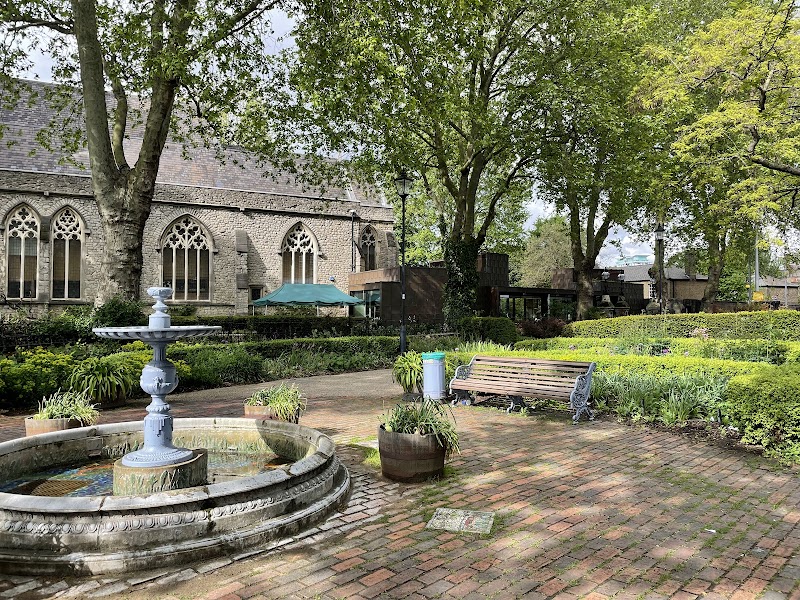
Photo: Google
Why was St Mary's Gardens in London established in 1932?
Look around you. This quiet patch of green feels almost accidental... and that's because it IS. St Mary's Gardens was originally part of the old road that led up to the site of the original Lambeth Bridge of eighteen sixty-two. When that bridge was replaced by a new one further to the south, this leftover wedge of land was laid out as a small public garden by Lambeth Borough Council in nineteen thirty-two to thirty-three. But let me take you back further... much further. The site of Lambeth Bridge has long been an important Thames crossing, with records of a horse ferry operated by the Archbishop of Canterbury dating back to medieval times. For centuries, this very ground you're standing on was part of the busy route down to the river. The first modern bridge here was a suspension bridge designed by Peter W. Barlow, sanctioned by the Lambeth Bridge Act of eighteen sixty-one, and it opened as a toll bridge on the tenth of November, eighteen sixty-two. But here's the thing... Doubts about its safety, coupled with its awkwardly steep approaches deterring horse-drawn traffic, meant it soon became used almost solely as a pedestrian crossing. The bridge was basically a failure from day one. By nineteen ten, it was closed to vehicular traffic entirely, severely corroded and tilting. And then came the great Thames flood of nineteen twenty-eight, which devastated the Millbank area and delayed the replacement even further. The current Lambeth Bridge, a five-span steel arch designed by Sir George Humphreys, was finally opened on the nineteenth of July, nineteen thirty-two, by King George the Fifth. And that is what created this garden. When the new bridge was built slightly south of the old one, the old approach road became redundant... and this odd triangular space was born. Now, look just beyond the garden. There has been a church on the neighbouring site since at least ten sixty-two — a thousand years of worship. A wooden church was built here by Goda, sister of Edward the Confessor. And beneath that church, in twenty sixteen, workers made an astonishing discovery. A hidden vault beneath the chancel was found containing up to thirty lead coffins, including as many as five Archbishops of Canterbury. Contractors had lifted a loose stone in the floor and revealed a staircase descending into darkness. Among those believed to be buried there is Archbishop Bancroft, who died in sixteen ten after overseeing the translation of the King James Bible. And there's one more delicious detail. Local Lambeth legend states that if the Tradescant tomb nearby is danced around twelve times while Big Ben strikes midnight... a ghost appears. Whether you believe that or not... in a place where lost roads, hidden crypts, and nearly a thousand years of the dead lie just beneath your feet, it doesn't seem entirely impossible, does it?
Unlocked for everyone by someone who walked here