Morton's Tower — The Gatehouse of Power
Why is it significant?
Morton's Tower is a five-storey Tudor red brick gatehouse built in 1490 at Lambeth Palace in London as its formal entrance. Constructed by Cardinal John Morton, the five-hundred-year-old structure uniquely combines military battlements with decorative Tudor architecture. It contains a sixteenth-century ground-floor prison cell, hosted a twelve-year-old Thomas More as a page in 1490, and served as the distribution point for the charitable Lambeth Dole until 1842.
Key Facts
| Place | Morton's Tower — The Gatehouse of Power |
|---|---|
| Address | Morton's Tower, Lambeth Palace, London SE1 7JU |
| Geo Coordinates | 51.49509, -0.12052 |
| Audio Duration | ~4 min |
| Part of Walk | Bones, Gardens & Gates: The Lambeth Riverside |
| Generated | Generated |
What to look for?
- Cardinal John Morton constructed Morton's Tower at Lambeth Palace in 1490 using five storeys of red Tudor brick.
- In 1490, twelve-year-old Thomas More served as a page for Cardinal John Morton inside Lambeth Palace.
- The south tower of Morton's Tower housed a sixteenth-century prison cell fitted with two iron wall rings.
- The Lambeth Dole distributed bread, broth, and money from Morton's Tower to the needy until 1842.
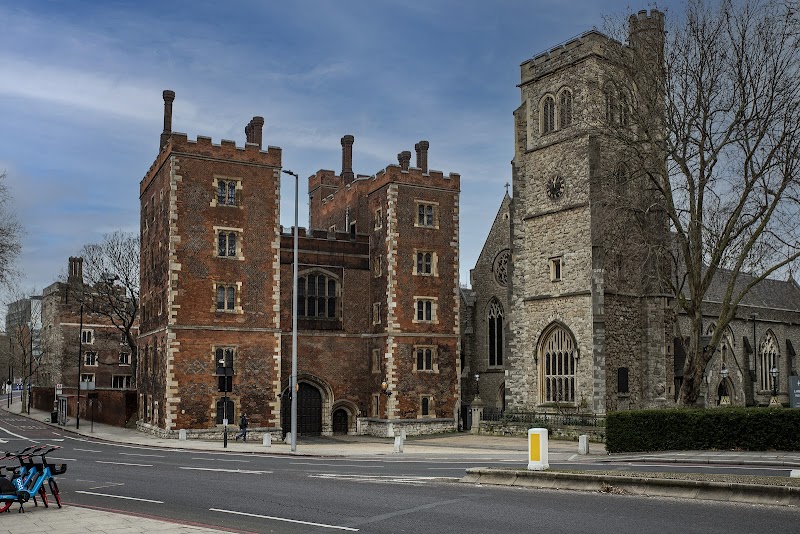
Photo: Google
Who built Morton's Tower at Lambeth Palace in London and when was it constructed?
Look up at this magnificent wall of Tudor red brick rising five storeys above you. This is Morton's Tower, the formal entrance to Lambeth Palace, built in fourteen ninety by Cardinal John Morton. Over five hundred years old... and still the only way in. Now, Cardinal Morton was no ordinary churchman. Born around fourteen twenty in Dorset, he was a cleric and civil lawyer who navigated the bloody chaos of the Wars of the Roses, serving under Henry the Sixth, Edward the Fourth, and finally Henry the Seventh, who made him Lord Chancellor, Archbishop of Canterbury, and cardinal. A survivor in an age when backing the wrong king meant losing your head. And here's what makes this gatehouse so fascinating. Look at its design... it sits right at that moment in history when outright castles were becoming less necessary, and powerful men aspired to grand houses with expensive glass-filled windows. But they weren't quite certain things had calmed down, so military features remain... just to be safe! Those battlements up top? Not just decorative. They're a hedge against uncertainty. Now, look closely at the south tower on your right. On the ground floor, there's a small cell that was used for imprisonment in the sixteenth century. Two iron rings can still be found fixed to the wall. Even an archbishop's palace needed its own little prison. But Morton's Tower also had a Gentler purpose. The Lambeth Dole... a daily offering of bread, broth, and money, first started by Archbishop Winchelsea in the thirteenth century... was handed out from this very tower until eighteen forty-two. Charity and confinement, separated by just a few feet of brick. And there's a connection here to one of England's most famous figures. In fourteen ninety, a twelve-year-old boy named Thomas more was sent to Lambeth to be educated in a gentleman's household. He served as one of Cardinal Morton's pages. Can you imagine? The future author of Utopia, running errands through this very archway as a child. More later included a glowing portrait of Morton in his famous book. Oh, and one more thing. Ever heard the expression Morton's Fork? Traditionally, Morton has been known as the inventor of this devious dilemma, imposed on rich and poor alike to extort funds for the crown. The rich were told they could afford to contribute, and the poor were accused of having concealed wealth. You spend lavishly? Clearly you can pay more tax. You live frugally? Then you must have savings! Either way... the king gets his money. Though historians note this story was actually Francis bacon's invention, written over a century later. Now look above the arch. The gateway still bears lead rain-water heads with a "tun" device... that's Cardinal Morton's Rebus, a visual pun on his name. A falcon, known as a "mort," perched on a cask, or "tun." Mort... tun. Morton. Tudor wordplay, hiding in plain sight for five centuries.
Unlocked for everyone by someone who walked here