Nine Elms Pier
Why is it significant?
Nine Elms Pier in London is a historic floating community of roughly twenty vintage Dutch barges moored on the River Thames. Originally built in the 1920s and 1930s, many steel-hulled vessels navigated European waterways, including a 1932 barge that ferried tanks during World War II. In the 1980s, the former industrial wharf transformed into a residential sanctuary, now housing around eighty residents whose boats settle onto the riverbed during twelve-hour tides.
Key Facts
| Place | Nine Elms Pier |
|---|---|
| Address | Nine Elms Pier, Nine Elms Lane, London SW8 5DA |
| Geo Coordinates | 51.48306, -0.13714 |
| Audio Duration | ~2 min |
| Part of Walk | Vauxhall to Battersea: Riverside Modern Marvels |
| Generated | Generated |
What to look for?
- In 1838, chroniclers compared Nine Elms in London to Holland due to its low, swampy landscape and windmills.
- Nine Elms Pier features historic Dutch grain and cargo barges built during the 1920s and 1930s.
- A 1932 Dutch barge at Nine Elms Pier ferried tanks during World War II before crossing the English Channel.
- Around eighty residents currently live on roughly twenty historic boats moored at London's Nine Elms Pier.
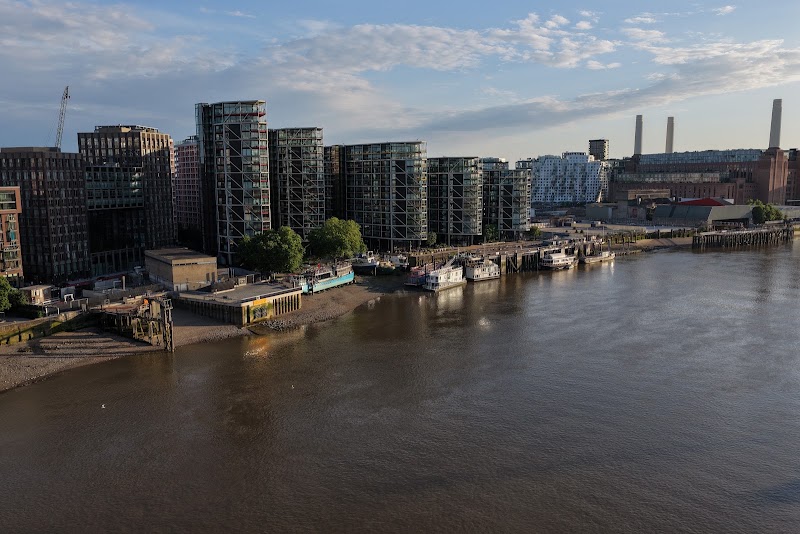
Photo: Google
What is the history of the vintage Dutch barges moored at Nine Elms Pier in London?
Look out at the riverbank, where a quiet fleet of vintage Dutch barges and houseboats bobs gently against the wooden pylons. Standing here, you are witnessing one of London’s most striking contrasts. Just meters away, the gleaming glass towers of modern Nine Elms soar into the sky. Yet down on the water lies a historic, self-contained community anchored to the ancient rhythm of the Thames tides. Did you know that long before these floating homes arrived, this stretch of river was already being compared to Holland? Back in eighteen thirty-eight, when the London and Southampton Railway built its original terminus nearby, chroniclers described Nine Elms as a low, swampy landscape of willow beds and windmills, noting its distinct Dutch character. Decades later, that comparison became literal. Many of the vessels moored at Nine Elms Pier today are authentic historic Dutch grain and cargo barges, built in the nineteen twenties and thirties. These heavy steel hulls spent their early lives navigating the inland waterways of mainland Europe. One remarkable barge moored in this area was built in Holland in nineteen thirty-two to transport grain along the River Seine. During the Second World War, it was requisitioned to ferry tanks along European canals before eventually crossing the English Channel to find a peaceful retirement on the Thames. By the nineteen eighties, as the surrounding factories, railway yards, and gasworks closed down, Nine Elms Pier transformed from an industrial wharf into a sanctuary for boat dwellers. While developers drew up ambitious plans to reshape the shore, a resilient community of around eighty residents quietly carved out an aquatic sanctuary. Today, roughly twenty boats form this floating neighborhood. Life here requires a special kind of devotion. Every twelve hours, as the tide recedes, the riverbed rises up to cradle the hulls, only for the returning waters to lift them back into the air. Surrounded by hyper-modern luxury apartments and diplomatic headquarters, Nine Elms Pier remains a stubborn, beautiful reminder of London's bohemian maritime soul.