Metropolitan Tabernacle
Why is it significant?
The Metropolitan Tabernacle in London is a monumental neoclassical church at Elephant and Castle that opened in 1861 as the world's largest non-conformist place of worship. Designed by architect William Willmer Pocock for preacher Charles Haddon Spurgeon, the 6,000-seat sanctuary survived devastating fires in 1898 and May 1941. Rebuilt in 1957, the historic site retains its original 1861 grand stone portico.
Key Facts
| Place | Metropolitan Tabernacle |
|---|---|
| Address | Elephant and Castle, London SE1 6SD |
| Geo Coordinates | 51.49407, -0.10143 |
| Audio Duration | ~3 min |
| Part of Walk | Elephant & Castle to Kennington: Stories Along Stane Street |
| Generated | Generated |
What to look for?
- Architect William Willmer Pocock designed the Metropolitan Tabernacle to accommodate 6,000 listeners without modern microphones.
- Preacher Charles Haddon Spurgeon first arrived in London in 1853 and drew crowds of up to 10,000 people.
- Fire destroyed the church's timber interior in 1898, but the original stone portico survived undamaged.
- German incendiary bombs struck the Metropolitan Tabernacle in May 1941 before its final reconstruction in 1957.
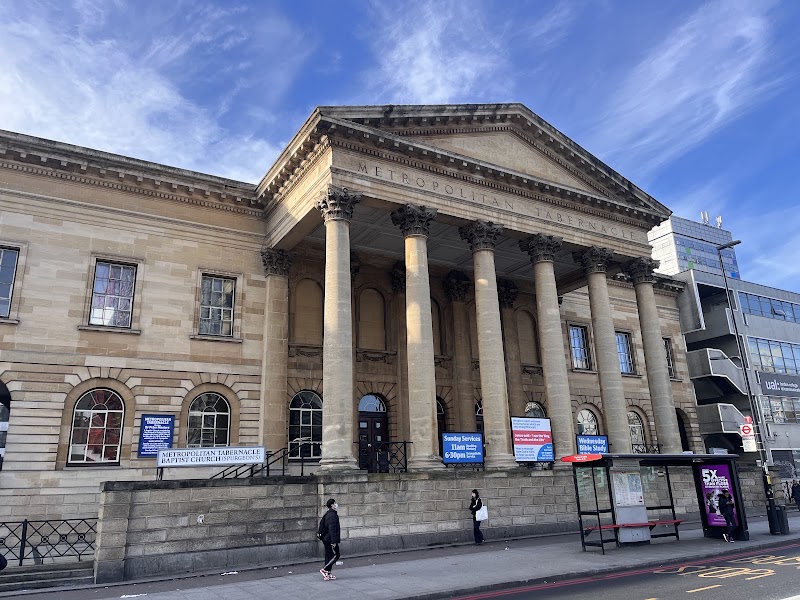
Photo: Google
When did the Metropolitan Tabernacle in London first open as the world's largest non-conformist church?
Look up at those imposing Corinthian columns rising above the bustle of Elephant and Castle. You are standing before the Metropolitan Tabernacle, one of Victorian London's most extraordinary landmarks. When it opened its doors in eighteen sixty-one, this was the largest non-conformist church in the world, capable of holding over six thousand worshippers under its roof. And the man who built it was a nineteen-year-old country youth from Essex with no formal college degree. His name was Charles Haddon Spurgeon, known to history as the Prince of Preachers. When he first arrived in London in eighteen fifty-three, few anticipated the storm he would unleash. The moment he took the pulpit, listeners were captivated. Spurgeon preached with dramatic humor, vivid imagery, and a raw emotional conviction that shattered the dry traditions of the era. His popularity exploded so rapidly that existing chapels simply could not hold the crowds. He was forced to hire vast public halls and pleasure gardens, where up to ten thousand people gathered just to hear him speak. To give his massive congregation a permanent home, architect William Willmer Pocock designed this monumental neoclassical sanctuary. The acoustics were so meticulously engineered that Spurgeon’s thunderous voice could carry clearly to all six thousand listeners without any modern microphones. His fame spread across the globe as stenographers recorded every word he spoke, publishing millions of copies of his sermons in dozens of languages. Spurgeon even enforced an unusually strict system of membership, issuing each congregant a yearly booklet of dated, perforated communion tickets that had to be handed over every single week to prove their faithful attendance! The choice of location was deeply symbolic as well. The church chose this specific plot because local tradition claimed it was the site where Protestant martyrs had been burned at the stake centuries earlier. Yet this magnificent building would soon face its own trial by fire. In eighteen ninety-eight, a fire broke out in a kitchen flue during a ministers' conference, quickly reducing the interior timber and roof to ashes. Miraculously, the grand stone portico survived. The congregation rebuilt, only for tragedy to strike again during World War Two. On a May night in nineteen forty-one, German incendiary bombs struck during the Blitz. Eyewitnesses recalled the sanctuary burning like a giant glowing birthday cake in the dark sky. Yet when morning came, that same stoic portico was still standing amongst the smoking rubble. Rebuilt once more in nineteen fifty-seven, the Tabernacle continues to thrive today, a testament to endurance in stone and spirit.