Michael Faraday Memorial
Why is it significant?
The Michael Faraday Memorial in Elephant Square, London, is a six-meter-tall stainless steel box that houses an active Underground electrical substation. Built in 1961 and designed by architect Rodney Gordon in 1959, the monument honors scientist Michael Faraday, who was born nearby in 1791. Clad in 728 steel panels, the structure transforms high-voltage current for the Bakerloo and Northern tube lines while serving as a work of modern art.
Key Facts
| Place | Michael Faraday Memorial |
|---|---|
| Address | Elephant Square, Elephant and Castle, London SE1 6TG |
| Geo Coordinates | 51.49512, -0.10065 |
| Audio Duration | ~2 min |
| Part of Walk | Elephant & Castle to Kennington: Stories Along Stane Street |
| Generated | Generated |
What to look for?
- Built in 1961, the Michael Faraday Memorial was designed by architect Rodney Gordon in 1959.
- The Michael Faraday Memorial is covered with 728 stainless steel panels and stands six meters tall.
- Inside the Michael Faraday Memorial, an electrical substation powers London Underground's Bakerloo and Northern lines.
- Scientist Michael Faraday was born near Elephant Square in Newington Butts in 1791.
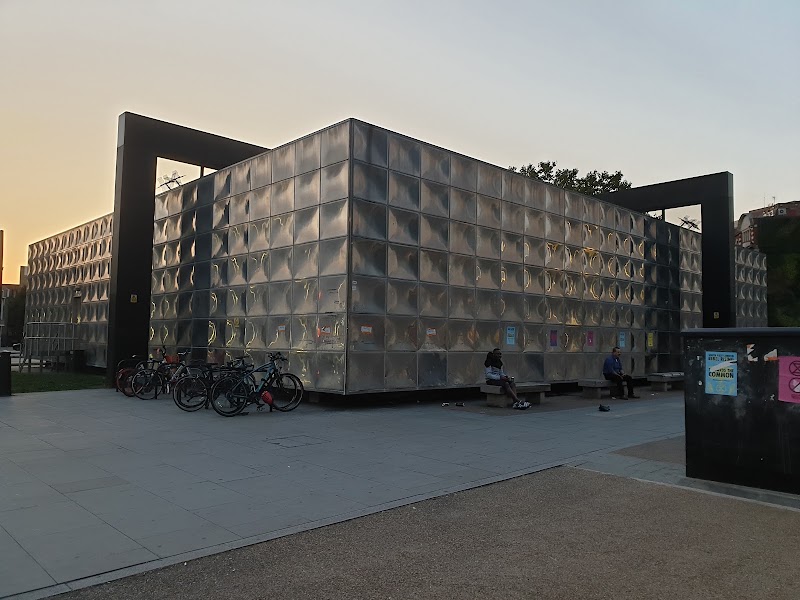
Photo: Google
What is inside the Michael Faraday Memorial in London?
Standing here in Elephant Square, you are looking at a sleek metallic box six meters tall, clad in seven hundred and twenty-eight shimmering stainless steel panels. At first glance, it feels less like a classic monument and more like a mysterious artifact from a sci-fi film. But what is it actually doing here? This striking structure is the Michael Faraday Memorial, built in nineteen sixty-one to honor the legendary scientist born right nearby in Newington Butts in seventeen ninety-one. Yet, this isn't just a static sculpture. Step closer, and you might catch a faint, continuous hum. Inside this steel shell lies a fully active London Underground electrical substation, transforming high-voltage current for the Bakerloo and Northern tube lines running below. When young architect Rodney Gordon designed it in nineteen fifty-nine, he originally planned to encase the structure in glass. He wanted passersby to watch the machinery at work, illuminated by glowing mercury vapor rectifiers. But city authorities feared the flashing lights would dazzle drivers, and worried vandals would smash the glass panels. So, the design was changed to solid stainless steel, hiding its inner life. Because the original explanatory signs were omitted, Londoners were left baffled for decades. In nineteen ninety-five, a major newspaper headline famously asked, "But what on Earth is it?" Wild urban legends took hold—some insisted it was a secret nuclear shelter, while electronic musician Aphex Twin famously claimed in an interview that he had bought it as a studio. In truth, it remains a brilliant fusion of modern art and utility. A monument to the pioneer of electromagnetism, quietly powering the very trains passing beneath your feet.