Battersea Power Station
Why is it significant?
Battersea Power Station in London is Europe's largest brick building, constructed from over six million bricks and designed in Art Deco style by architect Sir Giles Gilbert Scott. Beginning construction in 1929, the station generated one-fifth of London's electricity at its peak. During World War II, both British and German pilots used its steam plumes for navigation. In December 1976, rock band Pink Floyd famously flew a 40-foot inflatable pig above the station.
Key Facts
| Place | Battersea Power Station |
|---|---|
| Address | Circus Road East, London SW11 8BZ |
| Geo Coordinates | 51.47977, -0.14187 |
| Audio Duration | ~3 min |
| Part of Walk | Vauxhall to Battersea: Riverside Modern Marvels |
| Generated | Generated |
What to look for?
- Construction of Battersea Power Station began in 1929 using more than six million individual bricks.
- Architect Sir Giles Gilbert Scott completed the first half of Battersea Power Station in 1935.
- At its peak, Battersea Power Station generated one fifth of all electricity in London.
- In December 1976, Pink Floyd flew a 40-foot inflatable pig over Battersea Power Station.
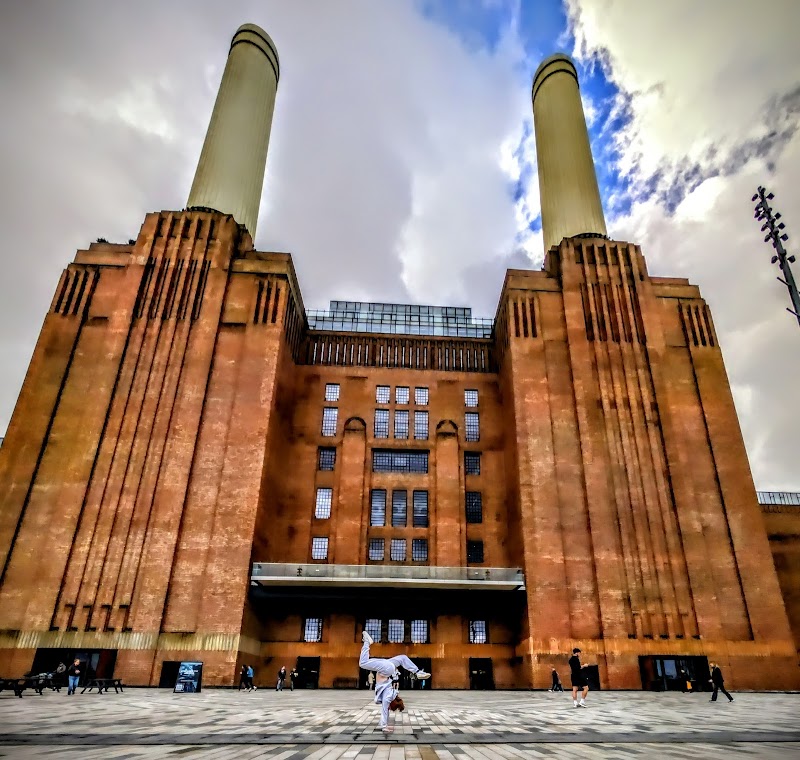
Photo: Google
Why did German pilots avoid bombing Battersea Power Station during World War II?
Look up at the monumental brick silhouette towering above the River Thames. What you are looking at is the largest brick building in Europe, built from more than six million individual bricks. When work began here in nineteen twenty-nine, local residents across the river in Chelsea and Westminster were horrified. They feared a giant industrial eyesore would pour soot over their elegant homes. To soothe public outrage, the London Power Company brought in Sir Giles Gilbert Scott, the brilliant architect who gave Britain its iconic red telephone box. Scott treated the industrial turbine house like a secular cathedral. He added vertical brick fluting to draw the eye upward and topped the corners with four majestic white chimneys. When the first half, Battersea A, was finished in nineteen thirty-five, critics praised it as a triumph of Art Deco elegance. It was so vast that the main boiler house alone could have comfortably fit Saint Paul's Cathedral inside it. At its peak, this single station generated a fifth of all the electricity in London, keeping the lights on at Buckingham Palace, the Houses of Parliament, and the neon signs of Piccadilly Circus. During the Blitz in the Second World War, the power station played a bizarre role in the battle for London skies. The towering chimneys continually vented massive plumes of white steam. Royal Air Force pilots returning from missions over Europe relied on those bright white plumes to guide them home through the dense London fog. Unbeknownst to the public at the time, German Luftwaffe bombers used the exact same steam plumes for navigation, which meant enemy pilots intentionally avoided bombing the plant so they would not lose their landmark. Inside, no expense was spared for the nerve centre of the station. Control Room A was finished with grey Italian marble walls, teak parquet floors, and a gold-coffered glass ceiling. Operatives monitored massive turquoise switchboards with dial indicators carrying secretive codenames for key London landmarks. If the room looks strangely familiar, you might have seen it in the film The King's Speech or Monty Python's The Meaning of Life. Of course, no story of Battersea Power Station is complete without a floating pig. In December nineteen seventy-six, rock band Pink Floyd gathered here to photograph the cover of their album Animals. They hired a forty-foot inflatable pig named Algie to float between the southern chimneys. A marksman was hired to shoot the pig down if it escaped, but on the second day of shooting, the marksman was not brought back. A sudden gust of wind snapped the tethering cable. Algie sailed high into the clouds, drifting straight into the flight paths of Heathrow Airport! Planes were grounded, radar systems tracked the stray pig at twelve thousand feet, and it eventually landed quietly in a farm field in Kent. After the station was decommissioned in nineteen eighty-three, it spent almost forty years as a hollowed-out ruin. Today, following a monumental restoration, the former cathedral of power has been born anew as a vibrant neighborhood of shops, homes, and cultural spaces.