Vauxhall Pleasure Gardens: Spies Built on Fun
Why is it significant?
Vauxhall Pleasure Gardens in London was a famous entertainment venue leased by Jonathan Tyers in 1729, built above a site holding London's oldest known structure from around 4790 BC. Tyers illuminated the gardens with 1,000 whale-oil lamps, hosting famous guests like Giacomo Casanova in 1763. In 2010, archaeologists near the adjacent MI6 building discovered 6,000-year-old Neolithic timber piles driven into the Thames foreshore.
Key Facts
| Place | Vauxhall Pleasure Gardens: Spies Built on Fun |
|---|---|
| Address | Vauxhall Pleasure Gardens, Kennington Lane, London SE11 5JA |
| Geo Coordinates | 51.48744, -0.12091 |
| Audio Duration | ~3 min |
| Part of Walk | Secrets of Westminster & MI6 |
| Generated | Generated |
What to look for?
- Samuel Pepys recorded his visit to London's Vauxhall Pleasure Gardens on May 29, 1662.
- Jonathan Tyers leased Vauxhall Pleasure Gardens in 1729 and installed 1,000 whale-oil lamps igniting in two minutes.
- Giacomo Casanova wrote about the unlit Dark Walks at Vauxhall Pleasure Gardens during his 1763 London visit.
- Archaeologists found six timber piles near Vauxhall Pleasure Gardens dated between 4790 BC and 4490 BC.
- Excavations for the nearby MI6 building in the 1990s uncovered seventeenth-century glass kilns and The Vine inn.
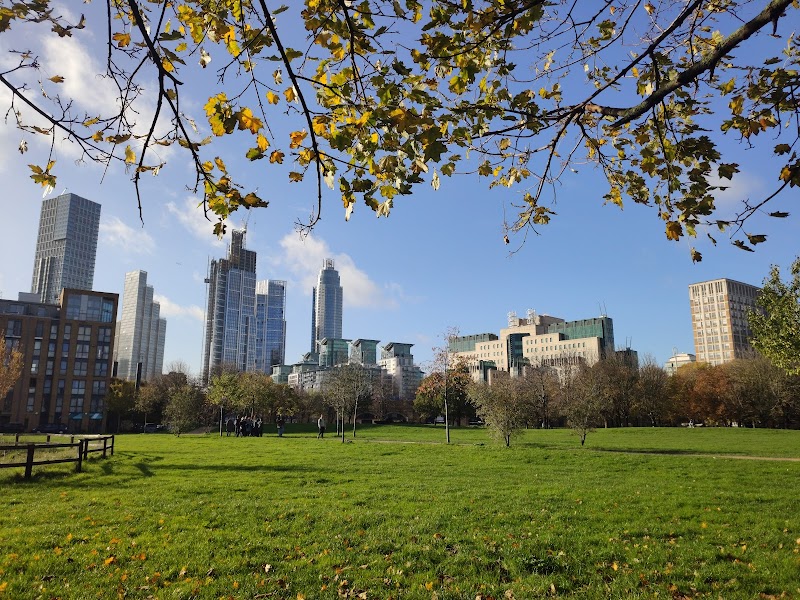
Photo: Google
What is the oldest structure ever discovered near Vauxhall Pleasure Gardens in London?
Stand where you are... and imagine the ground beneath your feet peeling back, layer by layer, like pages of a book stretching back thousands of years.
This quiet park was once the site of Vauxhall Pleasure Gardens, London's most electrifying night out for nearly two centuries. It all began before sixteen sixty, when diarist Samuel Pepys came here by boat and scribbled about it on the twenty ninth of May, sixteen sixty two, calling the New Spring Gardens a place that "much exceeds the other." Back then, entrance was free. You just wandered in among the trees... and anything could happen.
But what transformed this place from a seedy woodland into a sensation? One man. Jonathan Tyers, a leather worker's son, took the lease in seventeen twenty nine and reinvented everything. He hung a thousand whale-oil lamps from the trees and invented a system of linked fuses so they could all ignite simultaneously... in under two minutes! Imagine standing in darkness... and then Whoosh... the entire garden erupts in golden light. In an age before electricity, witnesses described being "almost struck blind with the blaze."
Music by Handel echoed from the orchestra stand. Princes mingled with shopkeepers. And then there were the notorious Dark Walks... deliberately left unlit, where lovers disappeared among the shadows. Even Giacomo cas-a-Nova wrote about them when he visited London in seventeen sixty three.
But here is where this story gets truly strange. When the MI6 building was constructed in the early nineteen nineties, archaeologists dug into the earth and found the remains of seventeenth century glass kilns, old barge houses, and a lost riverside inn called The Vine... layers of London's forgotten industrial past, buried right beneath the spy headquarters.
And that is not even the deepest secret. In twenty ten, on the Thames foreshore just metres from the MI6 building, archaeologists discovered six timber piles driven into the riverbed. Radiocarbon dating revealed the trees had been felled between four thousand seven hundred ninety BC and four thousand four hundred ninety BC... making this the oldest known structure in all of London. Over six thousand years old! Stone tools and Neolithic pottery were found alongside them. The site was initially kept secret while surveys were carried out... fittingly, given its neighbour.
So the next time you glance toward that distinctive ziggurat of green glass on the riverbank... remember. Spies, pleasure seekers, glassblowers, and Stone Age builders have all claimed this same stretch of earth. Six thousand years of secrets, buried in plain sight.
Unlocked for everyone by someone who walked here