Vauxhall City Farm
Why is it significant?
Vauxhall City Farm in Lambeth, London, is a free community farm established in 1977 on the historic grounds of the former Vauxhall Pleasure Gardens. Originally opened in 1661, the site was transformed in 1729 by Jonathan Tyers into an entertainment venue drawing up to 16,000 visitors nightly. After its 1859 closure and 1970s demolitions, local residents cleared the wasteland to open Jubilee Farm.
Key Facts
| Place | Vauxhall City Farm |
|---|---|
| Address | Vauxhall City Farm, 165 Tyers Street, London SE11 5HS |
| Geo Coordinates | 51.48713, -0.11911 |
| Audio Duration | ~3 min |
| Part of Walk | Secrets of Vauxhall: Spies, Pleasure & Hidden London |
| Generated | Generated |
What to look for?
- Jonathan Tyers leased the New Spring Gardens site in 1729, installing 1,000 whale-oil lamps across the grounds.
- At its peak, the venue on the site of Vauxhall City Farm welcomed up to 16,000 visitors per night.
- Giacomo Casanova visited the notorious Dark Walks at the Lambeth entertainment grounds in 1763.
- In 1977, local residents cleared demolished rubble on Saint Oswald's Place to establish Jubilee Farm.
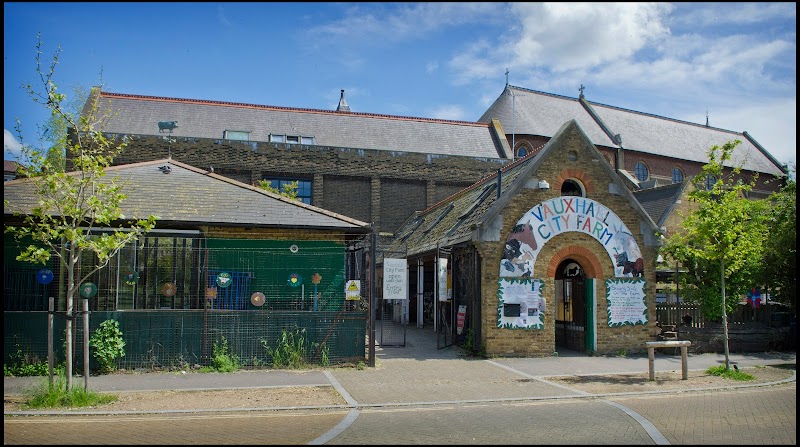
Photo: Google
What famous entertainment venue originally occupied the site of Vauxhall City Farm in London?
You're standing on one of the most unlikely pieces of land in all of London. Right here... where alpacas munch hay and children chase chickens... this was once the Hottest nightlife destination in Georgian England. Can you imagine? Thousands of masked revelers, fireworks overhead, the music of Handel drifting through lantern-lit trees? The story of this ground begins in sixteen sixty-one, when the New Spring Gardens first opened on the south bank of the Thames. But the real magic started in seventeen twenty-nine, when a twenty-seven-year-old entrepreneur named Jonathan Tyers took over the lease. The very street you walked down to get here... Tyers Street... is named after him. He transformed what was, frankly, a notorious rural brothel into the most spectacular mass entertainment venue London had ever seen. He hung a thousand whale-oil lamps from the trees, commissioned a statue of Handel, and hired Hogarth to design the season tickets. At its peak, up to sixteen thousand visitors would crowd in on a single night! But the Gardens had a darker side too. The infamous "Dark Walks"... unlit paths deliberately left in shadow... became so notorious for scandal that the novelist Frances Burney used them as the setting for a terrifying scene in her novel Evelina. Even Casanova wrote about them when he visited in seventeen sixty-three. The gardens finally closed in eighteen fifty-nine. The land was carved up for housing... but those houses fell into decline. Between nineteen seventy-two and seventy-six, large-scale demolitions left nothing but wasteland. And then something wonderful happened. A group of young architects squatting in nearby buildings on Saint Oswald's Place looked at the rubble... and saw a farm. In the spring of nineteen seventy-seven, locals came together to clear the site. By year's end, the Jubilee Farm was born, named for Queen Elizabeth's Silver Jubilee... and its very first residents were a turkey named Adolf... and a fox called Basil. So from pleasure garden to slum to rubble to farmyard... this little patch of Lambeth keeps reinventing itself. And the spirit of Jonathan Tyers... the showman who believed entertainment should be for everyone... lives on in a place that still opens its gates to all, completely free of charge.