Secrets of Vauxhall: Spies, Pleasure & Hidden London
From MI6 to forgotten pleasure gardens — central London's most underrated neighbourhood revealed
London · 15 stops · 5.6 km · ~2.2 h · 51 min audio · Generated
-
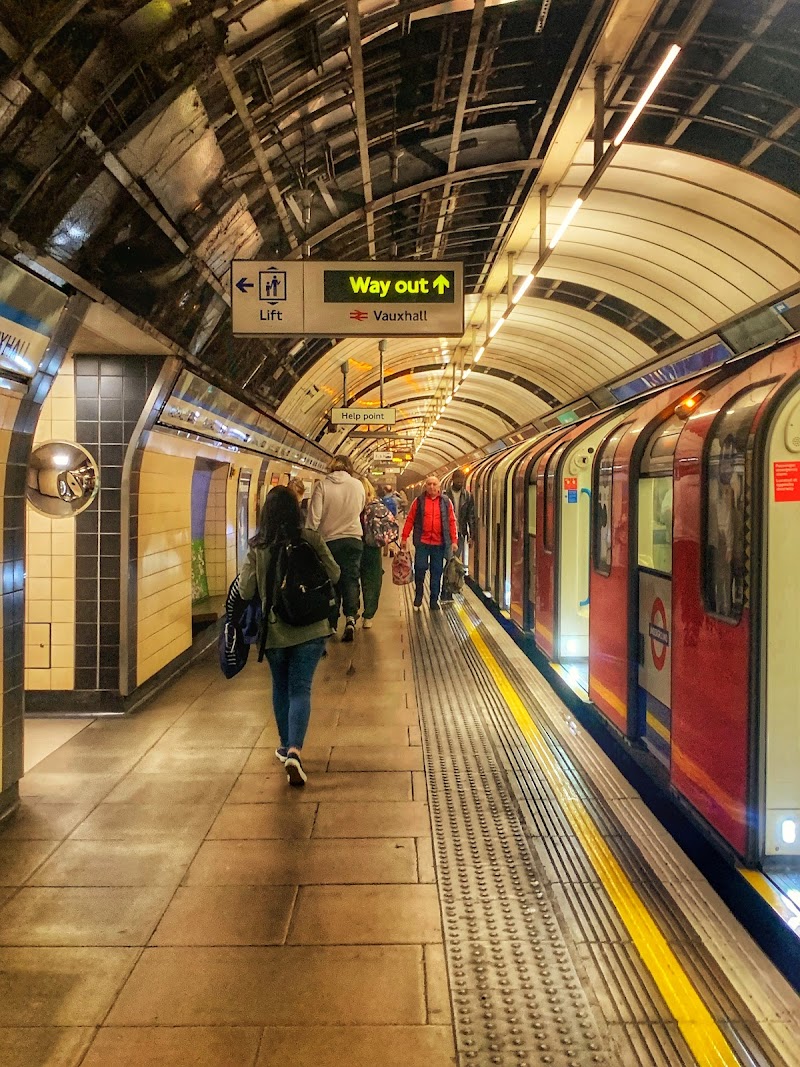
1. Vauxhall Station & The Roundabout
Vauxhall Underground Station, London SE1 7NA
Photo: Google
Welcome to Vauxhall... or should I say, welcome to the spot that may have named every major railway station in Russia.
That's right. If you speak Russian, the word for a grand railway terminus is "vok-Zal." Say it out loud. Vok-Zal... Vauxhall. Hear the echo? That's no coincidence.
Now, there's a popular legend that a Russian delegation visited this very station around eighteen forty and simply Misheard the place name as the English word for a train station. Could an entire delegation of officials really make such a blunder? The story was even embellished to claim that Tsar Nik-o-las the First himself visited in eighteen forty-four and made the same mistake.
But the true story is actually more remarkable. The word had already entered Russian decades before any delegation boarded a train here. You see, this area was once home to the Vauxhall Pleasure Gardens... a dazzling entertainment paradise that operated for nearly two hundred years. Fireworks, orchestras playing Handel, masked balls, tightrope walkers, even hot air balloon ascents! It was SO famous that similar gardens across the world simply borrowed the name.
In seventeen eighty-three, an Englishman named Michael Maddox, who had once tutored the Russian heir to the throne, exported the concept to Russia, creating a pleasure garden he called a "vok-Sal" near Saint PE-ters-burg. Then in eighteen thirty-seven, when Russia's first railway was built from Saint PE-ters-burg to Pavlovsk Palace... guess what sat at the terminus? Those very pleasure gardens. An entertainment pavilion built right at the station in eighteen thirty-eight was named the vok-Zal in homage to this London neighbourhood. Passengers soon called the station itself a vok-Zal... and the word spread to every major terminus across the empire.
But the name Vauxhall itself? It goes back even further... to a medieval warlord. In twelve sixteen, an Anglo-Norman soldier called Faulkes de bre-o-Tay, who served King John, married into property here. His home became known as Faulkes Hall... which locals softened to Foxhall... and eventually, Vauxhall. He met a grim end in Rome in twelve twenty-six... allegedly killed by a poisoned fish.
So next time you hear a Russian ask for directions to the vok-Zal in Moscow or Saint PE-ters-burg... know that the word began right here, beneath your feet, with a medieval mercenary's mansion, a legendary pleasure garden, and a language that borrowed a name and never gave it back.
-
2. Royal Vauxhall Tavern
Royal Vauxhall Tavern, 372 Kennington Lane, London SE11 5HY
You're standing before one of the most remarkable buildings in all of London. This handsome Victorian pub with its sweeping curved facade... this is the Royal Vauxhall Tavern, and it sits on ground that has been dedicated to pleasure, scandal, and reinvention for over three hundred and sixty years.
You see, long before this building existed, this very land was part of the legendary Vauxhall Pleasure Gardens. Open from sixteen sixty-one to eighteen fifty-nine, Vauxhall was considered the first and most popular pleasure garden in London. People originally reached it by boat on the Thames, paying sixpence for the ride. It was a place of music, masked balls, fireworks... and the infamous "dark walks," unlit paths where all manner of mischief unfolded after sunset. Those dark walks were SO notorious they appeared in Frances Burney's novel Evelina as the setting for the heroine's near-rape experience.
When the gardens finally closed, the R V T was built between eighteen sixty and eighteen sixty-two on this very site. It was probably designed by the architect James Edmeston the elder. Though sometimes reported to have started life as a music hall, it was always constructed as a public house.
Then came the war. After the Second World War, returning servicemen and local gay men were drawn to the venue, which held shows by female impersonators. And by the nineteen eighties, this place had earned the nickname "The Palladium of Drag." Stars like Paul O'Grady, performing as Lily Savage, had an eight year, four times a week residency here.
But the story that still gives me chills happened on the twenty-third of January, nineteen eighty-seven. It was the height of the AIDS crisis... and thirty-five police officers stormed this building wearing rubber gloves. They wore the gloves to avoid touching those they arrested. This was the club's second raid that winter, based on the flimsy excuse of customers being drunk on licensed premises. Lily Savage was on stage in full drag. And what did she do? She looked at those rubber gloves and said... "Well, well... it looks like we've got help with the washing up." All those arrested were eventually released without charge.
And then there's the legend. According to Cleo Rocos in her memoir, Diana, Princess of Wales, visited this very pub in the late nineteen eighties, disguised as a man, accompanied by Rocos, Freddie mercury, and Kenny Everett. Diana was dressed in a camouflage army jacket, her hair tucked into a leather cap, wearing dark aviator sunglasses... and they decided the most famous woman in the world might just pass for an eccentrically dressed gay male model. Rocos said Diana just looked like Freddie's boyfriend, a gorgeous male model... and she loved it. Now, I should tell you... mercury's personal assistant Peter Freestone has stated that Freddie was not involved and never met the Princess. So, truth or legend? No one knows for certain. But what a story.
In twenty fifteen, this pub became the first building in the U K to receive Grade Two listed status specifically for its importance to the L G B T community. Three hundred and sixty years of pleasure, defiance, and reinvention... all on this one extraordinary patch of London ground.
-
3. Vauxhall Pleasure Gardens
Vauxhall Pleasure Gardens, Jonathan Street, London SE11 5NH
Stand where you are... and imagine the ground beneath your feet peeling back, layer by layer, like pages of a book stretching back thousands of years. This quiet park was once the site of Vauxhall Pleasure Gardens, London's most electrifying night out for nearly two centuries. It all began before sixteen sixty, when diarist Samuel Pepys came here by boat and scribbled about it on the twenty ninth of May, sixteen sixty two, calling the New Spring Gardens a place that "much exceeds the other." Back then, entrance was free. You just wandered in among the trees... and anything could happen. But what transformed this place from a seedy woodland into a sensation? One man. Jonathan Tyers, a leather worker's son, took the lease in seventeen twenty nine and reinvented everything. He hung a thousand whale-oil lamps from the trees and invented a system of linked fuses so they could all ignite simultaneously... in under two minutes! Imagine standing in darkness... and then Whoosh... the entire garden erupts in golden light. In an age before electricity, witnesses described being "almost struck blind with the blaze."
Music by Handel echoed from the orchestra stand. Princes mingled with shopkeepers. And then there were the notorious Dark Walks... deliberately left unlit, where lovers disappeared among the shadows. Even Giacomo cas-a-Nova wrote about them when he visited London in seventeen sixty three. But here is where this story gets truly strange. When the MI6 building was constructed in the early nineteen nineties, archaeologists dug into the earth and found the remains of seventeenth century glass kilns, old barge houses, and a lost riverside inn called The Vine... layers of London's forgotten industrial past, buried right beneath the spy headquarters. And that is not even the deepest secret. In twenty ten, on the Thames foreshore just metres from the MI6 building, archaeologists discovered six timber piles driven into the riverbed. Radiocarbon dating revealed the trees had been felled between four thousand seven hundred ninety BC and four thousand four hundred ninety BC... making this the oldest known structure in all of London. Over six thousand years old! Stone tools and Neolithic pottery were found alongside them. The site was initially kept secret while surveys were carried out... fittingly, given its neighbour. So the next time you glance toward that distinctive ziggurat of green glass on the riverbank... remember. Spies, pleasure seekers, glassblowers, and Stone Age builders have all claimed this same stretch of earth. Six thousand years of secrets, buried in plain sight.
-
4. MI6 (Vauxhall Cross): London's Worst Kept Secret
SIS Building, 85 Albert Embankment, London SE1 7TP
Take a look at this building across the river. Cream and green, layered like a wedding cake designed by a Bond villain. Known by many names... Legoland, The ziggurat, and my personal favourite... The Vauxhall Trollop. This is eighty five Albert Embankment... the real home of MI six. Now here's the thing. This postmodern citadel wasn't purpose built for spies. Architect Sir Terry Farrell envisaged a general commercial building with an "urban village" quality. It was only later bought by the government and adapted into a fortress. The government proposed to pay for the building outright to maintain secrecy over the intended use of the site... because at this time, the existence of MI six was not officially acknowledged by the UK government. They bought a hundred and thirty million pound building... and couldn't even say who it was for. Farrell's design was influenced by nineteen thirties industrial modernist architecture like Battersea Power Station... and Mayan and Aztec religious temples. And you can see it, can't you? Those stepped, ziggurat-like layers rising from the Thames. The building has sixty separate roof areas and uses twenty five different types of glass. The walls and windows are designed to withstand bullets and bombs, and there's a Faraday cage inside that prevents electronic eavesdropping. It even features two moats for protection. Before all this, this site was the location of the Vauxhall Pleasure Gardens. Those were swept away in the eighteen fifties and replaced by industrial units... a glass factory, a vinegar works, and a gin distillery. Archaeological excavation during construction found the remains of seventeenth century glass kilns, barge houses, and an inn called The Vine. From pleasure gardens to gin to spies. Quite the career change for one piece of land. And before this building, MI six was based at century House near Lambeth North. Shabby and anonymous, more Harry Palmer than James Bond, its cover was regularly blown by extrovert bus conductors shouting "Spies Corner!" while passengers looked to see who got off. That's right... London's top secret spy headquarters was being outed by Bus drivers. Now, the attack. On the twentieth of September two thousand, the Real Irish Republican Army fired a single Russian-manufactured R P G twenty two anti-tank rocket from about three hundred metres away, striking the eighth floor. It was carried out at nine forty five pm under the cover of darkness... and it was the first time this Russian rocket launcher had ever been used in Britain. Damage was limited to one window and two wall panels on the eighth floor. The building barely flinched. No individuals were ever arrested or convicted in connection with the attack. The case remains unsolved to this day. And one last detail that might make you smile. A special premiere of The World Is Not Enough was held right here at Vauxhall Cross for MI six staff... who cheered when their headquarters was destroyed in the film. Even spies, it seems, enjoy watching their own office blow up.
-
5. Vauxhall Bridge: Eight Hidden Giants
Vauxhall Bridge, London SW1V 4SS
Now look at me... you're standing on Vauxhall Bridge right now, and I'd wager you have NO idea what's hiding just beneath your feet. Not underground... but clinging to the very sides of this bridge, invisible from where you stand.
Eight colossal bronze women... each one twice life-size, each weighing around two tonnes... are perched on the piers below, gazing out over the Thames. And yet ninety nine percent of the people who cross this bridge every single day have absolutely no idea they're there.
Here's how they came to be. The bridge you're standing on opened in nineteen oh six, designed by Sir Alexander Binnie. It came in under budget... imagine that, a London construction project under budget! And so the London County Council decided to spend the leftover money on art. They consulted the renowned architect Richard Norman Shaw, who proposed monumental bronze statues above each pier. Three sculptors were hired... but one, George Frampton, dropped out due to pressure of work. That left Alfred Droory and Frederick Pomeroy, each taking four figures.
On the fourth and fifth of September, nineteen oh seven, workmen hauled these giants into position... lowering them over the parapets by crane, one by one. Pomeroy's four face upstream... Agriculture, Architecture, Engineering, and Pottery. Droory's four face downstream... Science, Fine Arts, Local Government, and Education.
Now here's the secret within the secret. If you carefully lean over the upstream parapet... the second pier along... look at the hands of the figure representing Architecture. In one hand she holds a compass. And in the other... a miniature model of Saint Paul's Cathedral. About two feet long, incredibly detailed, weathered by over a century of Thames wind and rain. It is, quite possibly, the smallest cathedral in all of England.
And Pomeroy? He wasn't just any sculptor. This is the same man who created the famous Lady Justice statue atop the Old Bailey... that golden figure of sword and scales you see on every courtroom drama. He was working on both projects at virtually the same time, around nineteen oh five to nineteen oh seven.
But the story of crossing the river here goes back far longer than any bridge. In nineteen ninety three, shifting currents washed away layers of silt just upstream... revealing oak timber posts dating to around fifteen hundred B C. The remains of a Bronze Age bridge or jetty, with two parallel rows of massive oak posts, possibly the oldest bridge structure ever found in Britain. Two bronze spearheads were discovered driven deep into the foreshore beside them... not lost, but deliberately placed... a ritual offering to the river, three and a half thousand years ago.
So the next time someone tells you Vauxhall Bridge is just a busy road, remind them... eight hidden giants watch the water below, one of them cradling a cathedral in her palm... and beneath the mud, the ghosts of an ancient crossing still sleep.
-
6. Brunswick House: The Georgian Mansion That Survived Everything
Brunswick House, 30 Wandsworth Road, London SW8 2LG
Look at this red-brick mansion... standing defiantly on the edge of the Vauxhall roundabout, dwarfed by glass towers on every side. This is Brunswick House. And it has absolutely NO business still being here.
It was built in seventeen fifty-eight by John Dawson... but here's where it gets interesting. The Dawsons were local glassmakers who had started out as apprentices at the Second Duke of Buckingham's glassworks right here in Vauxhall. Buckingham, a favourite of Charles the Second, had acquired the Royal Monopoly in glassmaking and recruited a team of Venetian craftsmen to revolutionise the English glass trade. But then he was thrown into the Tower of London on a charge of High Treason... and simply handed the entire business over to his industrious apprentice, Richard Dawson. So the family that built this mansion? They earned their fortune from secrets smuggled out of Venice.
Originally it was called Belmont House. In seventeen ninety-one, the house was divided into two halves. And one of those halves would shelter one of Napoleon's fiercest enemies. Friedrich Wilhelm, Duke of Brunswick-Wolfenbüttel, had been driven out of his duchy, escaping to England with his private army in eighteen oh nine. He took up residence here and established his Court-in-Exile. His morose, melancholic character and his habitual black dress... worn in mourning for his father and his lost duchy... earned him the nickname The Black Duke. His soldiers, the famous Black Brunswickers, wore black uniforms with skull-and-crossbones insignia. He was killed by a gunshot at the Battle of Quatre Bras on the sixteenth of June eighteen fifteen... the night after attending the Duchess of Richmond's ball in Brussels. He never returned to this house. But the house took his name.
After the Duke, came the railways. For a hundred and fifty years the house retained its links with the London and South Western Railway... first as offices, then as a Scientific and Literary Institute for railway staff, complete with two bars, a lending library, and a billiard hall.
Then came abandonment. From two thousand two to two thousand four, the building was squatted and extensively vandalised. A hundred and fifty years of railwaymen's club papers and record books were burnt or stolen. And yet... it survived! It ended up on the English Heritage register of Buildings at Risk, before being rescued by Lassco, an architectural salvage company. Now look around you. The house is an emblem of bygone elegance among major glass, steel and concrete office blocks. Its near neighbours include the MI six offices and the newly built US Embassy.
From Venetian glass secrets to a Napoleon-era duke in black... from railwaymen playing snooker to squatters throwing raves... this building has outlasted everything that Vauxhall has thrown at it. And it is still standing.
-
7. Fentiman Road: A Street That Defied Vauxhall
Fentiman Road, London SW8 1JY
Take a look around you. These grand Victorian terraces, the mature plane trees, the quiet confidence of this street... Fentiman Road is a survivor. And its story begins not with bricks, but with a land deal.
In eighteen thirty-eight, a man named William Evans bought the sprawling grounds of Carroun House, a grand estate just north of here. Evans split the grounds by laying out a new road to the south of the house. That road is the one you're standing on now. It was named after local mid-nineteenth century developer John Fentiman, who had purchased some of the former leasehold land in this area.
But here's the part most people walk right past. Originally on Wandsworth Road, Caron's Almshouses moved to new buildings on Fentiman Road in eighteen fifty-four. Who was Caron? Sir Philip Noel Caron was the Dutch Ambassador to the court from sixteen oh nine to sixteen twenty-four, a close friend of King James the First. In sixteen eighteen he founded an almshouse on what is now Wandsworth Road. His mission was simple... shelter seven women over sixty. The fifteen hundred pounds from the sale of the original site was used to erect these new almshouses in a Tudor style, and they are now Grade Two listed. And here's the beautiful detail. Modernised and repaired, they were officially reopened by the Dutch Ambassador in nineteen ninety-seven and are still housing local women in need. Nearly four hundred years of the same charitable purpose, and a Dutch ambassador bookending the story at both ends!
Now look north. Vauxhall Park was created following a public campaign led by suffragist Millicent Fawcett, social reformer Octavia Hill, and members of the Kyrle Society. In eighteen eighty-six, developers wanted to bulldoze the old estate grounds for housing. A proposal was made to form roads across the estate for development, but owing to the activity of Octavia Hill, eight and a half acres were purchased for forty-three thousand five hundred pounds by the Lambeth Vestry in eighteen eighty-nine. Octavia Hill, who would later co-found the National Trust, saved that green space. The design of the park was the work of Fanny Wilkinson, the first professional female landscape designer in Britain.
And then came the twentieth century... and the wrecking ball. Since the nineteen fifties, successive governments looked unfavourably on terraced houses, believing them to be outdated. Between nineteen sixty and nineteen sixty-seven, around half a million houses deemed unfit were demolished. Across Vauxhall, entire streets vanished, replaced by concrete towers. But Fentiman Road... held on. These late Victorian terraces were built not long after the rerouting of the road in eighteen eighty-three. They endured the Blitz, they endured the planners, and today they stand as quiet proof that sometimes, the best thing a street can do... is simply refuse to disappear.
-
8. Vauxhall Park & the Model Village
Vauxhall Park, Fentiman Road, London SW8 1LA
Look around you. This quiet little corner of Vauxhall Park holds one of London's most delightful secrets... a tiny Tudor village, with miniature houses no taller than your knee, nestled among the flower beds. Most Londoners have never even heard of it. But the story of how these little homes got here... and the story of this park itself... is extraordinary.
Let's start with the park. On the seventh of July, eighteen ninety, the Prince of Wales... later King Edward the Seventh... arrived here with Princess Louise, the Duke of Edinburgh, and even the Archbishop of Canterbury to formally open this green space. But this wasn't some royal whim. This park exists because of a remarkable couple who once lived right where you're standing.
Henry Fawcett was Britain's first completely blind Member of Parliament. At just twenty five, he was out shooting with his father when a terrible accident occurred... his own father misfired at a flock of partridges and the shot struck Henry in both eyes. He never saw again. But when told he was permanently blinded, he reportedly said... "Well, it shan't make any difference in my plans of life." And it didn't. He became a Cambridge professor, then an MP, and eventually Postmaster General... the man who gave Britain parcel post, postal orders, and the sixpenny telegram.
Henry and his wife, Millicent Garrett Fawcett... the great suffragist... lived right here, at number fifty one South Lambeth Road. After Henry's death in eighteen eighty four, Millicent campaigned alongside Octavia Hill, co-founder of the National Trust, to save this land from developers. And the woman they hired to design the park? Fanny Wilkinson... Britain's first professional female landscape gardener, who had to convince the Crystal Palace School of Gardening to accept her as their first female student. She went on to design over seventy five public gardens across London!
Now, the model village. These charming little houses were handcrafted from cement in nineteen forty three by a retired engineer named Edgar Wilson, who was seventy seven years old at the time. He originally made them for Brockwell Park, but in the nineteen fifties, Lambeth Council decided Brockwell had too many tiny houses... so they moved half of them here. And here's the twist... Edgar was so touched by food parcels sent from Melbourne, Australia during the war that he built a Third Tudor village, crated it up, and shipped it by navy vessel all the way to Australia. That village still stands today in Melbourne's Fitz-Roy Gardens. A local man named Nobby Clark restored these little houses in two thousand one, and his secret to keeping them safe from vandals? He fills each one with sand and cement!
Take a moment to crouch down and peer into these tiny windows. Each house is signed and dated on the inside by Edgar himself.
-
9. Bonnington Square Pleasure Garden
Bonnington Square Pleasure Garden, Bonnington Square, London SW8 1TE
Look around you. Tropical palms, winding mosaic paths, bamboo, banana plants... You'd think you were somewhere in the Mediterranean. But you're standing in Vauxhall, south London... on a World War Two bomb site.
How did a crater left by the Blitz become one of London's most extraordinary secret gardens?
The story begins in the eighteen seventies, when these Victorian houses were built for railway workers. But many railway workers preferred a pension and to pay for their own homes, so the cottages were soon sold off as conventional housing. Then came the bombs. Seven houses on this very spot were destroyed during the war, leaving nothing but rubble and weeds.
For decades, the gap just... sat there. The council installed a set of swings and a couple of seats in the seventies but neglected the upkeep. The whole square was falling apart. By the late nineteen seventies, Bonnington Square was compulsorily purchased by the Greater London Council, which intended to demolish it entirely to build a new school.
And here's where it gets extraordinary. A single Turkish shopkeeper in one of the buildings managed to prevent the demolition through legal means... buying just enough time for something remarkable to happen. A disparate crew of travelling hippies and wandering anarchists, many from New Zealand, brought their Diy communal ethos to London in the early nineteen eighties. They squatted the empty houses. At one point, there were over three hundred people squatting in the area!
These weren't people just passing through. The squatters established a volunteer-run vegetarian café, a community garden, a bar, a nightclub, and a wholefoods shop. They called the place "Squatty Bonny."
Then in nineteen ninety, a threat appeared. A builder working in the area applied to the council to use this bomb site as storage... which woke everybody up to the danger of losing it forever. The Bonnington Square Garden Association, led by resident Evan English, was set up to lobby the council for money to create a community garden. After prolonged negotiations, money became available from a joint Government and Local Council scheme, and construction began in August nineteen ninety four.
Now, here's a detail most people miss. For five years in the early nineties, the celebrated landscape designer Dan Pearson lived in a flat overlooking this very park, and helped redesign it. The same Dan Pearson who would go on to design gardens for Roppongi Hills in Tokyo and restore the grounds of Althorp House after Princess Diana's death.
And see that enormous metal wheel at the far end of the garden? That's a classic piece of Industrial Revolution art dating from the eighteen sixties. It was rescued from a nearby marble factory that was under demolition just as this garden was being built. A relic of one world, saved to anchor another.
The garden's name is, of course, partly in homage to the original Vauxhall Pleasure Gardens, which existed just one hundred meters to the north and were a major feature of London for three centuries. So in a way, the tradition of pleasure and spectacle never really left this patch of earth. It just... went underground for a while.
-
10. Bonnington Square: The Jungle Neighbourhood
Bonnington Square, London SW8 1TF
Look around you. Vines creeping up Victorian brickwork... bamboo rustling overhead... banana plants stretching toward grey London skies. This is Bonnington Square, and it shouldn't exist.
These terraced houses were built in the eighteen seventies, neat rows of London brick for the workers at Nine Elms Goods Yard, the great railway depot nearby. Charles Booth's famous poverty map marked this square as "mixed... some comfortable, others poor." Not fashionable. Not grand. Just hardworking families scrubbing their front steps each morning.
Then came the Blitz. On the fourteenth of October, nineteen forty, bombs tore through the heart of the square, destroying seven houses and killing two residents. The gap they left would sit empty for decades... a wound in the streetscape that refused to heal.
By the late nineteen seventies, the whole square was in terrible shape. The Greater London Council swooped in with a compulsory purchase order, planning to flatten everything and build an extension for the Lillian Bayliss School. Residents were leaving. Demolition seemed certain. But then... one shopkeeper changed everything. A single trader in one of the buildings fought the demolition through legal means, buying just enough time for something extraordinary to happen.
Squatters began pouring in. And these weren't just drifters. Many came from New Zealand, bringing a fierce do-it-yourself communal spirit. By the early nineteen eighties, the square was completely occupied. They built a volunteer-run vegetarian café... a wholefoods shop... a nightclub! Even a bar. The café started because most squatters didn't have functioning kitchens, so they simply fed each other.
And the names who passed through here? John Lydon of the Sex Pistols. The Jesus and Mary Chain. It became a genuine artistic melting pot.
In nineteen ninety, a local builder nearly destroyed the dream by applying to use the old bomb site for storage. This accidentally alerted Lambeth Council that they owned the land. But the residents fought back again, forming the Bonnington Square Garden Association led by Evan English. They secured funding in nineteen ninety-four and created what you see today... the Pleasure Garden, named as a loving tribute to the famous Vauxhall Pleasure Gardens that stood just a hundred metres north of here for three centuries.
The designers drew inspiration from Operation Green Thumb community gardens on New York's Lower East Side. Look for the giant metal wheel near the back... it was salvaged from a nearby marble factory dating to the eighteen sixties, rescued just as that building was being demolished.
In nineteen ninety-eight, the housing cooperative finally purchased these buildings from Lambeth Council. Former squats now sell for over a million pounds. But here's what truly matters... this jungle, this impossible green paradise, grew from a bomb crater and the stubbornness of people who simply refused to let a neighbourhood die.
-
11. Harleyford Road Gardens
Harleyford Road Gardens, Harleyford Road, London SE11 5AW
You're standing at the entrance to one of London's most improbable green spaces. Harleyford Road Community Garden... a pocket wilderness hiding in plain sight on one of South East London's busiest arteries. The Oval cricket ground is practically over the road. The upper floors of MI six are visible from here. And yet... step through that iron gate, and the city just... vanishes.
What was here before? Well, for over a century, a handsome Georgian terrace lined Harleyford Road, with long, elegant front gardens stretching toward the street. But in the early nineteen seventies, the Greater London Council demolished the majority of those houses, seizing the land for redevelopment plans that... never actually happened. The plot sat abandoned. Wasteland. Rubble and weeds, forgotten by the authorities.
Then, in nineteen eighty four, something remarkable began. Local residents from the Vauxhall Housing Co-operative simply started growing vegetables on the derelict ground. Carrots and cabbages, right there among the ruins. They formed the Harleyford Road Garden Association and applied for a small grant to study what the space could become. But here's where bureaucracy became its own kind of drama... the GLC owned most of the land, and when Margaret Thatcher's government abolished the GLC in nineteen eighty six, lease negotiations dragged on and on.
Undeterred, the volunteers pressed forward! Between nineteen eighty six and eighty eight, they designed and built this entire garden from scratch. Winding paths, a small hidden pond, shrubberies mixing native and exotic species, a children's play area, even a little greenhouse and allotment for herbs.
Now look closely at the paths beneath your feet. In two thousand nine, local artists threaded colourful mosaics into the walkways, bright fragments of tile that catch the light as you wander. And wander you will... the garden's irregular shape, full of nooks and crannies and overgrown corners, makes it feel far larger than it actually is.
And here's a secret most visitors never discover. This garden connects through a hidden passageway to Bonnington Square, the legendary neighbourhood just behind the hedge... a place where squatters in the nineteen eighties saved condemned Victorian houses, formed cooperatives, and eventually bought their homes. The famous garden designer Dan Pearson lived among them in the early nineties, helping shape the neighbouring Pleasure Garden. A few mature Sycamores still standing here are survivors from those original Georgian house gardens... living witnesses to two and a half centuries of Harleyford Road's transformation from elegant terrace, to wasteland, to this wild little paradise.
-
12. Gasworks Gallery
Gasworks, 155 Vauxhall Street, London SE11 5RH
Take a look at this unassuming white building on Vauxhall Street. You might walk straight past it... and that would be a mistake. Because behind this modest facade lies one of London's most quietly powerful art spaces... a place that has launched careers across more than eighty countries.
This is Gasworks. And the name is no accident. This building sits in the shadow of the great Oval gasholders, those iconic Victorian cylinders just next door. The building itself is a hundred and fifty year old Victorian warehouse that once served as a storage depot for the neighbouring Oval Gasworks. But what was it used for in the years before the artists arrived? A plastic Christmas tree depot. Yes, really... artificial Christmas trees were stored right here before this place was reborn.
In nineteen ninety four, Gasworks was founded with a radical mission... to provide platforms for artists whose voices were not represented in mainstream galleries. It is part of something much bigger... the Triangle Network, an international arts movement co-founded in nineteen eighty two by British sculptor Sir Anthony CA-ro and collector Robert LO-der. That first workshop brought together twenty five artists from the US, Canada, and the UK at a fish and game preserve in upstate New York... hence the name Triangle. Today the network spans over thirty countries.
Since its founding, Gasworks has supported more than six hundred artists from over eighty countries! Alumni have gone on to earn nominations for the Turner Prize, the Pinchuk Art Prize, and the AB-solut Award. Artists get twenty four hour access to private studios, a stipend, materials, and even a travel card for London... all free of charge.
Then in twenty fifteen, the building nearly disappeared. When the freehold came up for sale, Gasworks faced extinction from rising Vauxhall property prices. The building was in terrible shape... leaking roofs, no insulation, buddleia bushes literally growing out of the back wall. But a two point one million pound campaign, including a fundraising auction at Christie's where former resident artists donated works, saved this place. Architects hat Projects transformed the crumbling warehouse into the crisp, light filled space you see today... doubling the gallery size while halving its energy consumption.
So next time you pass a building with no flashy signage, no queue around the block... remember. Some of the most important art in the world is being made right here, in a former Christmas tree warehouse, in the shadow of Victorian gasholders.
-
13. St Peter's Church, Kennington Lane
St Peter's Church, 310 Kennington Lane, London SE11 5HY
You're standing before Saint Peter's Church on Kennington Lane... and you might never guess that beneath your feet lies one of London's most extraordinary secrets. What if I told you that the exact spot where the high altar stands inside this church was once the site of a Firework tower... a place where rockets and flames lit up the London sky for thousands of cheering revellers?
For nearly two hundred years, this ground belonged to the legendary Vauxhall Pleasure Gardens... London's most famous entertainment venue. From sixteen sixty to eighteen fifty-nine, this was where Samuel Pepys strolled, where Handel's music filled the night air, and where sixty-one thousand people once gathered in fancy dress for a single gala evening in seventeen eighty-six. The walks were lit by fifteen thousand glass lamps. Masked balls, tightrope walkers, hot air balloon ascents... this was London's original playground.
But in eighteen fifty-nine, the party ended. The final firework display spelled out the words "Farewell For Ever" in blazing letters... and Vauxhall Gardens was closed and sold off.
Now here's where it gets fascinating. The developer who bought the land gave the site for this church on one remarkable condition: that every single seat must be free. No rented pews. You see, a man named Gregory, the vicar, was fiercely opposed to the pew-rent system because it excluded the poor. He agreed instantly.
The architect chosen was John Loughborough Pearson... and this was his first major town church. He'd go on to design Truro Cathedral, the first new Anglican cathedral built in England since Saint Paul's. But here in Vauxhall, working on a modest budget of just eight thousand pounds, Pearson created something extraordinary. The exterior is deliberately plain... because the idea was that the spirituality of the interior would reveal itself only once you stepped inside. A planned grand tower was never built, but the richly decorated sanctuary, with its alabaster reredos crafted by Poole of Westminster and mosaics by Salvati of Venice, remains remarkably intact from the eighteen sixties.
And next door, at number three oh eight Kennington Lane, stands the original manager's house of Vauxhall Gardens... the only building from the pleasure gardens to have survived both the demolition and the slum clearances of the nineteen seventies. Pearson simply converted it into the vicarage. From a house of entertainment... to a house of God.
-
14. Vauxhall City Farm
Vauxhall City Farm, 165 Tyers Street, London SE11 5HS
You're standing on one of the most unlikely pieces of land in all of London. Right here... where alpacas munch hay and children chase chickens... this was once the Hottest nightlife destination in Georgian England.
Can you imagine? Thousands of masked revelers, fireworks overhead, the music of Handel drifting through lantern-lit trees?
The story of this ground begins in sixteen sixty-one, when the New Spring Gardens first opened on the south bank of the Thames. But the real magic started in seventeen twenty-nine, when a twenty-seven-year-old entrepreneur named Jonathan Tyers took over the lease. The very street you walked down to get here... Tyers Street... is named after him. He transformed what was, frankly, a notorious rural brothel into the most spectacular mass entertainment venue London had ever seen. He hung a thousand whale-oil lamps from the trees, commissioned a statue of Handel, and hired Hogarth to design the season tickets. At its peak, up to sixteen thousand visitors would crowd in on a single night!
But the Gardens had a darker side too. The infamous "Dark Walks"... unlit paths deliberately left in shadow... became so notorious for scandal that the novelist Frances Burney used them as the setting for a terrifying scene in her novel Evelina. Even Casanova wrote about them when he visited in seventeen sixty-three.
The gardens finally closed in eighteen fifty-nine. The land was carved up for housing... but those houses fell into decline. Between nineteen seventy-two and seventy-six, large-scale demolitions left nothing but wasteland. And then something wonderful happened. A group of young architects squatting in nearby buildings on Saint Oswald's Place looked at the rubble... and saw a farm. In the spring of nineteen seventy-seven, locals came together to clear the site. By year's end, the Jubilee Farm was born, named for Queen Elizabeth's Silver Jubilee... and its very first residents were a turkey named Adolf... and a fox called Basil.
So from pleasure garden to slum to rubble to farmyard... this little patch of Lambeth keeps reinventing itself. And the spirit of Jonathan Tyers... the showman who believed entertainment should be for everyone... lives on in a place that still opens its gates to all, completely free of charge.
-
15. Newport Street Gallery
Newport Street Gallery, Newport Street, London SE11 6AJ
Now look at this street in front of you... a row of pale red brick buildings stretching along almost half of Newport Street. It looks calm, understated, almost shy. But this quiet facade hides one of London's most extraordinary transformations.
The original buildings here date from nineteen thirteen. They were designed by John Woodward, the London County Council's district surveyor, purpose-built as scenery painting studios for the booming Victorian theatre industry in London's West End. Think about that for a moment. Over a century ago, craftsmen stood inside these very walls... painting enormous theatrical backdrops. Forests, castles, moonlit balconies... all conjured on vast canvases, then shipped across the river to dazzle audiences in the West End.
And who brought these forgotten workshops back to life? None other than Daymien Hirst... Britain's most famous, and perhaps most controversial, living artist. The twenty five million pound construction involved the conversion of the three listed buildings, flanked by two new build structures at either end, creating a gallery that spans the length of the street. Designed by architects Caruso St John, the gallery spans thirty seven thousand square feet and includes six exhibition spaces split over two levels. One of these spaces boasts a ceiling height of eleven metres... perfect for the oversized ambitions of what lives inside.
And what lives inside is Hirst's personal art collection... called the "Murderme collection." It began with works he received from exchanges with his artist friends, such as Angus Fairhurst, Sarah Lucas, and Mat Collishaw. The collection, which Hirst has been acquiring since the late nineteen eighties, contains over three thousand works... ranging from Francis bacon and Pablo Picasso to Banksy, Jeff Koons, and Tracey Emin. And it doesn't stop at paintings. Also featured are natural history specimens, taxidermy, anatomical models, and historical artefacts.
Now here's a detail most people walk right past. A huge LED panel on the railway facade encourages passing train commuters to visit. So if you've ever ridden the train through Vauxhall and seen a glowing art display flashing by... that was this building, calling out to you.
In twenty sixteen, the gallery won the RIBA Stirling Prize... awarded to the best new building in the UK. It was the first time Caruso St John architects had won the prize. The jury called it "a bold and confident contribution to the best of UK architecture."
And the best part? The exhibitions are free to the public, reflecting Hirst's own words: "I believe art should be experienced by as many people as possible." From scenery painting workshops to prize-winning gallery... Newport Street proves that sometimes the most powerful art isn't just on the walls. It's in the buildings themselves.