Barbican Station
Why is it significant?
Barbican Station on Aldersgate Street in London opened on December 23, 1865, as an open-cut railway station where ancient Roman ruins, Victorian railway cuttings, and twentieth-century Brutalist architecture intersect. Originally named Aldersgate Street, its original eighty-foot glass roof was destroyed during a Blitz bombing on December 29, 1940. The loss of the glass canopy inspired Poet Laureate Sir John Betjeman's tribute poem before the station was renamed Barbican in 1968.
Key Facts
| Place | Barbican Station |
|---|---|
| Address | Aldersgate Street, Barbican, London EC1A 4JA, UK |
| Geo Coordinates | 51.52061, -0.09751 |
| Audio Duration | ~3 min |
| Part of Walk | From Steam to Brutalism: Farringdon to Barbican Walk |
| Generated | Generated |
What to look for?
- Barbican Station in London originally opened on December 23, 1865, under the name Aldersgate Street.
- Construction required demolishing number 134 Aldersgate Street, a building falsely linked to resident William Shakespeare.
- An eighty-foot glass arch spanned the open station cutting before incendiary bombs destroyed it in 1940.
- Poet Laureate Sir John Betjeman memorialized the lost structure in Monody on the Death of Aldersgate Street Station.
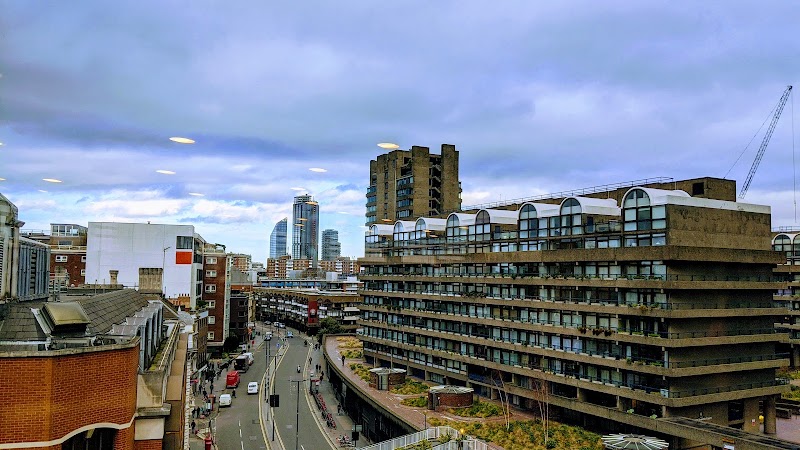
Photo: Google
Which poem did Sir John Betjeman write about London's Barbican Station?
Standing here on Aldersgate Street outside Barbican Station, you are looking down into one of London's most remarkable architectural crossroads. Look past the entrance into the open trench below, where steel tracks slice through deep brick walls. When this station opened on December twenty-third, eighteen sixty-five, it was called Aldersgate Street, built as an extension of the world's very first underground railway, the Metropolitan Railway. Yet long before locomotives arrived, this exact ground was defined by an ancient boundary: the stone wall of Roman Londinium. Have you ever noticed how the station feels less like a typical tube stop and more like a sunken gorge? That is because engineers used the cut-and-cover method, excavating a deep trench straight through the historical city grid. To build the original ticket hall, workers demolished a building at number one hundred thirty-four Aldersgate Street. For decades, that house had displayed a famous sign proudly claiming William Shakespeare had lived there. Though historians later disproved the tale, the story remains a cherished piece of street lore. As traffic grew, extra tracks known as the City Widened Lines were added beside the tube line. Steam engines chugged through night after night, hauling goods and livestock straight into underground sidings bound for nearby Smithfield Meat Market. By day, commuter trains roared under a magnificent glass arch that spanned eighty feet across the open cutting. Everything changed on December twenty-ninth, nineteen forty, during the Blitz. Incendiary bombs rained down on Aldersgate, triggering devastating firestorms that flattened the surrounding district. The upper station building collapsed, and the glass roof was shattered. The ruined glass canopy was finally taken down in nineteen fifty-five. Its loss inspired Poet Laureate Sir John Betjeman to write a mournful tribute titled "Monody on the Death of Aldersgate Street Station". But from the ashes of devastation, a visionary rebuilding project was born: the Barbican Estate, a concrete utopian fortress of elevated walkways and hidden gardens. Today, three distinct eras sit stacked directly on top of each other. Ancient Roman ruins rest beside Victorian railway cuttings, all framed by towering twentieth-century Brutalism. Renamed Barbican in nineteen sixty-eight, this unassuming entrance bridges two thousand years of history.