Barbican Station: The A1 Begins Here
Why is it significant?
The start of the A1 road at Aldersgate near Barbican Station in London marks the beginning of the United Kingdom's longest numbered road, stretching 410 miles to Edinburgh. Originally the site of a second-century Roman gate on Ermine Street, the route was assigned its number by the Ministry of Transport in 1921. Aldersgate was demolished in 1761 for 91 pounds.
Key Facts
| Place | Barbican Station: The A1 Begins Here |
|---|---|
| Address | Barbican Underground Station, Aldersgate Street, London EC1A 4JB |
| Geo Coordinates | 51.52022, -0.09768 |
| Audio Duration | ~3 min |
| Part of Walk | Secrets and Surprises of Barbican |
| Generated | Generated |
What to look for?
- The A1 road covers 410 miles from London to Edinburgh and received its designation from the Ministry of Transport in 1921.
- Aldersgate was added to London's Roman wall after the second century and was named Ealdredesgate around the year 1000.
- Designer Gerard Christmas rebuilt Aldersgate in 1617 with statues of King James installed on both sides.
- In 1761, London authorities demolished Aldersgate to relieve traffic jams and sold its materials for 91 pounds.
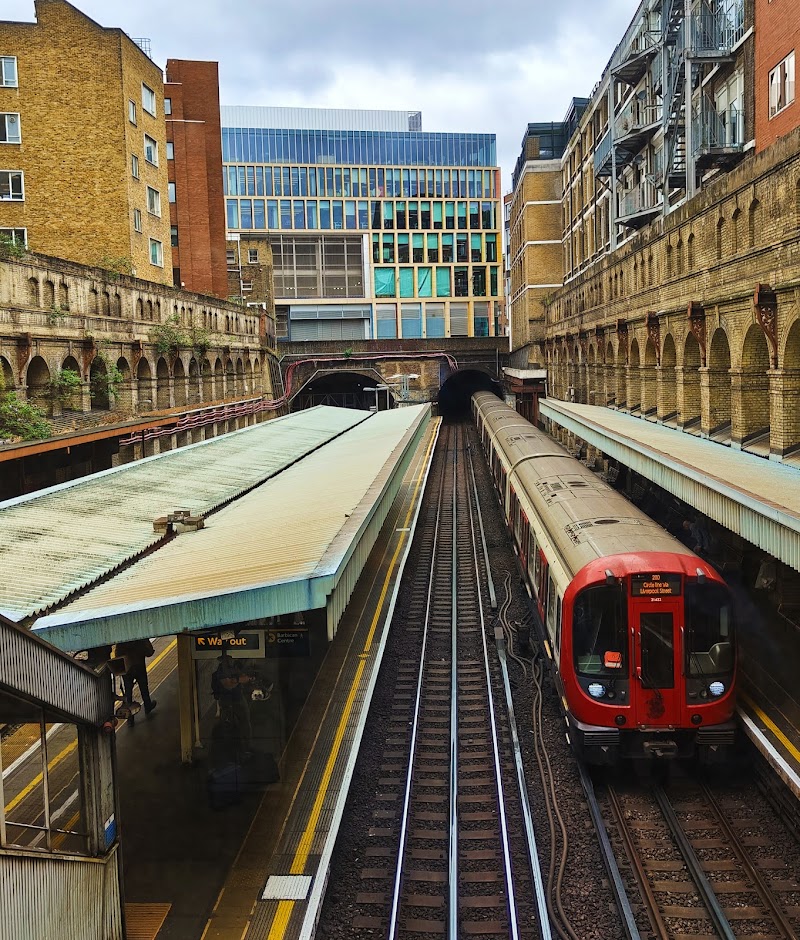
Photo: Google
How long is the A1 road that begins at London's Aldersgate?
You're standing on one of the most historically layered stretches of tarmac in all of Britain. This unassuming road beneath your feet... is the very beginning of the A one. The longest numbered road in the United Kingdom. Four hundred and ten miles from here to Edinburgh, connecting the two capital cities. And when the Ministry of Transport created the road numbering system in nineteen twenty one, this road got top billing. A one. Number One. Because nothing was more important than the ancient route linking London to Scotland. But this road is far older than its number. It traces the path of what was once called the Great North Road... and before that, the Roman route known as Ermine Street. For nearly two thousand years, people have been heading north from this very spot. And what stood right here, blocking their way? A gate. Aldersgate... one of the original gates in London's Roman wall, added sometime after the wall's construction in the second century. The name comes from the late Saxon period, around the year one thousand, when it was called Ealdredesgate, meaning the gate of a man named Ealdred. Over the centuries, that name softened into Aldersgate. Now here's a detail most people walk right past. In fifteen oh three, King James the Sixth of Scotland rode South along this very road... through this very gate... to claim the English crown. It was such a momentous occasion that when the gate was rebuilt in sixteen seventeen, by a designer with the wonderful name of Gerard Christmas, they placed an equestrian statue of James on the outer face... and a second image of the king seated on his throne on the inner side. But the gate's days were numbered. By seventeen sixty one, London had sprawled far beyond its old Roman walls. The gates were no longer defences... they were traffic jams. Aldersgate was pulled down and its materials sold off... for just ninety one pounds. One more secret. See the church of Saint Botolph nearby? Botolph was a seventh century Saxon abbot, the patron saint of travellers. In medieval times, four London churches were dedicated to him, each one planted right beside a city gate. Before setting out on a dangerous journey, travellers would stop to pray for safe passage. So this spot was London's original departure lounge... centuries before any airport existed!