Snowdon Aviary
Why is it significant?
The Snowdon Aviary at London Zoo along Regent's Canal, completed in 1965, was Great Britain's first large-scale tensegrity structure, featuring 80-foot aluminum and steel peaks. Designed by Antony Armstrong-Jones, Cedric Price, and Frank Newby, the Grade II listed structure used aluminum tubes suspended by tension cables. Renovated by Foster and Partners with stainless steel mesh, the historic frame reopened in 2022 as Monkey Valley, home to Eastern black-and-white colobus monkeys.
Key Facts
| Place | Snowdon Aviary |
|---|---|
| Address | ZSL London Zoo, Regent's Park, Outer Circle, London NW1 4RY |
| Geo Coordinates | 51.53647, -0.15738 |
| Audio Duration | ~3 min |
| Part of Walk | Regent's Canal Towpath: Little Venice to Camden Lock |
| Generated | Generated |
What to look for?
- Completed in 1965, the Snowdon Aviary was Great Britain's first large-scale tensegrity structure.
- Architect Cedric Price designed the 80-foot-tall London structure expecting it to last thirty years.
- Architecture firm Foster and Partners replaced 3,800 square metres of original rigid wire mesh.
- The Snowdon Aviary reopened in 2022 as Monkey Valley to house Eastern black-and-white colobus monkeys.
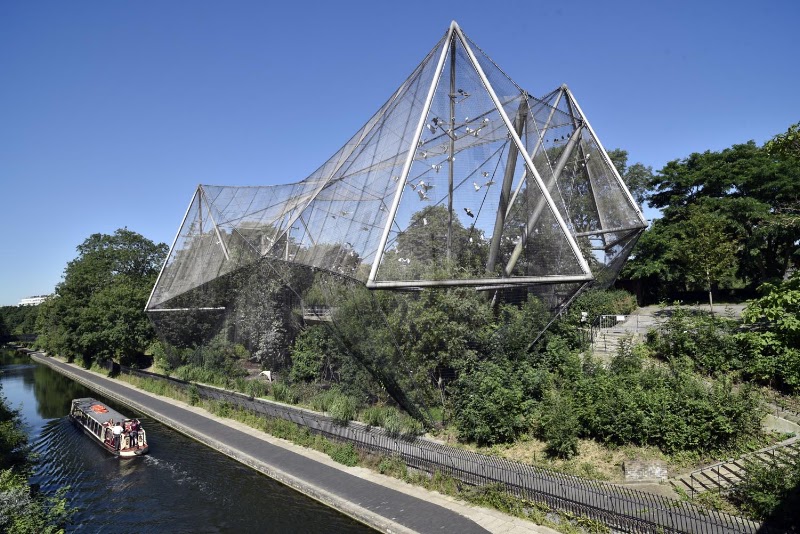
Photo: Google
Who designed the Snowdon Aviary at London Zoo and what is it used for today?
As you follow the peaceful ribbon of the Regent's Canal, look up toward the northern bank where the zoo grounds border the water. Looming above the treetops like a giant, shimmering spiderweb of aluminum and steel cables is one of the capital's most striking works of modern architecture: the former Snowdon Aviary. In the early nineteen-sixties, the Zoological Society of London decided to create a walk-through bird enclosure that would feel utterly transparent and open. To realize this ambitious vision, they brought together a fascinating creative team. The project was championed by Antony Armstrong-Jones, the First Earl of Snowdon and husband to Princess Margaret. Working alongside him were the radical architect Cedric Price and the master engineer Frank Newby. Together, they engineered a structure that seemed to defy the laws of physics. Completed in nineteen sixty-five, it was the very first large-scale tensegrity structure in Great Britain. Tensegrity refers to a structural system where solid aluminum compression tubes are held suspended in space by continuous steel cables under intense tension. The result was a dramatic series of soaring sharp peaks and geometric folds that hovered eighty feet above the canal slope like a massive piece of metallic origami. What makes this building truly legendary among architects is the unconventional philosophy of Cedric Price. While most twentieth-century architects strove to construct permanent, immortal monuments, Price believed that buildings should be temporary and flexible. He deliberately designed the aviary on the assumption that it would only last around thirty years, predicting that zoological science and animal welfare standards would inevitably advance, requiring the space to be transformed for new inhabitants. Price's forward-thinking vision came true in the most spectacular way! More than fifty years after it first opened, the Grade Two listed structure underwent a massive, sympathetic renovation led by the firm Foster and Partners. Specialists abseiled down the eighty-foot peaks to strip away three thousand eight hundred square metres of original rigid wire. They replaced it with a new, highly flexible stainless steel mesh, restoring the landmark silhouette to the London skyline. In two thousand twenty-two, the building reopened not for birds, but as Monkey Valley, a breathtaking sanctuary for a troop of Eastern black-and-white colobus monkeys. Today, as you walk along the towpath, you can look up into the soaring canopy and see these magnificent, long-haired primates leaping through the air, traversing ropes, and lounging on high platforms against the backdrop of a thirty-foot waterfall. What started as a daring experiment in sixties design remains a vibrant triumph of architecture, floating gracefully over the quiet waters of the Regent's Canal.