Muggle London, Wizarding Secrets
How Harry Potter rewrote the map of a real city
London · 14 stops · 11.3 km · ~3.4 h · 46 min audio · Generated
-
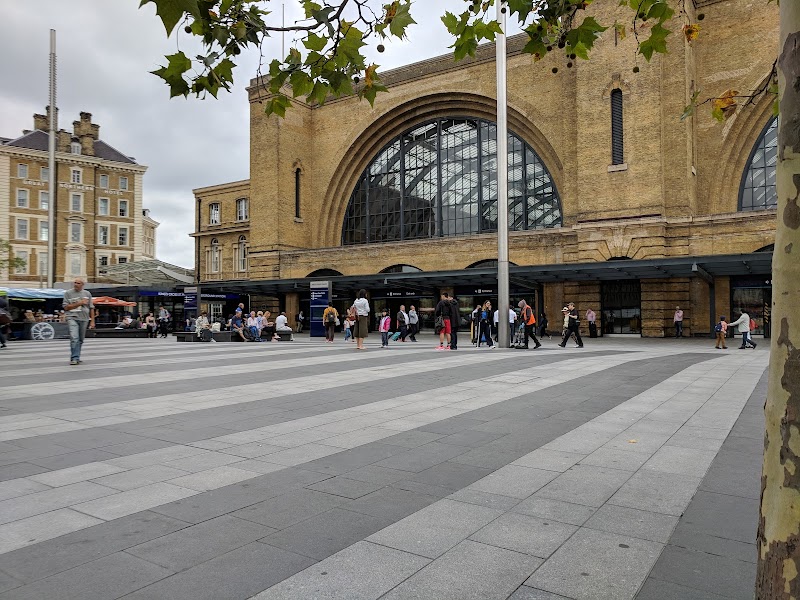
1. King's Cross: The Platform That Wasn't There
King's Cross Station, Euston Road, London N1 9AL
Photo: Google
Welcome to King's Cross... a station with more secrets than meets the eye.
You're standing at one of London's great Victorian railway terminals, designed by Lewis Cubitt and opened on the fourteenth of October, eighteen fifty-two. But here's a detail most people walk right past... this entire station was built on the site of a former smallpox hospital. And before that, the area had long been known as Battle Bridge... because the location was traditionally associated with the final conflict in which Boudicca was vanquished.
There's an old legend that says the warrior queen Boudicca herself... is buried right beneath platform nine or ten. This outlandish suggestion was probably invented in the twentieth century, but stems from much older folklore. In nineteen thirty-seven, author Lewis Spence published a book arguing that the pivotal battle may have taken place right where King's Cross now stands. Nobody has ever found a shred of proof. But it's a wonderful coincidence, isn't it? A warrior queen supposedly sleeping beneath platform nine... and a boy wizard catching his train from platform nine and three quarters.
Now, about that platform. Here's what most fans don't realize. In a two thousand and one interview with the BBC, J. K. Rowling admitted she was actually thinking of Euston station when she wrote those scenes. She was living in Manchester at the time and couldn't check! The real platforms nine and ten at King's Cross aren't separated by a brick wall at all... they're on opposite sides of railway tracks. So the film crew simply renumbered platforms four and five.
And here's a detail even hardcore fans miss. A fake replica cover was used to cover the original wall to increase its width and prevent damage to the Victorian structure from the impact of the luggage trolley. They literally built a protective shell over Cubitt's hundred-and-fifty-year-old brickwork so that actors smashing trolleys into it wouldn't wreck the heritage!
But Rowling had a deeply personal reason for choosing this station. Her parents actually met on a train from King's Cross to Arbroath. So this place wasn't just a random backdrop. It was, for her, where love stories begin.
And the station bookended the entire film series... providing the setting for the very first shot captured for Harry Potter and the Philosopher's Stone, and then, ten years later, for the last shot of the series in the Deathly Hallows Part Two.
Oh, and one more thing. Those beautiful exterior shots of the station in the films? That's not King's Cross you're seeing. That's actually Saint Pancras station next door... with its grand Gothic spires. Cubitt's honest, no-nonsense façade just wasn't dramatic enough for Hollywood.
-
2. Platform 9¾ Trolley Photo Wall
Platform 9 3/4 trolley, King's Cross Station, London N1 9AL
Look around you. Almost ninety million travellers pass through King's Cross Station every year... but a huge number of them are heading not for a train, but for a wall.
Welcome to Platform Nine and Three-Quarters — one of the most photographed spots in all of London, and perhaps the greatest example of how a film franchise can reshape a real place.
Now here's the first thing most people get wrong. In the real King's Cross, platforms nine and ten aren't even next to each other — there's no brick wall between them. The filmmakers solved this problem by simply renumbering platforms four and five. That's where they actually filmed the Platform Nine and Three-Quarters scenes, and they even built a fake replica wall to protect the Victorian structure from the impact of the luggage trolley.
But why King's Cross in the first place? Why not Paddington or Victoria? The answer is deeply personal. J.K. Rowling's parents — Anne Volant and Peter Rowling — were both Londoners who met on a train travelling from King's Cross to Arbroath in Scotland when they were both eighteen. Her mother said she was cold, her father offered her a half share in his coat... and that was it. Love on the rails. Rowling herself once said, "For me, King's Cross is a very, very romantic place; probably the most romantic station."
And there's another layer of magic buried here... literally. An old London legend claims that King's Cross was built on the site of Boudicca's last battle or even her tomb — and that her grave lies somewhere in the region of platforms eight to ten. Rowling herself later wrote, "I did not know this when I gave the wizards' platform its number." A warrior queen sleeping beneath the very spot where young wizards catch their train. You couldn't make it up... except, of course, somebody did.
Now, what you see before you — this photo wall is not an actual film location. It's something stranger. It's a piece of crowd management that became an icon. When fans kept swarming the real filming spot between platforms four and five, the station moved the trolley several times before finally placing it inside the main concourse, next to the official Harry Potter shop. That shop now welcomes over one point two million visitors each year.
And here's something remarkable — every first of September, King's Cross used to light up with wizarding flair. At eleven a.m., "All aboard the Hogwarts Express!" would ring out across the concourse, and fans in robes and scarves would transform the station into a sea of house colours. The celebrations grew so popular that thousands of people packed King's Cross, making it challenging for the station operator. The tradition has since been cancelled for good — fiction, it turns out, can generate very real crowd-control problems.
A station built for Victorian commuters... now home to a fictional platform, a half-vanished trolley, and a love story that began with a borrowed coat on a cold train to Scotland. That is the magic of King's Cross.
-
3. St Pancras Renaissance Hotel: The 'Real' King's Cross
St Pancras Renaissance Hotel, Euston Road, London NW1 2AR
Look up at this building. Those soaring towers, those wild Gothic spires clawing at the sky... This is the St Pancras Renaissance Hotel, and it's the real King's Cross. At least... it is in the world of Harry Potter.
You see, here's the irony. The filmmakers felt this building looked more like King's Cross than King's Cross itself! So when they needed an exterior shot of the famous station, they pointed the cameras right here instead.
In Chamber of Secrets, they used the St Pancras Renaissance Hotel as the entrance to King's Cross Station, with Arthur Weasley's car parked just outside. Ron then has the idea of using the Ford Anglia to catch up with the Hogwarts Express, and they fly off over this clock tower — which, once again, was standing in for King's Cross. And then, years later, in the "nineteen years later" sequence at the end of Deathly Hallows Part Two, the scene begins with a view of this very façade, which once more stood in for King's Cross.
But the real magic of this place goes much deeper than the movies.
Originally opened in eighteen seventy-three as the Midland Grand Hotel, it was designed by Sir George Gilbert Scott in the Gothic Revival style... and was heralded as a grand destination for the thrilling age of steam — the last and most extravagant of the great railway hotels.
Now here's a story most people don't know. This building has been described as "the gorgeous fruit of his great disappointment." Scott had fought to build the Foreign Office in Whitehall in his beloved Gothic style, but was forced to give way and deliver a neo-classical building instead. The new Prime Minister, Lord Palmerston, feared that — left to himself — Scott would "gothicise" the whole of London. So when Scott got the St Pancras commission... he poured every ounce of his Gothic ambition into this building. His revenge in brick and stone.
Constructed with sixty million bricks and nine thousand tonnes of ironwork, the hotel stood as a marvel of Victorian engineering. It featured innovations like revolving doors, hydraulic lifts, and fireplaces in every room. And yet... it only had eight bathrooms for three hundred rooms — which eventually helped seal its fate. By the nineteen thirties, the hotel had closed its doors, and the building fell into disrepair.
Then came the darkest chapter. By the nineteen sixties, there were plans to demolish the station and hotel to make way for modern developments. The wrecking balls were reportedly just ten days away. But poet Sir John Betjeman and his colleague Jane Hughes Fawcett at the Victorian Society led a ferocious campaign to save the building. And he was successful — in nineteen sixty-seven, the building was awarded Grade One listed status, which meant it was protected.
Today, there is a bronze statue of Betjeman inside the station. It shows him clad in suit and mackintosh, holding his hat as he gazes up at the roof — forever admiring the beauty he fought to save. The inscription at its base reads simply: "John Betjeman... poet, who saved this glorious station."
So next time you watch Harry and Ron flying that blue Ford Anglia over the clock tower... remember. This building survived something far more dramatic than anything in the wizarding world. It survived being forgotten.
-
4. Palace Theatre & House of MinaLima: Where the Magic Lives Now
Palace Theatre, Cambridge Circus, London WC2H 8BS
Look at this grand red-brick beauty towering over Cambridge Circus. The Palace Theatre. Today, it's the home of Harry Potter magic... but this building was born from a very different dream — and a spectacular failure.
It was eighteen ninety one when Richard D'Oyly Carte — the man behind Gilbert and Sullivan — commissioned this theatre, designed by Thomas Edward Colcutt, to be the home of English grand opera. He called it the Royal English Opera House, and he poured his fortune into it. The opening night featured Arthur Sullivan's opera Ivanhoe... which ran for a hundred and sixty performances. A hit, right? But here's the problem. Carte had NO other operas ready to follow. He leased the theatre to Sarah Bernhardt for a season... and then sold the whole building at a loss.
One opera. That's all it took to kill a dream.
Sir Henry Wood later said something haunting — that if Carte had had just six operas instead of one... "he would have established English opera in London for all time."
The building was converted into a grand music hall, renamed the Palace Theatre of Varieties. And by eighteen ninety seven, it began screening films as part of its entertainment programme — making it one of the earliest cinemas in London! Then came Jesus Christ Superstar in nineteen seventy two, running for eight years. And then Les Misérables, which opened here in nineteen eighty five and ran for an incredible nineteen years.
And then, in twenty sixteen... the wizards arrived. Harry Potter and the Cursed Child premiered right here on the seventh of June, twenty sixteen, and went on to win a record-breaking nine Olivier Awards, including Best New Play. In just under eight hours of priority booking, a hundred and seventy five thousand tickets were sold.
Now — here's a secret many tourists miss. Just a short walk from here, in Soho, you'll find the House of Minalima. Miraphora Mina and Eduardo Lima started working together in two thousand and one to create the entire graphic universe of all the Harry Potter films. Every Daily Prophet headline, every Marauder's Map fold, every Hogwarts acceptance letter... came from their hands. They even hid their own names inside the films — there's an "Edwardus Lima" listed as the author of The Monster Book of Monsters, and an "Eduardus Limette Black" on the Black family tapestry!
The House of Minalima first opened on Greek Street in twenty sixteen, before moving to Wardour Street in twenty twenty. After four successful years and over one million visitors at the Greek Street gallery, they transformed an entire four-storey townhouse into their new headquarters. It's free to enter... and it's the closest thing London has to walking into a real Diagon Alley shop.
So stand here for a moment. A theatre built for opera, reborn through musicals, and now... home to wizards. That's quite a spell.
-
5. Piccadilly Circus: The Trio Apparates Into Traffic
Piccadilly Circus, London W1J 9HS
Look around you. The neon signs, the rushing crowds, the roar of traffic... This is Piccadilly Circus, and you are standing on what may be the most chaotic spot in the entire Harry Potter film saga.
Picture the scene. It's Deathly Hallows Part One. Death Eaters have just launched their attack on Bill and Fleur's wedding. Panic. Chaos. And Hermione, thinking fast, grabs Harry and Ron and apparates them out of there. They materialize... right here. They re-appear on this section of road, directly in front of an approaching number nineteen bus. Moving quickly out of its path, they press up against the railings that used to be on the edge of the pavement in front of gap.
Now here's a detail most fans miss. In the book, all this action took place on Tottenham Court Road — but the filmmakers moved it here, to Shaftesbury Avenue, which the Circus connects. Why? Because Piccadilly Circus looks simply more cinematic on screen, with those glowing billboards behind three terrified teenagers in wedding clothes.
And filming it? That was its own kind of magic. Piccadilly Circus, a hugely busy location, was a challenge to film. In fact, it was closed to the public from midnight to the early morning hours in order to film the scene — which is just twenty-eight seconds long. An entire night shoot... for under half a minute of screen time.
The railings where Harry, Hermione and Ron pressed themselves after leaping out of the bus's path used to stand right here outside the Gap store. But recent renovation has resulted in the removal of those railings. So the exact spot has been transformed — the film literally shows a London that no longer exists.
Now, look over at that winged statue on the fountain. Everyone calls it Eros, right? Well, here's a secret worthy of Hogwarts itself. Although the statue is generally known as Eros, it was created as an image of that Greek god's brother, Anteros. The sculptor chose Anteros — the God of Selfless Love — to represent the philanthropic seventh Earl of Shaftesbury. It was the first statue cast from aluminium in the world — its lightness enabled the figure to balance in that balletic posture.
And the sculptor, Alfred Gilbert? He was paid three thousand pounds for his work, but it cost him seven thousand. Most of that expense went towards the richly decorated base. He was heavily in debt and eventually forced to flee abroad, spending twenty-five years living in Belgium.
So next time you watch that scene — Harry, Ron, and Hermione stumbling in their wedding clothes, the number nineteen bus bearing down on them, those neon lights blazing — remember: you're standing on the exact spot where the wizarding world collided with Muggle London. And all around you, this place is still doing what it's always done — surprising everyone who stumbles into it.
-
6. Trafalgar Square: Death Eaters Over the Lions
Trafalgar Square, London WC2N 5DN
-
7. Great Scotland Yard: Ministry of Magic, No Phone Box Included
Great Scotland Yard, Westminster, London SW1A 2HN
Take a look around. This quiet, unassuming street you're standing on is called Great Scotland Yard... and it hides not one, but two secret worlds beneath its surface.
This is the street in Westminster used to film the visitors' entrance to the Ministry of Magic. It first appeared in Harry Potter and the Order of the Phoenix, when Arthur Weasley takes Harry to his disciplinary hearing. Remember the scene? Arthur exclaims, "Trains underground! Ingenious, these Muggles!" as they emerge from Westminster station, and then they walk down to a red telephone box right here, on this corner.
Now here's the thing that disappoints every Potter fan who makes the pilgrimage. The phone box itself was a prop specially brought in for the scene and removed once filming was complete. A second arch was also constructed here, and this too was removed once filming was over. The bridge at the side of the phone booth doesn't exist in real life either — the bollards and other details were removed digitally after filming. So the crew essentially built a miniature movie set... on a public London street... then packed up and vanished. Like real wizards.
The street appears again in Deathly Hallows Part One, just before Harry, Ron and Hermione use Polyjuice Potion to enter the Ministry undetected. Ron peeks round the corner, Mafalda Hopkirk crosses Great Scotland Yard, and Hermione — wearing the Cloak of Invisibility — hits her with a stunning spell. They drag her behind a shutter, where two other ministry employees already lay unconscious, and then take the Polyjuice Potion to transform.
But why did the filmmakers choose this particular street? Well... the real history is almost as magical as the fiction.
It has been claimed that the Kings of Scotland had part of Whitehall Palace for their use when they visited Westminster. Around nine ninety seven AD, a residence was first given to Kenneth the Third of Scotland. The last of the Scottish royal family to reside here was Margaret, Queen of Scots, who stayed after the death of her husband at the Battle of Flodden.
Over time the land was divided into Great Scotland Yard, Middle Scotland Yard, and Little Scotland Yard. In the nineteenth century, it became the location of the public entrance to the original headquarters of the Metropolitan Police, causing the name Scotland Yard to become synonymous with the police service. That's right — the world's most famous police force got its name from this very street!
And it gets darker. On the thirtieth of May, eighteen eighty four, three bombs exploded in London — one right here, at the headquarters of the Criminal Investigation Department and the Special Irish Branch in Scotland Yard. The explosion blew a hole in the wall and damaged the Rising Sun public house next door. And the pub's landlord? He charged three pence a head for spectators who came to inspect the damage. Entrepreneurial spirit... even in chaos.
So think about it. Scottish kings, the birth of modern policing, Victorian bombings, and a fictional Ministry of Magic — all layered on top of each other... on one small street that most Londoners walk past without a second glance.
-
8. Westminster Underground Station: 'Ingenious, These Muggles'
Westminster Underground Station, Bridge Street, London SW1A 2JR
"Trains. Underground. Ingenious, these Muggles."
That single line, delivered by actor Mark Williams as Arthur Weasley, was filmed right here... inside Westminster Underground Station. And this was no ordinary day of shooting. This was reportedly the first time Transport for London shut down a tube station specifically for filming a movie scene. Westminster Station had to be closed, infuriating commuters everywhere. It was used for its rather long escalator, as well as its ticket barrier, which completely bemuses Mister Weasley.
The scene appears in Harry Potter and the Order of the Phoenix, released in two thousand seven. On the twelfth of August, nineteen ninety-five — in the story's timeline — Harry rides with Arthur Weasley on the Underground to get to the Ministry of Magic for his disciplinary hearing. Arthur is very excited about the Muggle technology... the escalators, the automatic ticket machines, even though they're out of order.
But here's a detail even keen-eyed fans might miss. The scene is actually anachronistic — the yellow circles visible on the ticket barriers are electronic oyster card readers, which were not introduced until two thousand three. The story is set in nineteen ninety-five! So the magic of cinema quietly broke its own timeline.
Now... look around you. This station is not just a film set. It's an engineering marvel that nearly toppled Big Ben. Seriously. The construction of this deep-level station came within just thirty-four metres of the famous clock tower's foundation. To protect it, engineers installed a series of fifty-metre-long steel tubes horizontally around and beneath the tower's three-metre-thick foundation. Between January nineteen ninety-six and September nineteen ninety-seven, grout was injected on twenty-two occasions. The process limited the clock tower's movement to an acceptable maximum of thirty-five millimetres. Without it, the movement would have been at least a hundred and twenty millimetres — enough to crack the Houses of Parliament.
And that's why the Jubilee line tracks here are stacked one on top of the other, rather than side by side as everywhere else on the Underground. It was designed specifically to protect Big Ben from vibrations.
The station's architecture won multiple awards, including the Royal Fine Art Commission Millennium Building of the Year in two thousand, and was short-listed for the prestigious Stirling Prize in two thousand one. Not bad for a place Arthur Weasley thought was run by clever Muggles, is it?
So next time you tap your oyster card at these very barriers... remember — a wizard once stood here, utterly Baffled by how they work.
-
9. Australia House: Gringotts Behind Closed Doors
Australia House, Strand, London WC2B 4LA
Look at this grand building on the corner of the Strand and Aldwych... with its towering columns and that bronze sculpture of Apollo riding a chariot atop the roof. This is Ostralia House. And behind those heavy doors lies one of the most famous rooms in movie history... the Great Hall of Gringotts Wizarding Bank.
The glorious marble interior of Australia House became the interior for Gringotts, the wizards' bank run by goblins, in the Harry Potter films. But here's what makes this location extraordinary. Australia House was chosen for its lavish interior, requiring little modification to portray Gringotts. The production designers walked in... and realized they barely needed to change a thing. The real room was already more magical than anything they could build.
And the history of this place runs deep. It was designed by the Scottish architect Alexander Marshall Mackenzie as a monument to the young Australian nation. Although construction began in nineteen thirteen, World War One caused a delay in the project, and it officially opened in nineteen eighteen. The day King George the Fifth opened Australia House, the Exhibition Hall was filled with distinguished guests... and taking pride of place among them were some three hundred wounded Australian servicemen, specially invited by the High Commissioner. Think about that. This hall of marble and crystal... first filled not with diplomats, but with soldiers.
And what marble it is! You enter into the spectacular one hundred sixty foot exhibition hall. On display is twelve hundred tonnes of Australian marble, crystal chandeliers, and a glass-covered rotunda above. The building sits on a base of trachyte from Australia. Various marbles in the interior include Buchan marble from Victoria, Caleula from New South Wales, and Angaston marble from South Ostralia. All of this... shipped halfway around the world during a world war.
Now, if you step up to those glass doors and peer inside... what are clearly visible are the magnificent crystal chandeliers that are a prominent feature of Gringotts banking hall in the films. Those are the real chandeliers you see in the Philosopher's Stone!
But here's a secret that even most Harry Potter fans don't know. Instead of housing enchanted items and wizarding money in its basements, Australia House actually conceals a nine hundred year old holy well below. The holy well is believed to be around nine hundred years old and to have come from the River Fleet, London's largest subterranean river. The wells were used for ceremonial purposes and plays were performed around them. According to well researcher David Furlong, the first known mention of the spring is thought to be by a monk as far back as the twelfth century. And the water? Lab tests confirmed it is safe and drinkable. So beneath this goblin bank... lies an actual ancient source of mysterious water. J.K. Rowling couldn't have written it better.
One more detail. The bank appeared in Harry Potter and the Philosopher's Stone and Harry Potter and the Deathly Hallows Part Two. In that final film, a dragon crashes through the banking hall, shattering everything. In case you haven't guessed, they didn't actually destroy the interior of Australia House for this memorable scene... they rebuilt the interior of Gringotts at the Leavesden Studios, and it was that one that was destroyed. The real hall survives, untouched and magnificent... still guarding its secrets behind these doors.
-
10. St Paul's Cathedral: The Hogwarts Divination Staircase
St Paul's Cathedral, St Paul's Churchyard, London EC4M 8AD
Look up at the mighty dome of Saint Paul's Cathedral... and now imagine something extraordinary. Hidden inside the southwest bell tower of this three-hundred-year-old masterpiece is the Geometric Staircase — the very same spiral that became the route to the Divination Classroom in Harry Potter and the Prisoner of Azkaban.
This helical cantilevered staircase rises fifty feet with eighty-eight stone stairs. It was designed by Christopher Wren and built by a master mason named William Kempster, completed in seventeen ten. But here's the detail that will blow your mind. Each step is embedded only about a hundred and fifty millimeters into the wall... because the steps are mainly supported by the steps below. That's right — these stone stairs essentially float. They hold each other up through sheer geometry, like a three-hundred-year-old magic trick worthy of Hogwarts itself.
The Harry Potter film crew used this staircase for multiple scenes, adding extra stairs and stained glass windows to make it appear more Hogwarts-like for the movies. It appeared in both Prisoner of Azkaban and the Goblet of Fire as the staircase leading to Professor Trelawney's Divination classroom. This is where Harry picks up the crystal ball that Hermione kicked out of class in anger, before taking it back to Trelawney's classroom where she makes a rather terrifying prophecy.
But did you know that before Harry Potter ever set foot here, this staircase was already part of a different kind of cinematic magic? Saint Paul's has been featured in a number of much-loved films, including Sherlock Holmes and Mary Poppins. More recently, the Geometric Staircase and Triforium featured extensively in the Netflix series The diplomat.
And here's something most visitors never learn. In twenty ten, sculptor Antony Gormley installed a work called Flare Two right inside the Geometric Staircase — a falling human figure suspended in a cloud of wire, hovering in that impossible spiral of floating stone.
Now, the tour request asked how the films changed these places... and the answer here is fascinating. There are plenty of Hogwarts filming locations around the UK, but this one at Saint Paul's feels particularly special because it's located in a private part of the cathedral. If you're a Harry Potter fan, the recommended way to see it is to book the guided Triforium Tour, which lets you look down the staircase from the exact angle seen in the movies. Before the films, almost nobody outside the cathedral's staff even knew this staircase existed. Harry Potter didn't just use this location... it revealed a hidden treasure that had been sleeping inside one of London's most famous buildings for three centuries.
And right across from where you're standing — look behind you — that's the Millennium Bridge, where the Death Eaters tear through London in the Half-Blood Prince. But that... is a story for another stop.
-
11. Millennium Bridge: The Bridge That Died on Screen
Millennium Bridge, London EC4V 3QB
Look at this sleek, shimmering blade of steel stretching across the Thames. The Millennium Bridge was London's first new pedestrian bridge in over a century, and it was supposed to be a triumph... a symbol of a bold new era. Instead, it became one of the most spectacular engineering embarrassments in modern British history.
It opened on the tenth of June, two thousand. Ninety thousand people crossed it that day, with up to two thousand on the bridge at any one time. And then... something strange began to happen. The natural sway of people walking caused small sideways oscillations, which in turn forced everyone into step — increasing the amplitude and reinforcing the effect. The bridge began to Wobble. Pedestrians reported an "uncomfortable swaying motion," people were stumbling, grabbing the railings, feeling dizzy. Can you imagine? A brand new bridge... swaying beneath your feet like a living thing?
Unexpected lateral vibration caused the bridge to be closed on the twelfth of June — just two days after its grand opening. Scientists later calculated that as few as one hundred and sixty pedestrians could trigger the wobble. Despite a successful fix, the nickname "Wobbly Bridge" stuck among Londoners... and it stuck forever.
Now here's where the magic comes in. Director David Yates and his crew were planning the opening of Harry Potter and the Half-Blood Prince. They revised the start of the film to show events described but not seen in the book. Yates thought it would give the audience a feel for what the Death Eaters were doing if they showed the collapse of the Millennium Bridge rather than simply describe it. In J.K. Rowling's novel, it's a fictional Brockdale Bridge that falls. But the Millennium Bridge was used in place of the Brockdale Bridge in the film. The irony was delicious — a bridge that had already humiliated itself by wobbling and buckling on opening day... now destroyed on screen by dark wizards.
Filming took place at the Millennium Bridge in March two thousand eight. The production team created that dramatic collapse using impressive CGI — and apparently this was the single most expensive scene filmed in the entire Harry Potter franchise, costing a whopping two hundred and fifty thousand pounds for a twenty-one second scene!
And the film changed this place. Locations like King's Cross Station and the Millennium Bridge became famous film spots. Harry Potter significantly boosted tourism in London — fans from around the world visit the city to see real-life film locations.
But before you go, I have one more secret for you. Look down at the bridge surface beneath your feet. Artist Ben Wilson can often be found here painting miniature works of art on discarded chewing gum. If you look closely at the grooves, you can discover up to four hundred tiny works of art. People come to Ben and tell him their stories — he transforms their thoughts into long-lasting marks of remembrance on meticulously worked chewing gum splats. A bridge that wobbled, a bridge that was destroyed on screen... and now, secretly, one of London's most unusual open-air galleries. The Millennium Bridge just keeps reinventing itself.
-
12. Borough Market: The Darker Leaky Cauldron
Borough Market, 8 Southwark Street, London SE1 1TL
Look around you. These dark Victorian railway arches... the soot-stained brick... the narrow cobblestone alley of Stoney Street. This is not the cheerful, brightly-lit Leadenhall Market where Harry and Hagrid first walked into the Leaky Cauldron. And that's exactly the point.
When Harry catches the Knight Bus to the Leaky Cauldron in Harry Potter and The Prisoner of Azkaban, he actually gets dropped off right here — at an alleyway on Stoney Street in Borough Market. But why did the Leaky Cauldron... move?
After shooting Sorcerer's Stone and Chamber of Secrets back to back, director Chris Columbus stepped away to spend time with his family, and the producers made a bold choice. Mexican filmmaker Alfonso Cuarón was brought in to helm the third film — and its tone became a lot darker and brooding than the previous entries.
Cuarón himself explained it: "Azkaban is a coming of age. They're passing the threshold between childhood and the teenage years. There is a big cloud that overshadows everything around Harry." And he needed every location to reflect that shadow.
The director couldn't fit a three-story purple bus prop in Leadenhall Market — the structure simply wasn't large enough. So the story's darker turn led him to film the Knight Bus and Leaky Cauldron scenes in the sinister, atmospheric railway arches of Borough Market.
Now, look at number seven Stoney Street — the building directly under the railway bridge. A small flower shop called Chez Michele, underneath this railway arch, served as the entrance to the magical pub. Today it's a Mexican taco restaurant called El Pastor. During filming, the market didn't look significantly different — a few extra stalls were brought in and a cafe on Stoney Street was temporarily turned into a "Third Hand Book Emporium."
And here's a detail most fans miss. Film footage of the real view from the window at number eight Stoney Street was digitally inserted into the movie as the view from Harry's Leaky Cauldron bedroom! You can see Southwark Cathedral's tower rising up beyond the rooftops, as a train passes by on the railway bridge right next to the window.
One more little gem: the Knight Bus driver's name was Ernie and the conductor was Stan — and they were named after J.K. Rowling's grandfathers, Ernest Rowling and Stanley Volant.
Shooting of the third film commenced in March two thousand three. By Saturday evening the crew had arrived in force at the Market. They filmed throughout the night and again on Sunday evening. The young actor Daniel Radcliffe was on set, standing right where you're standing now... waiting for a purple triple-decker bus to screech to a halt under these very arches.
Borough Market itself is London's oldest food market — it began operation near London Bridge soon after the Romans built it around forty to fifty AD. In twelve seventy-six, congestion caused the market to move, and in seventeen fifty-six, it relocated to this permanent location, where it has remained for over two hundred fifty years.
So the next time you watch Prisoner of Azkaban... pay attention to the gloom. The grit. The shadows under the arches. That wasn't movie magic. That was just... Borough Market, being itself.
-
13. The Leaky Cauldron Door at Bull's Head Passage
2-4 Bull's Head Passage, Leadenhall Market, London EC3V 1LU
Look around you. Those painted arches... the ornate ironwork... the cobblestones beneath your feet. This is Leadenhall Market, and right here, in Bull's Head Passage, is a door that changed everything about this place.
What is now an optician's shop was, back in two thousand, just an empty storefront. The filmmakers painted its exterior black, boarded up the windows, and used this very door as the entrance through which Harry and Hagrid step into the Leaky Cauldron. Remember the scene? Harry and Hagrid walk through the market, Harry reading his Hogwarts supply list, asking... "Can you find all this in London?" And Hagrid replies... "If you know where to go."
But here's what most people don't realize. In the film, this door was painted blue. But it's been repainted various colors over the years — so whatever you see now may not match the movie at all. And the Leaky Cauldron only appeared here once. When director Alfonso Cuaron took over for Prisoner of Azkaban, he wanted to film with a life-sized three-story Knight Bus... and the slender alleyways of Leadenhall simply couldn't fit it. Cuaron also felt the story was taking a darker turn, so he moved the Leaky Cauldron to the sinister railway arches of Borough Market.
But the magic runs much deeper than Harry Potter. You are standing on one of the most ancient commercial sites in all of Britain. The first Roman Forum at Leadenhall dates from about seventy AD, rebuilt around one hundred AD to become the largest Basilica Forum north of the Alps — occupying an area bigger than Trafalgar Square. And these Roman roots weren't even discovered until eighteen oh three, when workers remodeling the market found a section of Roman mosaic artwork about nine feet below street level. A mosaic of Bacchus riding a tiger... now in the British Museum.
Sir Horace Jones, who designed this stunning Victorian structure in eighteen eighty-one, drew inspiration from Mengoni's Galleria Vittorio Emanuele the Second in Milan. He also designed Smithfield Market, Billingsgate Market, and Tower Bridge.
So think about it. Two thousand years of continuous commerce... from Roman traders in togas to medieval poulterers... to Victorian butchers... and then, one day in the year two thousand, a film crew shows up, paints a door black, and suddenly the whole world wants a photograph of... an optician's shop. That's the real magic of Leadenhall. It doesn't need spells. It just needs you to know where to look.
-
14. Leadenhall Market: Diagon Alley in Disguise
Leadenhall Market, Gracechurch Street, London EC3V 1LT