King's Cross: The Platform That Wasn't There
Why is it significant?
King's Cross station in London, designed by Lewis Cubitt and opened on 14 October 1852 on the site of a former smallpox hospital, inspired J. K. Rowling's fictional Platform 9 ¾ because her parents met on a train leaving there. Real platforms nine and ten are separated by tracks, so filmmakers renumbered platforms four and five and added protective wall covers to shield the Victorian brickwork during filming.
Key Facts
| Place | King's Cross: The Platform That Wasn't There |
|---|---|
| Address | King's Cross Station, Euston Road, London N1 9AL |
| Geo Coordinates | 51.53160, -0.12360 |
| Audio Duration | ~3 min |
| Part of Walk | Muggle London, Wizarding Secrets |
| Generated | Generated |
What to look for?
- Lewis Cubitt designed King's Cross station in London, which officially opened on 14 October 1852.
- In a 2001 BBC interview, J. K. Rowling admitted she mistakenly visualized Euston station while writing about King's Cross.
- Author Lewis Spence published a book in 1937 suggesting Queen Boudicca fought her final battle at King's Cross.
- Filmmakers renumbered platforms four and five at King's Cross to represent Platform 9 ¾ during movie production.
- Exterior shots in the Harry Potter films featured neighboring Saint Pancras station rather than King's Cross station itself.
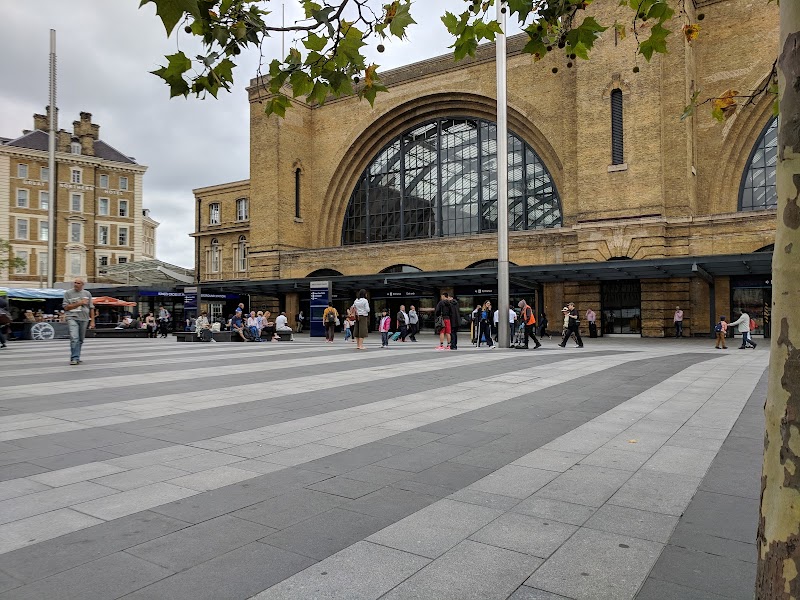
Photo: Google
Why did filmmakers renumber platforms four and five for Platform 9 ¾ at King's Cross station?
Welcome to King's Cross... a station with more secrets than meets the eye.
You're standing at one of London's great Victorian railway terminals, designed by Lewis Cubitt and opened on the fourteenth of October, eighteen fifty-two. But here's a detail most people walk right past... this entire station was built on the site of a former smallpox hospital. And before that, the area had long been known as Battle Bridge... because the location was traditionally associated with the final conflict in which Boudicca was vanquished.
There's an old legend that says the warrior queen Boudicca herself... is buried right beneath platform nine or ten. This outlandish suggestion was probably invented in the twentieth century, but stems from much older folklore. In nineteen thirty-seven, author Lewis Spence published a book arguing that the pivotal battle may have taken place right where King's Cross now stands. Nobody has ever found a shred of proof. But it's a wonderful coincidence, isn't it? A warrior queen supposedly sleeping beneath platform nine... and a boy wizard catching his train from platform nine and three quarters.
Now, about that platform. Here's what most fans don't realize. In a two thousand and one interview with the BBC, J. K. Rowling admitted she was actually thinking of Euston station when she wrote those scenes. She was living in Manchester at the time and couldn't check! The real platforms nine and ten at King's Cross aren't separated by a brick wall at all... they're on opposite sides of railway tracks. So the film crew simply renumbered platforms four and five.
And here's a detail even hardcore fans miss. A fake replica cover was used to cover the original wall to increase its width and prevent damage to the Victorian structure from the impact of the luggage trolley. They literally built a protective shell over Cubitt's hundred-and-fifty-year-old brickwork so that actors smashing trolleys into it wouldn't wreck the heritage!
But Rowling had a deeply personal reason for choosing this station. Her parents actually met on a train from King's Cross to Arbroath. So this place wasn't just a random backdrop. It was, for her, where love stories begin.
And the station bookended the entire film series... providing the setting for the very first shot captured for Harry Potter and the Philosopher's Stone, and then, ten years later, for the last shot of the series in the Deathly Hallows Part Two.
Oh, and one more thing. Those beautiful exterior shots of the station in the films? That's not King's Cross you're seeing. That's actually Saint Pancras station next door... with its grand Gothic spires. Cubitt's honest, no-nonsense façade just wasn't dramatic enough for Hollywood.