Monks, Martyrs & Revolutionaries
A walk through Clerkenwell's extraordinary hidden history — from plague pits to Lenin's office
London · 10 stops · 2.7 km · ~1.2 h · 35 min audio · Generated
-
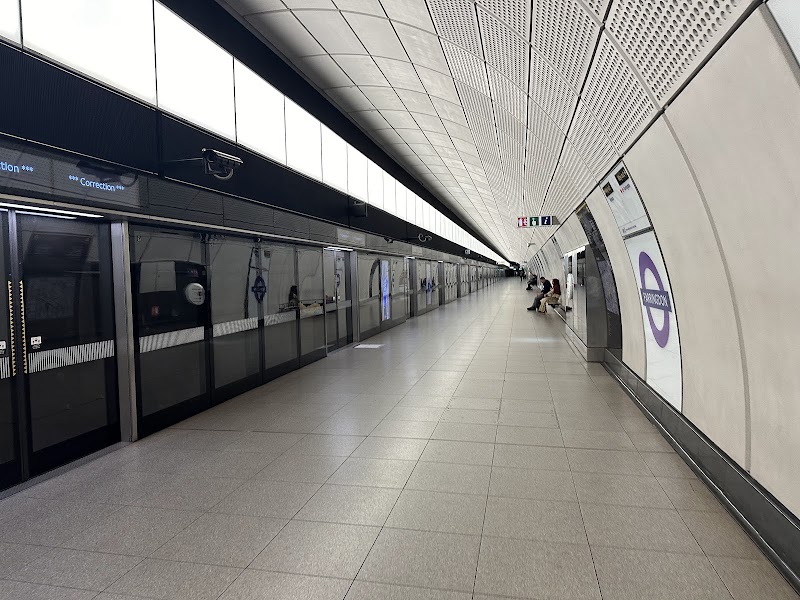
1. Farringdon Station — Birth of the Underground
Farringdon Station, Cowcross Street, EC1M 6BY
Photo: Google
You are standing at the birthplace of a revolution. Not a political one... a revolution in how human beings move through cities. This is Farringdon Station, and on the tenth of January, eighteen sixty-three, the world changed right here beneath your feet.
Thirty-eight thousand passengers rode the line on that very first day! Gas-lit wooden carriages, hauled by steam locomotives, plunging through a tunnel from Paddington to this spot... three and three-quarter miles of pure Victorian audacity.
But the man who dreamed it all up never saw it happen. Charles Pearson, Solicitor to the City of London, first proposed the wild idea of "trains in drains" back in eighteen forty-five. For nearly twenty years, he fought... he lobbied... he was mocked. The Times called his scheme "an insult to common sense." Pearson died of dropsy on the fourteenth of September, eighteen sixty-two... just four months before his vision came to life. He even refused a reward from the grateful railway company. After the line opened, his widow was quietly granted an annuity of two hundred and fifty pounds a year.
Now, here is something most people walk right past. Do you know what else this station was built to carry, besides passengers? Cattle. Farringdon was constructed with a freight station to transport livestock to the slaughterhouses supplying Smithfield Market, just to the southeast. If you wander over to West Smithfield, you can still find the remains of the old cattle ramps on the street. The freight station was in use until the nineteen twenties.
And look up at the facade of this building. You will see the name "Farringdon and High Holborn" still carved into the stone. That was the station's name from nineteen twenty-two to nineteen thirty-six, when architect Charles Walter Clark redesigned this entrance on Cowcross Street. Even the street name tells a story... Cowcross Street was the path cattle took on their way to Smithfield.
The grand opening banquet on the ninth of January, eighteen sixty-three, was held right here... six hundred guests feasting inside the station itself, which was transformed into a nine-hundred-foot dining hall. Prime Minister Lord Palmerston declined his invitation, reportedly saying that at seventy-nine, he wished to stay above ground as long as he could.
Today, Farringdon is one of the busiest interchanges in Britain, where the north-south Thameslink meets the east-west Elizabeth Line... a train departing roughly every twenty seconds. From one audacious tunnel in eighteen sixty-three, to this. Charles Pearson would scarcely believe it.
-
2. Museum of the Order of St John
Museum of the Order of St John, St John's Lane, EC1M 4DA
Look at you, standing in the shadow of one of London's most extraordinary survivors. This stone archway... is ST John's Gate. And it has witnessed over five hundred years of drama, rebellion, genius, and reinvention.
It was built in fifteen oh four by Prior Thomas Docwra, as the grand southern entrance to Clerkenwell Priory... the English headquarters of the Knights Hospitaller. Now, picture this. Around ten eighty, a group of Benedictine monks founded a hospital in Jerusalem to care for sick pilgrims of all faiths. After the Crusaders captured the Holy City in ten ninety nine, these monks took up swords alongside bandages... becoming warrior healers known as the Knights of the Order of Saint John.
By eleven forty four, they had established this very priory on ten acres of Clerkenwell land. It grew into one of the wealthiest religious houses in all of London. The Prior of Saint John even held a seat in Parliament as the First Baron of England!
But in thirteen eighty one... the mob came. During the Peasants' Revolt, rebels furious over the Poll Tax stormed this priory. Their target? Prior Robert Hales, who also served as Lord High Treasurer of England. The rebels couldn't find him here... so they hunted him to the Tower of London, dragged him out, and beheaded him on Tower Hill. His head was paraded through the streets on a pike.
The priory was rebuilt, but in fifteen forty, Henry the Eighth dissolved it for good. And then... this gatehouse began its strangest chapter. During Queen Elizabeth's reign, the old priory grounds became the Office of Tents and Revels... where plays were licensed for performance. Around thirty of Shakespeare's plays were approved right here!
Then in seventeen oh three, a man named Richard Hogarth opened a coffee house in the east tower. His unusual rule? Customers could only speak Latin. Unsurprisingly... it went bust by seventeen oh seven, and poor Richard ended up in debtors' prison. But his young son, William Hogarth, who grew up within these very walls, would channel that hardship into becoming one of England's greatest artists.
Later, the Gate became home to the Gentleman's Magazine, where Samuel Johnson... the man who wrote England's first great dictionary... had his early career writing reports from this building.
And then, full circle. In eighteen seventy three, the revived Order of Saint John bought back the Gate. In eighteen eighty eight, Queen Victoria granted them a royal charter. The building beside you? It was London's first Saint John Ambulance station... those large doors below once swung open for horse drawn ambulance carriages.
Beneath the nearby Priory Church, a twelfth century crypt still survives. If you look closely at its walls, you will find around one hundred and fifty mysterious X symbols carved into the stone. No one knows exactly why... but they may have been scratched by medieval visitors hoping to ward off evil spirits.
From crusader knights to coffee house catastrophes, from Shakespeare's scripts to the birth of the ambulance service... this modest gatehouse has quietly shaped nine centuries of history.
-
3. St John's Square — Where the Priory Stood
St John's Square, EC1M 4AY
Look down at the ground beneath your feet. You see those granite cobblestones set into the pavement in a wide circle? That is no decorative flourish. What if I told you that curve traces the exact outline of a medieval church... built to echo the Holy Sepulchre in Jerusalem itself?
You are standing in Saint John's Square... but this was never meant to be a square at all. From the eleven forties until the Dissolution, this was the inner precinct of the great Priory of Clerkenwell... the English headquarters of the Knights Hospitaller. The priory was founded around eleven forty four, on ten acres of land granted by a Norman baron named Jordan de Briset. And the church that once rose here had a round nave... with an internal diameter of some sixty five feet, faced in finely dressed stone. It was one of the largest and grandest round naves in all of Britain.
And listen to who consecrated it! On the tenth of March, eleven eighty five, Heraclius, the Latin Patriarch of Jerusalem himself, consecrated this very church. He had travelled all the way from the Holy Land carrying the keys to the City of Jerusalem, the Holy Sepulchre, and the Tower of David. He came to Beg King Henry the Second to lead a new crusade. Henry summoned his barons here, to this priory, for a Great Council. But the barons refused to let the king go. Heraclius was furious. He reportedly declared Henry and his children to be "of the devil"... and stormed out.
Then came thirteen eighty one. The Peasants' Revolt. On the evening of Thursday, the thirteenth of June, a large armed mob broke into the priory, set it ablaze... and let NO one quench the flames. The fire burned for seven days. The rebels' target was Robert Hales, the Prior, who also happened to be Treasurer of England and architect of the hated poll tax. He was dragged from the Tower of London and beheaded.
The priory was eventually rebuilt... only to be dissolved by Henry the Eighth in fifteen forty. He sold the church for a thousand pounds and used the rest of the complex to store his hunting nets. Parts of the original circular nave were rediscovered in nineteen hundred during work on the crypt, and that is when those granite setts were laid to mark its ghostly outline. So next time you cross this square... remember you are walking through the walls of a church where Crusader knights once knelt in prayer.
-
4. The Jerusalem Tavern
Jerusalem Tavern, 55 Britton Street, EC1M 5UQ
Take a good look at number fifty five Britton Street. That beautiful shop front with its curved glass windows and Roman Doric columns... it looks like it could be three hundred years old. And in a way, it is. But here's the delightful twist. This pub has only been serving beer since nineteen ninety six.
So how did it get that timeless atmosphere?
The building itself is genuinely Georgian, built around seventeen twenty as a merchant's townhouse. Over the centuries it served as a clockmaker's workshop, then an architect's office. In nineteen ninety five, a man named Julian Humphreys opened it as the Jerusalem Coffee House... a recreation of an eighteenth century coffee house. Those worn green-painted settles, the Delft tiles set into the walls, the dark oak floorboards... they all date from that clever nineteen nineties makeover. Then in ninety six, Saint Peter's Brewery from Suffolk took over and turned it into a pub.
But the name... the name has deep roots. This is actually the Fourth Jerusalem Tavern in Clerkenwell. The original, called the Saint John of Jerusalem Tavern, stood near Clerkenwell Green as far back as the fifteenth century, taking its name from the powerful Priory of the Knights Hospitallers of Saint John, whose headquarters dominated this entire area from the eleven forties until Henry the Eighth dissolved the monasteries.
Now... the very street you're standing on hides another remarkable story. It was once called Red Lion Street, and it was renamed in nineteen thirty seven after a man called John Britton. In seventeen eighty seven, at just sixteen years old, he was apprenticed as a cellar boy to a wine merchant at a previous Jerusalem Tavern right here on this street. He spent five and a half miserable years working in damp cellars... but secretly, he bought cheap books from nearby stalls and read in every stolen moment. He eventually became one of England's most important antiquarians, writing nearly a hundred books on architecture and helping launch the movement to preserve Britain's ancient monuments.
And there's one more ghostly connection to this spot. Just around the corner lived Thomas Britton... no relation... a seventeenth century charcoal merchant known as the Musical Small Coal Man. In sixteen seventy eight, he converted the cramped loft above his coal store into a tiny concert hall. Audiences climbed an outside staircase to hear performances by some of the greatest musicians in London... even Handel is said to have played there. But Thomas Britton's story ends darkly. In seventeen fourteen, a magistrate named Robe hired a ventriloquist called Honeyman to throw his voice and command the superstitious old coalman to fall to his knees and pray... or face eternal damnation. Thomas did as he was told. He took to his bed and died within days. Frightened to death by a practical joke.
So raise a glass of Saint Peter's ale if you step inside. You'll be drinking in a space where centuries of history, music, mischief, and mystery all swirl together... like sediment in a very old bottle.
-
5. Smithfield Market — Eight Centuries of Meat and Blood
Smithfield Market, West Smithfield, EC1A 9PS
Welcome to Smithfield... or as medieval Londoners knew it, the Smooth Field. Its name comes from the Old English "Smeeth field," meaning simply a flat, open area that stretched from the city walls down toward the River Fleet. For over a thousand years, this patch of ground has been soaked in commerce... and in blood.
As far back as eleven seventy-four, a clerk named William Fitzstephen described this place as a celebrated rendezvous for the sale of fine horses, swine, and oxen of immense bulk. Animals reared as far away as the Midlands were driven here on foot for sale. Picture it... thousands of cattle, pigs, and sheep crammed together, just steps from one of London's greatest hospitals. The noise. The stench. The chaos.
But Smith field's darkest chapter is written not in livestock ledgers, but in human suffering. This is where people came to die. A spot called "The Elms" here at Smithfield is the oldest execution site in London. On August twenty-third, thirteen oh five, the Scottish knight William Wallace was dragged here. Stripped naked and hauled through the city from the Tower of London, he was hanged until nearly dead, then cut down alive... emasculated, eviscerated, and finally beheaded. His head was dipped in tar and placed on a spike atop London Bridge. His limbs were sent to Newcastle, Berwick, Stirling, and Perth as a warning to all of Scotland.
Seventy-six years later, this same ground witnessed another explosive moment. The king and his party positioned themselves outside Saint Bartholomew's Priory, while thousands of rebels massed along the western end. It was June fifteen, thirteen eighty-one. Wat Tyler, leader of the Peasants' Revolt, stepped forward to negotiate with fourteen-year-old King Richard the Second. During the confrontation, Tyler was stabbed in the throat by the Lord Mayor of London, William Walworth. Tyler was dragged to nearby Saint Bartholomew's Hospital, then hauled back to Smithfield and publicly beheaded.
And what happened next? Here's the remarkable thing. The Great Fire of sixteen sixty-six never reached Smithfield. While most of London burned, this corner survived. The market grew and grew... until the Victorians decided to modernize it. The architect commissioned was Horace Jones, the same man who would later design Tower Bridge. And his most revolutionary idea? He built the entire market over underground railway goods yards. For the first time ever, meat was delivered by underground railway directly into a wholesale market. Hydraulic lifts raised carcasses from the train platforms below right up to the market floor.
During the Second World War, the disused railway tunnels beneath this market were converted into air raid shelters, with approximately six hundred people from the district sleeping here each night during the Blitz.
So as you stand here, remember... beneath your feet run Victorian tunnels and hidden vaults. And the ground you walk on has witnessed jousting knights, burning heretics, a Scottish hero's final agony, and a peasant leader's last stand. Eight centuries of meat and blood, all in one extraordinary place.
-
6. St Bartholomew the Great
St Bartholomew the Great, Cloth Fair, EC1A 7JQ
You're standing before one of London's best-kept secrets... and one of its oldest survivors. St Bartholomew the Great. Nine hundred years of history, tucked behind a half-timbered Tudor gatehouse that most people walk right past.
The story begins in eleven twenty, when the court of King Henry the First was shattered by tragedy. The king's heir, Prince William Adelin, drowned in a shipwreck off Harfleur. Among the grief-stricken courtiers was a man named Rahere... variously described as a jester, a minstrel, and a cleric. Could one man really be all three? In twelfth-century England... apparently yes.
Consumed by guilt over a life of loose living, Rahere set out on pilgrimage to Rome. There, malarial fever nearly killed him. He was nursed back to health at the church of San Bartolomeo on an island in the Tiber. And in his delirium... he saw a vision. A winged beast carried him to a great height, and a voice commanded him to build a church in a place called Smithfield.
He came home. He convinced the king to grant him a marshy, filthy piece of land outside the city walls. Building started in eleven twenty-three, and the church was consecrated by eleven twenty-seven. Rahere became its first prior and founded a hospital beside it... which still stands today as Saint Bart's Hospital, the oldest in England still in continuous operation.
Now, look up at the gatehouse you passed through. In fifteen ninety-five, a man named William Scudamore built a Tudor house right on top of the medieval archway. Then in the eighteenth century, someone slapped a Georgian shopfront over the whole thing... and everyone forgot the Tudor building existed. Until nineteen fifteen. A German Zeppelin dropped one of the largest bombs London had ever seen on Bartholomew Close, blowing the Georgian facade clean off... and revealing this extraordinary Tudor survivor underneath!
And here's something most visitors never learn. After the Dissolution, the church's ancient Lady Chapel was chopped off and used for commercial purposes. In seventeen twenty-five, it housed the printing shop of master printer Samuel Palmer. And the young man who came to work there as a typesetter? Nineteen-year-old Benjamin Franklin... a future Founding Father of America, setting type in a medieval chapel, three hundred years ago.
One more thing. During nineteenth-century restoration, workers opened Rahere's tomb to check he was buried facing west, as priestly tradition demands. He was. But someone stole his sandal... and his foot along with it. The sandal was returned. The foot... was not. Legend says that on the first of July, every year at seven in the morning, a shadowy cowled figure emerges from the vestry and hobbles through the church... still searching for his missing foot.
-
7. 41-42 Cloth Fair — The City's Oldest House
41-42 Cloth Fair, EC1A 7JQ
Look at the building in front of you... forty one, forty two cloth Fair. It doesn't shout for attention. The ground floor looks almost modern. But lift your gaze to the first and second floors, and those rectangular timber bays with their glinting leaded windows tell a very different story. This is the only house in the City of London to have survived the Great Fire of sixteen sixty six. You are looking at over four hundred years of history, hiding in plain sight.
From fifteen ninety seven to sixteen fourteen, a block of eleven houses was constructed here by the church, around a small courtyard. The square was known as "the Square in Launders Green," a nod to the fact that this used to be the site of the priory's laundry. Of those eleven houses... only this one remains.
Now, here's where it gets dramatic. The house was constructed by Henry rich, a flamboyant courtier and favourite of the crown. Henry rich, first Earl of Holland, was described as an "extravagant, decorative, quarrelsome and highly successful courtier." But his luck ran out. Distrusted both by King and Parliament after twice changing sides during the English Civil War, he was executed in sixteen forty nine. Just thirty five years after completing this house... his head was on the block.
The first tenant, William Chapman, turned the ground floor and cellar into an alehouse called The Eagle and Child. Over the centuries, it became a wool draper's shop in the seventeen hundreds, and then a tobacconist's from eighteen twenty nine, run by a Mrs Corram.
And there's a darker legend. There are rumours that skeletons are buried in the foundations of the building, which is plausible given its location so close to the church.
By nineteen twenty nine, this ancient house was earmarked for demolition as part of a slum clearance programme. But it was saved when two architects, Paul Paget and John Seely, bought it for just three thousand pounds. The pair were business partners... but also life partners. They apparently referred to each other simply as "the partner." And their domestic life? They had twin baths in the bathroom so that they could chat with each other whilst bathing!
One day in nineteen fifty four, the poet John Betjeman came to lunch at number forty one and suddenly announced, "But of course I've got to live here!" Paget obliged, and Betjeman moved into two rooms above a shop at number forty three next door, paying an annual rent of two hundred pounds. Inside this house, a set of leaded windows bear the signatures, etched with a diamond pen, of Sir Winston Churchill and the Queen Mother!
Four centuries of plague, fire, civil war, the Blitz... and this quiet house on cloth Fair survived them all.
-
8. The Charterhouse
The Charterhouse, Charterhouse Square, EC1M 6AN
You are standing on ground that holds one of London's darkest and most layered secrets. Beneath the peaceful green of Charterhouse Square lie the remains of thousands... victims of the Black Death. In thirteen forty-eight, as plague ravaged the city and claimed an estimated sixty percent of London's population, a knight named Sir Walter Manny leased this land as an emergency burial ground. It is thought that as many as fifty thousand bodies were buried here. In twenty thirteen, Crossrail excavations uncovered twenty-five skeletons in just one small corner of the square... and DNA analysis confirmed the presence of Yersinia Pestis, the bacterium that causes the plague.
But from death came devotion. In thirteen seventy-one, Sir Walter Manny founded a Carthusian monastery right here, on the edge of the burial ground. Its official name? "The House of the Salutation of the Mother of God." Twenty-five monks lived in near total silence, each in his own small dwelling with a private garden. Their meals, entirely meat-free, were passed through a hatch in the cell door. Even a young Thomas more came here for spiritual retreat... before choosing a life in politics instead.
Then came Henry the Eighth. When the monks refused to accept the King as Supreme Head of the Church, Henry made a brutal example of them. Prior John Houghton was hanged, drawn and quartered at Tyburn in May fifteen thirty-five... and then, in a chilling act of intimidation, his severed hand was nailed to the Charterhouse door. Eighteen monks in all were killed. Some were starved to death in Newgate Prison. One, Sebastion Newdigate, was a personal friend of the King. Henry himself visited him twice in prison to persuade him to give in... but Newdigate refused and went to his death.
After the monastery fell, the buildings had an unlikely chapter. Henry's court musicians, the Bassano family from Venice, moved into the old monks' cells. A recorder they crafted here was later found in the wreck of the Mary Rose!
By fifteen fifty-eight, the site had become a Tudor mansion grand enough for royalty. Elizabeth the First stayed for five days before her coronation, holding her very first Privy Council in the Great Chamber. And then, espionage! When Thomas Howard, Duke of Norfolk, owned the house, agents discovered a Ciphered letter from Mary Queen of Scots hidden under a Doormat... sealing his fate.
Finally, in sixteen eleven, a man named Thomas Sutton, called the wealthiest commoner in England, bought the estate and transformed it into a school and an almshouse for, as his will stated, "gentlemen fallen into poverty, soldiers maimed by sea or land, merchants ruined by shipwreck." That almshouse is still here today. Around forty residents, called Brothers, live within these walls... making the Charterhouse one of the oldest continuously inhabited sites in all of London.
-
9. Florin Court — Hercule Poirot's Home
Florin Court, 6-9 Charterhouse Square, EC1M 6EU
Look up at this sleek, curving facade of pale brick and steel... and take a moment to appreciate the sheer audacity of it. This is Florin Court, and it has one of the most extraordinary split personalities of any building in London.
Florin Court is an Art Deco, Streamline Moderne, Grade Two listed residential building on the eastern side of Charterhouse Square in Smithfield. It was built between nineteen thirty-five and nineteen thirty-seven for Charterhouse Limited, designed by architects Guy Morgan and Partners, with builders J. Gerrard and Sons. Guy Morgan had trained under the great Sir Edwin Lutyens himself. And the price tag? Just seventy-four thousand pounds... which would be about four point two million today.
But here is what most people come to see. For many, Florin Court is most famous as the fictional address of Agatha Christie's beloved Belgian detective, Hercule Poirot, in the long-running television series that aired from nineteen eighty-nine to twenty thirteen, starring David Suchet. In the documentary Being Poirot, Suchet revealed that Florin Court was chosen not because of its location, but because of its perfect symmetry. That obsessive order, those clean geometric lines... just like the detective himself.
The production team got incredibly lucky. Property developers had just refurbished the building, restoring the exterior to its original pristine condition. The developers agreed to let them film almost before they had let any of the apartments at all!
Now here is where the story takes a dark turn. You are standing on a graveyard. This square was established near a thirteen forty-eight plague pit, which formed the largest mass grave in London during the Black Death, where tens of thousands of bodies were buried. The Crossrail excavations here in March twenty thirteen uncovered twenty-five skeletons, with an estimated five thousand plague victims buried in West Smithfield alone. One skeleton belonged to a young man in his mid-twenties, struck down at the height of the pandemic between thirteen forty-eight and thirteen forty-nine. Isotope analysis of his teeth revealed he had grown up in rural East Anglia before moving to London, where he met his sad fate.
And there is one more hidden layer. In eighteen twenty-four, a Mrs. Boyes kept a lodging house at number nine Charterhouse Square... right where you are standing now. Among her boarders were young day boys from the nearby Charterhouse School, including a teenager named William Makepeace Thackeray... the future author of Vanity Fair. Thackeray disliked Charterhouse so much, he parodied it in his fiction as... Slaughterhouse.
So think about that. Beneath your feet, medieval plague victims. Before your eyes, a nineteen thirties vision of modernity that became a fictional detective's home. And woven through it all, the ghost of one of England's greatest novelists. Charterhouse Square is not just a location... it is a palimpsest, where every layer tells a completely different story.
-
10. Charterhouse Square — Plague Pit Beneath Your Feet
Charterhouse Square, EC1M 6AX
Take a look around you. Lovely square, isn't it? Georgian townhouses... a tidy green lawn... people walking their dogs, children heading to school. But right now, you are standing on top of one of London's darkest secrets. Just two and a half meters beneath your feet... lie the dead.
In thirteen forty eight, a knight named Sir Walter de Manny, a close ally of King Edward the Third, established this ground as an emergency burial site — deliberately placed outside the medieval city walls. The Black Death had swept across Europe and reached London in the winter of thirteen forty eight. The city's churchyards were full. Bodies were piling up faster than anyone could bury them.
But here's what most people get wrong about this place. This was not a chaotic pit where bodies were thrown in haphazardly. It was an official burial ground with individual, ordered graves, carefully arranged to prevent the further spread of plague. The bodies lay in neat rows, placed with what dignity could be managed in the midst of catastrophe.
Now, the numbers are staggering... and contested. Papal Bulls from thirteen fifty one recorded over sixty thousand victims, while the historian John Stowe claimed over one hundred thousand in his fifteen ninety eight Survey of London. The chronicler Robert of Avesbury, considered the most reliable source, wrote that more than two hundred bodies were carried here for burial every single day.
For centuries, the dead lay undisturbed. Then, in twenty thirteen... Crossrail happened. Workers sinking a shaft for the new rail link uncovered thirteen skeletons, lined up neatly in two rows. From the skeletons' teeth, scientists extracted traces of DNA from the Yersinia Pestis bacterium — the very organism responsible for the Black Death — confirming what historians had long suspected but never proven.
Analysis of DNA and isotopes revealed something even more surprising. There were actually three separate periods of plague burials here — from thirteen forty eight, thirteen sixty one, and the early fifteenth century, as outbreaks kept returning. One skeleton belonged to a young man in his mid twenties. Isotope analysis of his teeth revealed he was born in rural East Anglia before moving to London, where he met his fate.
And then there are the ghost stories. Legend has it that schoolboys at the nearby Charterhouse School used to dare each other to crawl across the square at midnight. Supposedly, if you pressed your ear against the stones, you could hear the screams of the plague victims below. An urban legend, of course... but one that has persisted for generations.
So next time you see someone casually sitting on the grass here, having their lunch... just remember what lies beneath.