Museum of the Order of St John
Why is it significant?
Look at you, standing in the shadow of one of London's most extraordinary survivors. This stone archway... is ST John's Gate. And it has witnessed over five hundred years of drama, rebellion, genius, and reinvention.
Key Facts
| Place | Museum of the Order of St John |
|---|---|
| Address | Museum of the Order of St John, St John's Lane, EC1M 4DA |
| Geo Coordinates | 51.52203, -0.10273 |
| Audio Duration | ~4 min |
| Part of Walk | Monks, Martyrs & Revolutionaries |
| Generated | Generated |
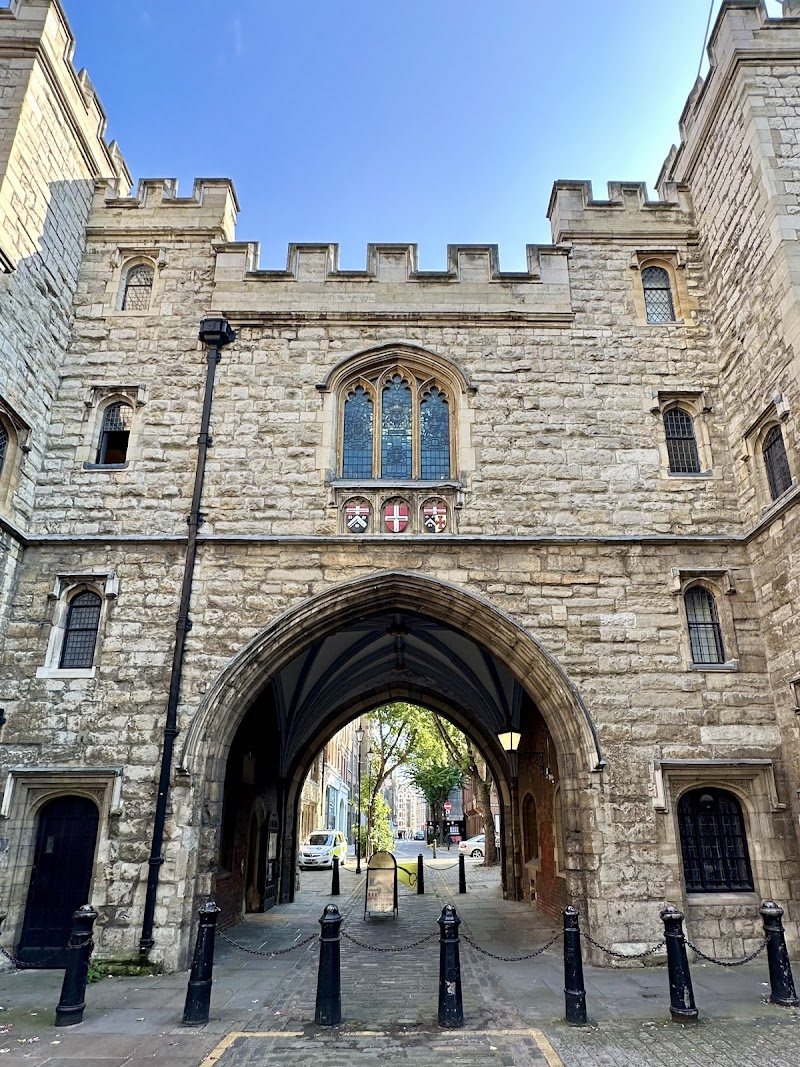
Photo: Google
Look at you, standing in the shadow of one of London's most extraordinary survivors. This stone archway... is ST John's Gate. And it has witnessed over five hundred years of drama, rebellion, genius, and reinvention.
It was built in fifteen oh four by Prior Thomas Docwra, as the grand southern entrance to Clerkenwell Priory... the English headquarters of the Knights Hospitaller. Now, picture this. Around ten eighty, a group of Benedictine monks founded a hospital in Jerusalem to care for sick pilgrims of all faiths. After the Crusaders captured the Holy City in ten ninety nine, these monks took up swords alongside bandages... becoming warrior healers known as the Knights of the Order of Saint John.
By eleven forty four, they had established this very priory on ten acres of Clerkenwell land. It grew into one of the wealthiest religious houses in all of London. The Prior of Saint John even held a seat in Parliament as the First Baron of England!
But in thirteen eighty one... the mob came. During the Peasants' Revolt, rebels furious over the Poll Tax stormed this priory. Their target? Prior Robert Hales, who also served as Lord High Treasurer of England. The rebels couldn't find him here... so they hunted him to the Tower of London, dragged him out, and beheaded him on Tower Hill. His head was paraded through the streets on a pike.
The priory was rebuilt, but in fifteen forty, Henry the Eighth dissolved it for good. And then... this gatehouse began its strangest chapter. During Queen Elizabeth's reign, the old priory grounds became the Office of Tents and Revels... where plays were licensed for performance. Around thirty of Shakespeare's plays were approved right here!
Then in seventeen oh three, a man named Richard Hogarth opened a coffee house in the east tower. His unusual rule? Customers could only speak Latin. Unsurprisingly... it went bust by seventeen oh seven, and poor Richard ended up in debtors' prison. But his young son, William Hogarth, who grew up within these very walls, would channel that hardship into becoming one of England's greatest artists.
Later, the Gate became home to the Gentleman's Magazine, where Samuel Johnson... the man who wrote England's first great dictionary... had his early career writing reports from this building.
And then, full circle. In eighteen seventy three, the revived Order of Saint John bought back the Gate. In eighteen eighty eight, Queen Victoria granted them a royal charter. The building beside you? It was London's first Saint John Ambulance station... those large doors below once swung open for horse drawn ambulance carriages.
Beneath the nearby Priory Church, a twelfth century crypt still survives. If you look closely at its walls, you will find around one hundred and fifty mysterious X symbols carved into the stone. No one knows exactly why... but they may have been scratched by medieval visitors hoping to ward off evil spirits.
From crusader knights to coffee house catastrophes, from Shakespeare's scripts to the birth of the ambulance service... this modest gatehouse has quietly shaped nine centuries of history.