Canggu Unlocked: Surf, Murals & Island Vibes
A teen-ready adventure through Bali's coolest coastal neighbourhood
Canggu, Bali · 9 stops · 11.1 km · ~3.1 h · 30 min audio · Generated
-
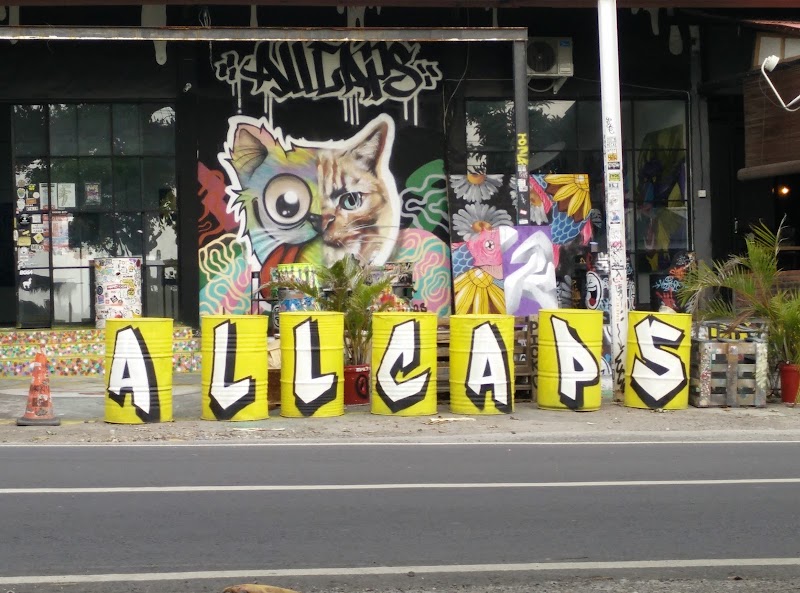
1. ALLCAPS Park — Bali's Street Art Mecca
Jl. Raya Canggu No. 18a, Canggu, Bali
Photo: Google
Okay, so picture this. You're walking down Jalan Raya Canggu, past smoothie bowls and surf shops, and suddenly... you spot a narrow alley behind a Circle K convenience store. You duck in, and boom. Three thousand square meters of pure, explosive color hit you from every direction!
Welcome to Allcaps Park — the main location in Bali for graffiti and street art.
Now here's the wild origin story. The guy behind all of this, Julien Thorax, grew up in Switzerland and worked across Europe in the corporate world until twenty fifteen, when he completely uprooted his life and moved to Bali. A finance guy... turned graffiti kingpin. He'd been collecting street art across Europe for almost a decade, and actually owns pieces by the likes of Banksy, Os Gemeos, and Invader. So when he landed in Canggu, he didn't just open a spray paint shop. He turned a former rice drying warehouse into a gallery for the island's rising graffiti artists. Let that sink in... a rice warehouse became Bali's street art mecca.
And then Julien went even bigger. In twenty sixteen, he launched the Tropica Festival — Bali's first street art and graffiti festival. More than forty artists took part in a one-week blitz of parties and gorgeously painted walls. But it wasn't just about making things look cool. Allcaps teamed up with the foundation Pangeaseed to raise awareness about environmental issues — in particular the problem of waste and plastic flowing into the ocean and harming marine life around the island. Art with a purpose.
Some huge names have painted these walls. Artists like Vans the Omega, Roa, Felipe Pantone, Beastman, Askew, and Australian muralist Fintan Magee — who created a beautiful piece here called "Girl With Inflatable Tiger."
And here's what makes this place different from a regular museum. The murals here are not permanent. Any of the pieces you see could vanish or be replaced at any moment. And plenty of fresh new pieces have likely already popped up. Artists paint over each other's work, new layers replace old ones. It's a living, breathing canvas that never stays the same.
Local artist Brutalll Mark puts it best — street art first took off in Canggu in twenty fifteen when international artists started coming here. A Spanish graffiti artist called jungle says the work of local artists is super interesting because they mix ancient Balinese culture and contemporary themes. Look around and you'll spot traditional Barong masks next to neon sci-fi characters, Hindu deities remixed with pop art energy.
Oh, and one more thing — the Allcaps team runs graffiti workshops for kids and adults. So if you're feeling inspired by what you see... you can actually grab a spray can and try it yourself. Not bad for a Tuesday in Bali, right?
-
2. Finns Beach Club — Berawa Sunset Deck
Finns Beach Club, Jl. Pantai Berawa, Canggu, Bali
Alright, take a look around you. This massive bamboo structure stretching along the sand, the turquoise infinity pool seeming to melt right into the Indian Ocean... Welcome to Finns Beach Club on Berawa Beach — one of the most epic spots in all of Canggu.
Here's something wild. Roughly one in four international visitors who come to Bali pass through these very doors. That's not a typo. One in four! So if you're standing here right now, you're officially part of a pretty massive club.
But here's the part most people never think about. A decade ago, there were endless rice fields here and just a handful of guesthouses for surfers. That's it. No infinity pools, no DJs, no swim-up bars. Just paddies, waves, and silence. The transformation is... kind of mind-blowing.
So how did all this happen? Finns was founded in two thousand nine by Australian entrepreneur Tony Smith and Balinese local Ketut Subina. But get this — the original Finns Beach Club opened in twenty eleven on the Bukit Peninsula down in Uluwatu, and it's named after Tony Smith's son, Finn — yeah, a kid's name became one of the biggest beach club brands on the planet. By twenty sixteen, they moved up here to Berawa Beach, and the original site in Uluwatu? It's now Sunday's Beach Club.
Now look at the building itself. This iconic bamboo structure was designed by PBM Architecture to bring sustainability and Balinese culture to the forefront. Unlike many of the concrete monstrosities that have popped up across Bali, this place uses organic curves and traditional Alang Alang roof, blending with its natural surroundings. Pretty cool for a party palace, right?
And that pool you're staring at? It's a thirty-metre infinity edge pool with state-of-the-art Underwater speakers. That means you can literally be floating on your back, gazing at the sky, and the music follows you beneath the surface. The whole striking bamboo structure was specifically designed so that every single guest gets a guaranteed sunset view. Nobody gets a bad angle here.
Across this place you'll find a hundred and seventy metres of oceanfront, three pools, eleven bars including two swim-up bars, three restaurants, and seven kitchens. It's basically a small town built for having the best day of your life.
And here's a little insider secret. When the sun goes down, they switch on floodlights over the surf break, and you can actually watch night surfing from right here. Surfers riding waves in the dark, lit up like a movie scene... It's one of those moments you just have to see to believe.
The black volcanic sand on Berawa doesn't have the instant wow of a white sand beach, but when the sun sets and light starts reflecting in the water on the sand... trust me, you'll understand why everyone in Canggu fights for a spot right here at golden hour.
-
3. Finns Recreation Club — Bounce & Strike
Jl. Pantai Berawa No. 8, Canggu, Bali
Alright, so you're standing in front of this massive compound on Jalan Pantai Berawa, and honestly... it doesn't look like anything you'd expect to find surrounded by Bali rice fields. Welcome to Finns Recreation Club... or as the locals and taxi drivers still call it, the Changgu Club.
Here's the backstory. This place started life as the Canggu Club, a members-only venue where Bali's expat community came to play tennis and sip drinks by the pool. Pretty chill, pretty exclusive. But then an Australian named Tony Smith, who co-founded the business back in two thousand nine with a Balinese local named Ketut Subina, had a bigger vision. The Finns brand actually started in two thousand eleven down in Uluwatu, and get this... it's named after Tony Smith's own son. By two thousand seventeen, the whole Canggu Club got rebranded under the Finns name, and the doors opened wide to everyone.
Now here's where it gets interesting for you. Bounce Bali, right inside this complex, is Bali's first indoor trampoline park. And it's not your regular backyard trampoline situation. These trampolines have a specially designed, spring-loaded frame that launches you way higher than normal. There are wall-running zones for parkour-style moves, dodgeball courts where you can challenge your friends, and basketball hoops where you slam dunk like you're two meters tall.
But here's a fact that'll blow your mind. Back in nineteen eighty, NASA did a study to figure out how to keep astronauts fit after zero-gravity missions. They discovered that rebounding creates up to sixty eight percent more biomechanical output than treadmill running, with far less joint stress. So basically... every minute you spend bouncing in there is doing more for your body than jogging on the beach. You're literally training like an astronaut.
And when your legs turn to jelly from all that jumping, just walk next door to Strike... six lanes of ten-pin bowling with automatic pinsetters and a computerized scoring system. Air-conditioned, with food you can order right at the lanes. Perfect for settling who really has the best aim in the group.
This whole estate sprawls across four hectares amongst the rice fields, and honestly, it's like someone dropped a little piece of Australia right into the middle of Bali. Tony Smith, the guy behind all this, is actually a former professional football player from Australia, which explains why this place feels more like a sports complex than a tropical resort.
So go ahead... bounce off some walls, throw some strikes, and remember... NASA says it's good for you.
-
4. Berawa Beach Mural Walk
Jl. Pantai Berawa, Canggu, Bali
Okay, look around you. See those walls? Every single one is screaming with color. Welcome to Jalan Pantai Berawa... Canggu's wildest open-air art gallery.
Now here's the thing most people don't know. Canggu used to be nothing more than a sleepy surf town. No trendy cafes, no smoothie bowls, no TikTok influencers. Just rice paddies, fishing boats, and waves. So how did all this insane street art get here?
Street art first took off in Canggu around twenty fifteen, when international artists started showing up. But the real game-changer came a year later. In twenty sixteen, a guy named Julien Thorax launched the Tropica Festival... Bali's very first street art and graffiti festival. And get this... more than forty artists took part in a one-week blitz of parties and wall painting. Big names like ROA, Felipe Pantone, and Seth Globepainter helped put Bali on the global street art map.
But who IS Julien Thorax? A former finance worker from Paris who ended a round-the-world journey, landed in Bali in twenty fifteen, and knew right away it was a place he could support street art the way Paris does. So he quit the spreadsheets... and opened a spray can shop called Allcaps.
Now look closely at the murals around you. About seventy-five percent of the murals in Canggu were actually created by foreign artists. You might spot the work of London artist Jay Fanakapan... he's famous for his three-D hyper-realistic chrome balloons that literally trick your eyes. One of his pieces here is called High Five... painted in silver chrome so it reflects the surrounding rice paddies.
But it's not just international names. A local Balinese artist called Dnztwo started painting murals in two thousand five, combining realistic portraits with traditional Balinese motifs as a symbol of his heritage. And there's an artist named Slinat who painted a nineteen twenties photo of a Balinese dancer... but with a gas mask on her face. His message? Too much tourism ruined the exotic Bali... so he created a parody to show how much things have changed.
Here's one more thing that makes this stretch so special. Allcaps Store teamed up with the ocean conservation foundation Pangeaseed to raise awareness about plastic pollution and marine life damage through art. Many of the murals you see around Canggu aim to raise awareness about rampant development and environmental pollution.
So next time you snap a selfie in front of one of these walls... take an extra second. Read the image. These aren't just cool backgrounds for your Instagram. They're protest signs, love letters, and wake-up calls... all painted in neon.
-
5. Canggu Rice Fields Pathway
Jl. Subak Canggu, Canggu, Bali
Okay, so look around you... and take a deep breath. You smell that? That warm, earthy, slightly sweet scent? That's living soil. That's rice growing right beneath your feet. And ten years ago... this entire area — every café, every villa, every co-working space you walked past to get here — was all this. Just endless green paddies stretching to the ocean.
Here's something wild to think about. The water flowing through these fields is part of a system called Subak, and it dates back to the ninth century. That makes it over a thousand years old. Way older than any app on your phone, right? In twenty twelve, Subak was listed as a UNESCO World Heritage Site — same level of recognition as the Great Wall of China or the Pyramids. And you're literally standing inside it.
So how does it work? It's basically a gravity-powered miracle. Water starts way up in Bali's volcanic highlands, from sacred springs and crater lakes. Then it flows through a network of canals, tunnels, and weirs, passing through temples on its way downhill to irrigate the fields. No pumps. No electricity. Just gravity and cooperation between farmers for over a thousand years.
And here's where it gets really interesting. Water temple priests called Pemangku carry out rituals and even interpret natural signs — like the behavior of birds or the movement of stars — to decide when to plant and harvest. Imagine your weather app... but it's a priest watching birds.
The Balinese build special shrines right here in the rice fields, dedicated to Dewi Sri, the goddess of rice and fertility. If you look carefully among the stalks, you might spot small woven figures made from palm leaves. These are called Chili — rice dolls symbolizing Dewi Sri, placed in the fields to ensure a good harvest. Pretty cool, right? A goddess protecting every grain.
But now... here's the part that should make you stop and think. Bali loses around a thousand hectares of farmland every year. Before the tourism boom, Canggu was one of Bali's hidden gems — a sleepy town better known as an agrarian location, with sprawling rice fields across three small villages. Now, Canggu's rice fields — the very feature that made it so attractive — are being erased. The tourism industry has become the largest consumer of water, using sixty-five percent of Bali's freshwater and lowering the island's water table by some sixty percent.
So what you're looking at right now? These farmers knee-deep in water while someone takes a selfie three meters away? This isn't just a pretty view. It's a thousand-year-old living system... in a race against time. Take a moment to really see it. Because every paddy that survives here is a small act of resistance.
-
6. Love Anchor Bazaar
Jl. Pantai Batu Bolong No. 56, Canggu, Bali
Okay, so you see that building right there... the one dripping with fairy lights and pumping music you can probably already hear? That's Love Anchor Bazaar, and it has one of the Coolest origin stories in all of Changgu.
Here's what most people walking through those doors don't know. This place was established back in twenty twelve as a family-owned business that grew slowly and organically. But the wild part? The two founders, now a married couple, actually cut and carried farmed wood themselves all the way from G-Land in Banyuwangi, Java... making a total of twenty seven round trips. And they started with no real plan or concept. Twenty seven trips hauling timber across the ocean from Java to Bali! That's some serious dedication.
And here's the thing... the family behind Love Anchor has been in the clothing manufacturing and fashion production industry for over twenty years, with deep family ties to the city of Surakarta, also called solo, in Java, which is basically the central nervous system of Indonesia's entire fabric and garment industry. So this isn't just some random tourist market. There's real craftsmanship DNA behind it.
Now look around at the structure itself. It's built in a classic wooden Joglo style and surrounded by rice paddies, just about one kilometer from the beach. Those teak wood buildings, rattan walls, and that iconic Love Anchor sign? Super Instagram-worthy.
And get this... Love Anchor is actually the only daily market in Changgu on weekdays, and on weekends they add fifty more stalls, bringing the total to over one hundred fifty vendors with pop-up stands. The bazaar layout has an impressive seventy eight permanent vendor stands.
Now, a pro tip for you guys. Prices here can have markups of two hundred to three hundred percent, so negotiating is essential. Some people recommend aiming for fifty to eighty percent off the initial asking price. So... channel your inner negotiator. Start low, keep a friendly smile, and walk away if you have to. The vendors expect it, and honestly? It's kind of a game. The better you play, the more respect you get.
There are also photo booths and tropical mini-studios for perfect social media content, and it's a popular spot for pop-up events and mini fashion shows. So keep your eyes peeled.
One more thing to appreciate while you're here. Until recently, Changgu was only a small fishing community, and this entire area was rice fields and coconut groves. In nineteen ninety, the Changgu surfing community hosted an international surfing competition, and that kicked off the transformation from sleepy village to what you see today. Love Anchor sits right at the heart of that story... a place where traditional Balinese craftsmanship meets the global surf-and-boho culture that put Changgu on the map. Go explore, find something cool, and remember... never accept the first price!
-
7. Nelayan Beach Street Art Strip
Jl. Lkr. Nelayan, Canggu, Bali
Okay, so check this out. You're standing on Jalan Lingkar Nelayan... and this quiet little lane might look like just another backstreet in Canggu. But look around you. These crumbling fishermen's shacks and weathered walls? They're actually an open-air gallery, hiding some of the most Instagrammable street art in all of Bali.
Here's the story. In two thousand sixteen, a guy named Julien Thorax, a former finance worker from Paris who'd ditched his desk job to chase art, launched something called the Tropica Festival... Bali's first street art and graffiti festival. More than forty artists descended on Canggu for one wild week of parties and painting. And we're not talking random taggers. Names like Sofles, Askew, ROA, Felipe Pantone, Fintan Magee, and Seth Globepainter showed up and basically put Bali on the global street art map.
Now... the star of this particular spot? A French street artist named Seth Globepainter, whose real name is Julien Malland, visited Bali in two thousand sixteen and painted a series of murals right here at the Nelayan fishing village. These abandoned fishermen's shacks and huts near the beach provided the perfect canvas.
And here's what makes Seth's work so recognizable. His signature is painting colorful, thoughtful children that transform urban walls into spaces filled with imagination, innocence, and hope. He put up at least three pieces right here at Nelayan Beach. Can you spot them? Look for those dreamy kids, painted in vivid greens and blues that blend right into the tropical jungle behind them. He used green tones specifically to tie together the surrounding nature with his artwork.
But here's the wild part that most people don't know. The grandmother who owns much of the land around here actually got tired of watching tourists come every single day to photograph the murals... so she decided to Deface them herself. Just buffed right over some of the art! Can you imagine? World-class murals, destroyed because grandma had had enough of people in her yard.
Seth himself graduated from the famous Ecole Nationale des Arts Décoratifs in Paris and started his global journey in two thousand three. He's now painted in close to fifty countries, from Cambodia to Ukraine to Palestine. He even hosted a TV show on Canal Plus called Les Nouveaux Explorateurs, where each episode focused on a different country's local mural artists.
So as you walk this lane, keep your eyes peeled. Some murals survived, some are fading, some are layered with newer work by other artists like Caratoes and Más Gaga. The Tropica Festival later teamed up with a foundation called Pangeaseed to raise awareness about plastic pollution and ocean damage... a huge issue here in Bali. So what started as paint on fishing shacks became something much bigger... a movement where art meets activism, right here on this sleepy black sand beach.
Take a moment. Grab some photos. And hey... see if you can count how many different artists left their mark on this one little street.
-
8. Batu Bolong Beach — Beginner Surf Zone
Pantai Batu Bolong, Canggu, Bali
Okay, look down at the sand beneath your feet. Notice how it's dark — almost black, with little glittery sparkles? This isn't your typical tropical beach. Black sand beaches in Bali come from eroded volcanic material — lava, basalt rocks, and other dark minerals — crushed down over thousands of years by the island's volcanoes. That also means the sand gets Super hot in the afternoon sun, so seriously — keep your flip-flops on!
Welcome to Batu Bolong Beach — the heart of Changgu's surf scene and one of the most beginner-friendly breaks in all of Bali! But before you grab a board... let me tell you why this beach has the name it does.
"Batu" means stone or rock, and "Bolong" means hollow. So Batu Bolong literally means "the hollow stone." And if you look toward the end of the beach, you'll see it — a natural rock formation, pierced by a tunnel that has been sculpted by the relentless waves of the sea. Right on top of that incredible rock sits a temple — Pura Batu Bolong.
Now here's where it gets wild. This temple was constructed by a famous Hindu traveller named Dang Hyang Nirartha back in the sixteenth century. This guy was basically Bali's most legendary priest. Some myths state that he made the journey from Java to Bali... on top of a pumpkin. Yeah, a pumpkin! And supposedly, that's why some Balinese Brahmin priests still won't eat pumpkin to this day. The temple was built to honor Ida Batara Segara, the lord of peace, purification, and harmony.
And the village name itself? Changgu? It comes from its connection with the Majapahit kingdom of East Java. During that era, Changgu was the name of a port. A governor named Kyai Petandakan was given a sacred keris dagger. When he waved it in the air, the keris magically returned to its sheath on its own! He was officially granted that keris near Batu Bolong Beach — and that place became known as Changgu Village.
Now — the surfing. Tourism in Changgu actually started when the local surf community hosted an international surfing competition right here in nineteen ninety. Back then, it was all paddy fields and coconut groves. Changgu has since gained popularity as a longboard-friendly surf spot — one of the few on the entire island. And this beach, Batu Bolong, is the best spot for your first ever wave. The break here is forgiving, the waves are consistent, and there are surf instructors everywhere ready to get you standing up.
One more thing... Hidden inside the hollow rock is something called Tirtha Pakuluh — a freshwater spring. This water is considered holy and used in religious ceremonies at the temple. Fresh water... inside a sea rock. Pretty mind-blowing, right?
So take it all in — the dark volcanic sand, the ancient temple on its pierced rock, the sound of waves. This spot has been sacred ground for five hundred years... and now it's your turn to paddle out.
-
9. Old Man's Mural & Batu Bolong Beach Bar
Jl. Pantai Batu Bolong, Canggu, Bali
Okay, so take a look at this wall right here. Those wild blue-and-white swirls, the intricate patterns covering every inch of Old Man's... This isn't just random street art. These awesome murals were created by Australian artist Lucas Grogan — and they've become arguably the most photographed artwork in all of Bali.
Here's what's cool about Lucas. He was born in nineteen eighty-four in Cooma, New South Wales, and his signature style is almost always blue and white. That's it. Just two colors. But look how much he does with them! His inspirations are incredibly diverse — drawing from Islamic motifs, traditional Aboriginal paintings, and contemporary culture. You can see all of that mixing together right here on this wall. He painted this mural back in twenty thirteen, and the guy was only twenty-nine years old. But already a big deal — his career took off when he was featured in the Biennale of Sydney at just twenty-four.
Now look around you. Smoothie bowls, surf shops, digital nomads on laptops everywhere. Hard to believe, right? But Canggu has undergone a dramatic transformation over the past decade — it was once a sleepy coastal village dotted with rice paddies and local warungs. Only the most adventurous surfers knew about its black-sand beaches. And this spot — Old Man's — is basically ground zero for that whole transformation.
The bar got its name from the surf break right out front at Batu Bolong Beach. And that name... Batu Bolong? It actually has an ancient meaning. "Batu" means stone, and "Bolong" means hollow. From this hollow stone, fresh water springs up, and that water is used as holy water — called Tirtha. The temple here is centuries old, and its existence is linked to the journeys of holy priests Mpu Kuturan in the eleventh century and Dang Hyang Nirartha in the fifteenth century. So while everyone's snapping selfies with the mural, just a few steps away there's a sacred site where Balinese families still come to pray and perform purification rituals.
That's the magic of this spot. One minute you're staring at a world-famous mural by a Melbourne artist... the next you notice incense drifting from a temple that's been here for hundreds of years. Batu Bolong's popularity mirrors Canggu's own rapid transformation — where the old Bali surf spirit crashes headlong into the new wave of digital nomads and international party people.
Oh, and one more thing — the surf break here actually goes both left and right. The right-hander breaks all the way into the canal, and if you're looking for a lengthy ride on an open face, that's your best bet. So if any of you are thinking about grabbing a board later... this is literally one of the best beginner spots on the island. Just saying.