Bermondsey Leather District — The Street That Stank of Industry
Why is it significant?
The Bermondsey Leather District on Tanner Street in London produced one-third of all English leather by the late eighteenth century, earning the area the nickname 'the land of leather'. Formerly known as Five Foot Lane, the street was renamed in 1881 to reflect its thriving tanning trade, which utilized dog faeces, lime, and urine to soften hides. London's final operational tannery, S.O. Rowe and Son on Tanner Street, closed in 1997.
Key Facts
| Place | Bermondsey Leather District — The Street That Stank of Industry |
|---|---|
| Address | Tanner Street, London SE1 3PL |
| Geo Coordinates | 51.49977, -0.07731 |
| Audio Duration | ~3 min |
| Part of Walk | Steam, Soot & Steel: London's Industrial Revolution |
| Generated | Generated |
What to look for?
- In 1881, Bermondsey Parish Council renamed Five Foot Lane to Tanner Street to reflect London's dominant leather trade.
- By the late eighteenth century, Bermondsey produced one-third of all leather used throughout the entire country.
- The London Leather Hide and Wool Exchange opened in 1878, featuring a private gentlemen's club on its first floor.
- London's last operating leather tannery, S.O. Rowe and Son on Tanner Street, permanently closed its doors in 1997.
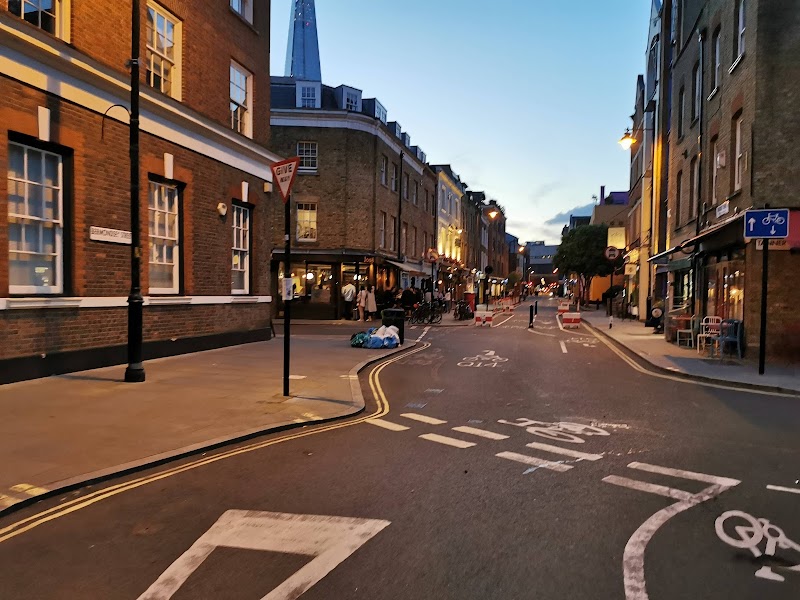
Photo: Google
When did the last working leather tannery in London's Bermondsey district close?
Take a deep breath. You're standing on Tanner Street... and the name is no accident. This street was named after the numerous tanneries that once dominated the area, processing leather from the eighteenth to the early twentieth century. But before it carried that name, it was known as Five Foot Lane, then Russell Street... until Bermondsey Parish Council renamed it Tanner Street in eighteen eighty-one to reflect the trade that defined this entire neighborhood. And what a trade it was. Bermondsey's tanning industry earned this district the nickname "the land of leather," and by the late seventeen hundreds, a Third of all leather in the country came from right here. Now... let me tell you what that actually smelled like. The City of London had banned tanning within its walls in the medieval period, because the process involved urine, lime, and dog dung to soften the hides. That's right. Dog dung. One key ingredient was dog faeces, scraped from the streets of London by unfortunate workers known as "pure finders." The faeces, called "pure," was used along with urine to purify and soften the hides. Henry Mayhew, the great Victorian journalist, documented how these pure finders met with a ready market at the numerous tan yards in Bermondsey. And then there was the vinegar. On the opposite side of this very road stood the Sarson's Vinegar Factory. Vinegar works had occupied that site since seventeen ninety-four. Locals living at Tanner House used to joke that if you had fish and chips for tea, you only needed to stand on the balcony and sniff the air! But this was also a place of Innovation. The Bevington brothers patented a machine for splitting hides, and their manufactory at Neckinger Mills relied on a tidal stream that provided fresh water twice every twenty-four hours — the Industrial Revolution harnessing nature's own clock. In eighteen seventy-eight they added the grand London Leather Hide and Wool Exchange, complete with a private gentlemen's club on the first floor — because even in the stinking heart of industry, status still mattered. The Dickens Dictionary of London, published in eighteen seventy-nine, described the scene: the neighbourhood was "devoted entirely to thinners and tanners, and the air reeks with evil smells."
The last working tannery in all of London — S.O. Rowe and Son, right here on Tanner Street — finally closed in nineteen ninety-seven. Six hundred years of leather... gone. But look around you. The warehouse buildings from this era survive around Bermondsey Street, Tanner Street, Morocco Street, and Leathermarket Street — every name a ghost sign of what this ground once was. The bricks still hold the memory of blood, bark, and industry.