Old Street Station — Where It All Begins
Why is it significant?
Old Street Station in London marks an ancient Roman route that evolved into the historic epicenter of the city's street art scene and tech sector. The station originally opened in 1901 before being rebuilt completely underground in 1968. Following industrial decline in the 1970s, the surrounding Shoreditch area attracted artists like Banksy, as well as tech startups around the Silicon Roundabout in 2008.
Key Facts
| Place | Old Street Station — Where It All Begins |
|---|---|
| Address | Old Street Station, Old Street, London EC1V 9NR |
| Geo Coordinates | 51.52566, -0.08753 |
| Audio Duration | ~4 min |
| Part of Walk | Walls That Talk: Shoreditch Street Art & Urban Creativity |
| Generated | Generated |
What to look for?
- The street above Old Street Station in London was recorded as Ealdestrate around 1200 AD.
- Old Street Station opened on November 17, 1901, on London's City and South London Railway.
- In 1968, the surface buildings at Old Street Station were removed, moving the entire complex underground.
- Artist Banksy created prominent artworks behind The Foundry bar near Old Street back in 2004.
- Matt Biddulph coined the phrase Silicon Roundabout when tech startups clustered around Old Street in 2008.
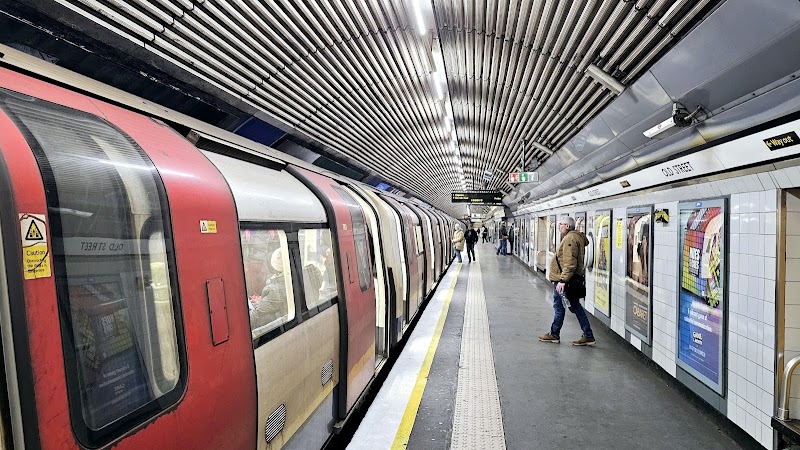
Photo: Google
When did Old Street Station in London first open?
You're standing at the gateway to London's greatest open-air gallery. Old Street Station... a place where ancient history and radical creativity collide right beneath your feet. This street you see stretching out before you is genuinely ancient. It was first recorded as "Ealdestrate" around twelve hundred AD, and as befits its name, there are suggestions this road is of truly ancient origin. How ancient, you ask? It lies on the route of an old Roman, or possibly even pre-Roman track, connecting Silchester and Colchester, skirting round the walls of Londinium. So when you walk these streets today... you're following footsteps that are nearly two thousand years old. The station beneath you opened on the seventeenth of November, nineteen oh one, as part of the City and South London Railway... the first deep-level tube railway in London. Its surface building was later redesigned by architect Stanley Heaps, with legendary consultant Charles Holden. But here's the thing... the station was rebuilt again in nineteen sixty-eight, replacing all the surface buildings with a subsurface complex. That's why there's no grand station entrance above ground. The station literally vanished underground. Now look around you. For most of the twentieth century, Shoreditch was a working industrial neighbourhood. The textile and furniture trades that sustained it for generations collapsed in the nineteen seventies and eighties, leaving behind empty warehouses and derelict factories. Rents fell. Artists moved in. By the early nineteen nineties, the area around Old Street and Brick Lane had become a loose community of studios, squats, and makeshift galleries. And that is when the walls came alive! Graffiti had been present on London's walls since the seventies, carried over from New York. But what developed in Shoreditch in the eighties was something different... less about tagging names, more about image-making, political expression, and the deliberate occupation of public space. Then came Banksy. He frequented a legendary Shoreditch drinking establishment called the foundry, pinched between Great Eastern Street and Old Street. From around two thousand and two, he was incredibly active inside, outside, and all around it. His giant knife-and-fork carrying rat and a television thrown through a window were placed on a wall behind the foundry bar back in two thousand and four. Those pieces were hidden under wooden boards for over a decade... and Hackney Council actually made their preservation a condition of planning permission when developers came knocking. Today, Old Street has become favoured by notable graffiti artists such as Banksy and Jef Aérosol. The district is home to numerous galleries, the Royal Drawing School, and a number of Banksy's most recognisable pieces. On Rivington Street nearby, you can find both "Guard Dog" and "His Master's Voice."
And there's one more twist to this place. The name "Silicon Roundabout" was originally proposed as a tongue-in-cheek joke by Matt Biddulph. A cluster of web businesses developed around this very roundabout in two thousand and eight, as the financial crisis suppressed rents, making the area affordable to tech startups. Art and technology... growing from the same crumbling soil. That is the spirit of Old Street. Now... keep your eyes on every wall, every shutter, every doorway as we walk. The art changes constantly here. What you see today may be painted over by tomorrow. This is a living, breathing canvas... and it's time to explore it.