Cathédrale Notre-Dame de Paris
Why is it significant?
Cathédrale Notre-Dame de Paris is a landmark Gothic cathedral on the Île de la Cité in Paris, constructed over an ancient Roman sanctuary dedicated to Jupiter. Started in 1163 by Bishop Maurice de Sully, construction spanned nearly 200 years. Saved from decay by Victor Hugo’s 1831 novel, architect Eugène Viollet-le-Duc restored it in 1845, adding iconic chimeras. Despite an April 2019 fire that collapsed the spire, its stone vaults survived.
Key Facts
| Place | Cathédrale Notre-Dame de Paris |
|---|---|
| Address | 6 Parvis Notre-Dame - Pl. Jean-Paul II, 75004 Paris, France |
| Geo Coordinates | 48.85298, 2.34990 |
| Audio Duration | ~3 min |
| Part of Walk | Secrets of Notre-Dame and Île de la Cité |
| Generated | Generated |
What to look for?
- Construction of Cathédrale Notre-Dame de Paris began in 1163 under Bishop Maurice de Sully and took nearly 200 years.
- During the French Revolution, anti-clerical mobs severed 28 stone heads of biblical kings from the cathedral facade.
- Architect Eugène Viollet-le-Duc began a major restoration in 1845, adding decorative 19th-century chimeras including Le Stryge.
- An April 2019 fire destroyed the cathedral roof and spire, but its 14th-century statue of Our Lady of Paris survived.
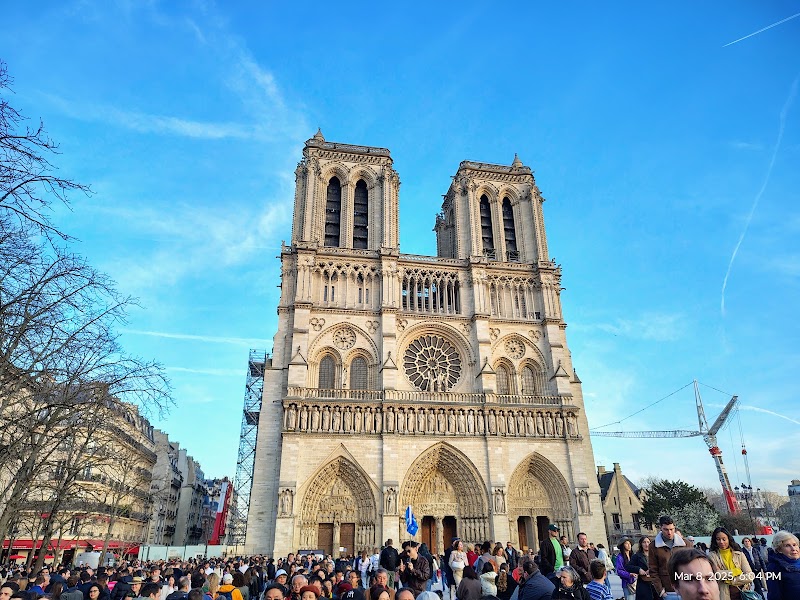
Photo: Google
Who added the famous chimeras to Cathédrale Notre-Dame de Paris in the 19th century?
Standing before the soaring facade of Notre-Dame, you are looking at more than eight centuries of living history resting on an ancient heart. Long before medieval masons laid the first cornerstone in eleven sixty-three, this exact spot on the Ile de la Cite was a Roman sanctuary dedicated to Jupiter. Beneath your feet, layers of worship lie buried, making this island in the Seine sacred ground for over two thousand years. When Bishop Maurice de Sully began construction, he envisioned a Gothic cathedral that would reach toward the heavens. It took nearly two hundred years to complete, meaning generations of stonecutters and glassblowers dedicated their entire lives to a building they would never see finished. Yet, Notre-Dame came dangerously close to disappearing altogether. During the French Revolution, anti-clerical mobs stormed the building, stripping away treasures and pulling down the statues from the facade. Revolutionaries mistakenly believed these sculpted figures represented French monarchs, when they were actually the biblical kings of Judah. They dragged twenty-eight stone heads into the street and severed them. Decades later, the cathedral was so neglected that city officials debated demolishing it completely. What saved it was a novel. In eighteen thirty-one, Victor Hugo published "The Hunchback of Notre-Dame," writing passionately about the crumbling sanctuary to awaken the French public. His story worked. A massive restoration began in eighteen forty-five under the architect Eugene Viollet-le-Duc. Have you ever noticed those stone monsters perched high on the balconies, staring over the rooftops of Paris? Most people assume those monsters are medieval, but almost all of them were invented by Viollet-le-Duc in the nineteenth century. He added these decorative chimeras—including the famous brooding beast known as Le Stryge—to give the building the haunting atmosphere Hugo described. The true medieval carvings are the lower gargoyles, designed simply as water spouts to protect the stone walls from rain. In April twenty nineteen, fire swept through the ancient roof frame known as "The Forest," causing the central spire to collapse. Yet, as the smoke cleared, the stone vaults held, and the fourteenth-century statue of Our Lady of Paris emerged untouched from the ashes. Through revolution, war, decay, and fire, Notre-Dame has continuously risen again, enduring as the eternal beating heart of Paris.