Michael Faraday's Royal Institution
Why is it significant?
The Royal Institution of Great Britain at 21 Albemarle Street in London is where Michael Faraday created the first electric motor in 1821 and the first electric generator in 1831. Founded in 1799 by leading British scientists, the building housed Faraday's home and basement laboratory for decades. Popular 19th-century lectures at the venue turned Albemarle Street into London's first one-way street. The site now contains a free museum with Faraday's original 1850s laboratory.
Key Facts
| Place | Michael Faraday's Royal Institution |
|---|---|
| Address | Royal Institution of Great Britain, 21 Albemarle Street, London W1S 4BS |
| Geo Coordinates | 51.50991, -0.14251 |
| Audio Duration | ~3 min |
| Part of Walk | Steam, Soot & Steel: London's Industrial Revolution |
| Generated | Generated |
What to look for?
- The Royal Institution was founded in 1799 by leading British scientists at 21 Albemarle Street in London.
- Michael Faraday began working at the Royal Institution on March 1, 1813, after submitting 300 pages of lecture notes.
- Faraday invented the first electric motor in 1821 and the first electric generator in August 1831 in the basement laboratory.
- Crowds attending lectures at the Royal Institution caused Albemarle Street to become London's very first one-way street.
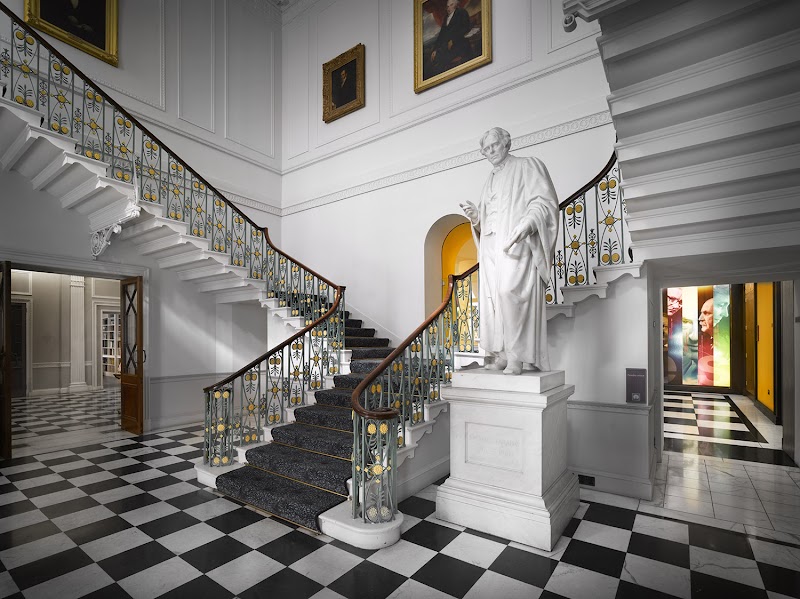
Photo: Google
What electrical inventions were created by Michael Faraday at the Royal Institution?
Look at this elegant building with its row of classical columns — number twenty-one, Albemarl Street. This is the Royal Institution of Great Britain, founded in seventeen ninety-nine by some of the leading British scientists of the age. And behind these grand walls, a blacksmith's son from south London would ignite a revolution... not with fire, but with invisible force. Michael Faraday was a self-educated bookbinder's apprentice when he attended lectures here by the great chemist Humphry Davy in eighteen twelve. What did this young man do? He sent Davy a three-hundred-page book of notes he had taken during those lectures. Davy was so impressed that he hired Faraday as his assistant. On March the first, eighteen thirteen, Faraday began his first day of work at this very building. He would never leave. In eighteen twenty-one, Faraday married Sarah Barnard and the couple settled permanently into rooms right here at the Royal Institution. He literally lived where he worked... for decades. Now here's where it connects to the Industrial Revolution. The lack of natural light in the basement was ideal for working with light beams, and Faraday quietly took it over in the eighteen twenties. Down there, in what had been the servants' quarters... he changed the world. In eighteen twenty-one, using a small mercury bath, he built a device that transformed electrical energy into mechanical energy — the first electric motor. Then, in August eighteen thirty-one, working in that same basement laboratory, he created the first ever electric generator... and the first transformer. Think about that. Every power station, every electrical grid on Earth... traces back to experiments conducted in a basement beneath your feet. His mathematical ability was limited to simple algebra, yet his experiments were so influential that Albert Einstein kept a picture of Faraday on his study wall. And when offered a knighthood? He turned it down on religious grounds, stating that he preferred to remain "plain Mr. Faraday to the end."
Now look at the street itself. Albemarl Street was the first one-way street created for better traffic flow in London — the decision was taken after lectures by Humphry Davy at the Royal Institution caused long traffic jams because of the horrendous queues formed by horse-drawn carriages. Science was SO popular in Victorian London that it literally created gridlock! If you visit the Faraday Museum inside — which is free — the highlight is Faraday's original eighteen-fifties laboratory, not a reconstruction as often cited. Red wax, used to seal the doors for his light experiments, still clings to the dumbwaiter in that old servants' hall. A quiet room in a Mayfair basement... where the age of electricity was born.