Praça do Comércio
Why is it significant?
Praça do Comércio is a monumental plaza on the Tagus River in Lisbon, rebuilt by the Marquis of Pombal after the 1755 earthquake destroyed the former royal palace. The square features quake-resistant yellow arcades and a 14-meter bronze equestrian statue of King José I, cast in a single pour in October 1774 by sculptor Joaquim Machado de Castro.
Key Facts
| Place | Praça do Comércio |
|---|---|
| Address | Praça do Comércio, 1100-148 Lisboa |
| Geo Coordinates | 38.70728, -9.13636 |
| Audio Duration | ~3 min |
| Part of Walk | Lisbon First Timers: Earthquake, Wine & Art Walk |
| Generated | Generated |
What to look for?
- On November 1, 1755, an earthquake, a nine-meter tsunami, and six days of fire destroyed Lisbon's Ribeira Palace.
- The Marquis of Pombal dedicated Praça do Comércio to trade and constructed arcades with internal wooden seismic cages.
- Sculptor Joaquim Machado de Castro created the fourteen-meter bronze statue of King José I in October 1774.
- In 1756, the Marquis of Pombal established the world's first regulated wine region in the Douro Valley.
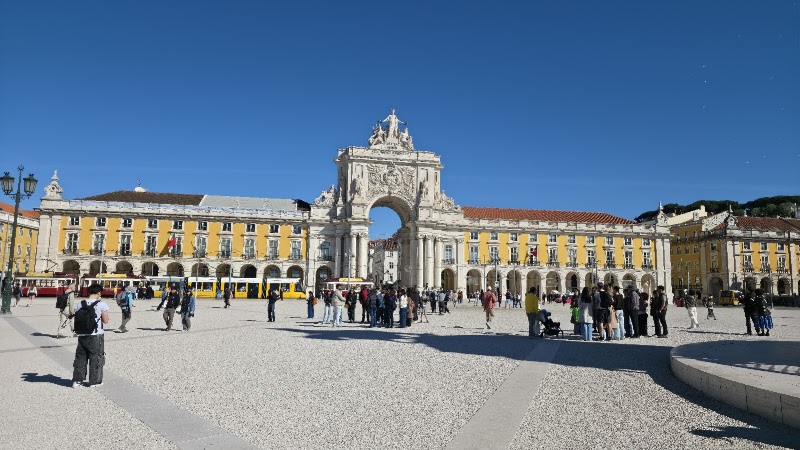
Photo: Google
Who sculpted the equestrian statue of King José I in Lisbon's Praça do Comércio?
Look out across this immense, sun-drenched square opening directly onto the shimmering Tagus River. For anyone arriving in Lisbon, this vast plaza is the ultimate grand entrance. But take a deep breath, because you are standing on ground zero of one of the most transformative disasters in European history. On the morning of All Saints’ Day, November first, seventeen fifty-five, at twenty minutes to ten, the ground beneath this spot began to violently heave. This was once the site of the magnificent Ribeira Palace, home to Portuguese kings for over two centuries. Within minutes, the palace crumbled. Terrified survivors rushed toward the riverbank, only to see the Tagus draw back... and return as a colossal tsunami wave, nine meters high. What the churning river did not wash away, six days of infernal fires consumed. King José the First survived because he was outside the city that morning. Yet the tragedy left him so paralyzed by claustrophobia that he refused to ever live in a stone building again, spending his remaining years inside wooden tents up in the hills. So, who rebuilt this ruined capital? Power fell to his visionary prime minister, the Marquis of Pombal. Pombal made a bold decision: instead of rebuilding the royal palace, he dedicated this ground to trade and the merchant class, naming it Commerce Square. The yellow arcades around you were engineered with internal wooden cages designed to flex and absorb future seismic shocks. At the center stands a masterpiece of Portuguese art: the equestrian statue of King José the First by sculptor Joaquim Machado de Castro. In October seventeen seventy-four, this entire fourteen-meter bronze figure was poured in a single continuous cast of molten metal, a staggering feat for its era. Look at the base: under the horse's hooves, snakes are crushed into submission, symbolizing order triumphing over disaster. Commerce brought trade, and with it came Portugal’s liquid gold: wine. In seventeen fifty-six, Pombal created the world’s very first regulated wine region in the Douro Valley. For centuries, barrels of rich Portuguese wine were unloaded right at the marble steps of Cais das Colunas by the water. Today, that legacy lives on under these arcades, where historic tasting rooms invite you to sip golden Port or crisp Vinho Verde in the majestic heart of Lisbon.