Alexandra Road Estate — Rowley Way
Why is it significant?
The Alexandra Road Estate on Rowley Way in north London is a Grade II* listed modern housing estate designed by architect Neave Brown as an eight-storey concrete ziggurat. Built beside a railway line on shock-absorbing rubber pads, the complex cost over £19 million and took six years to complete. It became the first modern housing estate in Britain to receive Grade II* listed protection.
Key Facts
| Place | Alexandra Road Estate — Rowley Way |
|---|---|
| Address | Rowley Way, Alexandra and Ainsworth Estate, London NW8 0SN |
| Geo Coordinates | 51.54034, -0.18237 |
| Audio Duration | ~4 min |
| Part of Walk | Concrete, Catacombs & Control |
| Generated | Generated |
What to look for?
- Architect Neave Brown designed the eight-storey stepped block of Alexandra Road Estate on rubber pads to absorb railway vibrations.
- Construction of London's Alexandra Road Estate cost over 19 million pounds, more than double its 7.2 million pound budget.
- Resident Elizabeth Knowles led a successful campaign to secure Grade II* heritage listing for the Alexandra Road Estate.
- Architect Neave Brown died in January 2018 at age 88, shortly after receiving the RIBA Royal Gold Medal.
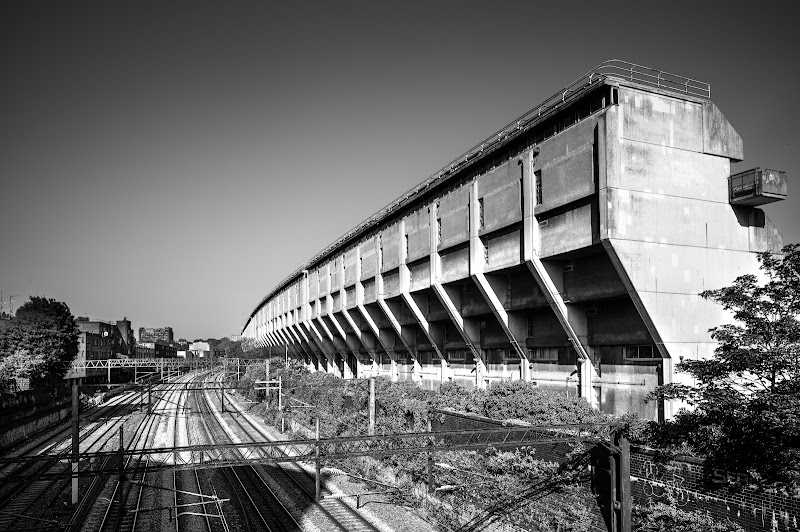
Photo: Google
Why was London's Alexandra Road Estate built on rubber pads?
Look at this place. Really look at it. White unpainted reinforced concrete, rising in jagged steps like some ancient ziggurat dropped into north London. If you feel like you've stumbled into a science fiction film... you're not far off. This estate has been used as a location in "The Professionals," "Kingsman: The Secret Service," "Twenty-eight Days Later," and "Morbius." Television dramas including "London Spy," "Spooks," "Silent Witness," and "Prime Suspect" have all shot scenes on its iconic walkways and balconies. Film crews keep coming back because Rowley Way looks like the future... a slightly unsettling future. But here's the twist. This building was designed as a Utopia. Architect Neave Brown believed that ziggurat-style terraces could provide a better solution than the bleak tower blocks scarring London's skyline. And who was Neave Brown? An American-born British architect, born in nineteen twenty-nine in Utica, New York. Known as "The Yank" at school, he arrived in post-war England and was struck by the devastation... and by the possibility of building something better. He recalled receiving this commission as "the most astonishing brief ever."
The concept was radical. The site sat directly beside the railway line, so Brown designed the eight-storey stepped block to act as a giant noise barrier... built on rubber pads to absorb the vibration of passing trains. Family flats opened onto their own front gardens at ground level, while smaller flats on higher levels each had private balconies open to the sky. Every home... its own front door, its own slice of outdoors. No corridors. No lifts. A piece of city, not a container for people. Then... disaster. The project ultimately cost over nineteen million pounds — more than double the anticipated seven point two million — and took six years instead of the expected three and a half. The ground was soft. One of the biggest Victorian sewers in London ran beneath the site. Inflation spiralled. Steel ran short. The press called it "wildly expensive" and a "disaster"... and Neave Brown never worked as an architect in Britain again. The public inquiry found NO mismanagement on his part. But being the subject of that inquiry destroyed his reputation in the UK, where he never built again. In his own words: "No reasonable client would give an architect a job who had been subject of an inquiry. So it finished me in England. It was literally traumatic."
But the residents? They loved it. Camden's own housing department found these flats "were probably the easiest ever to let." A campaign led by resident Elizabeth Knowles succeeded in getting the estate Grade Two-star listed — making it not only the youngest and largest building ever to be listed, but the first modern housing estate to receive that protection. Heritage Secretary Peter Brooke called it "one of the most distinguished groups of buildings in England since the Second World War."
Neave Brown remains the only architect to have had all of his UK work listed. At seventy-three, he closed his practice, retrained as a fine artist... and died in January twenty-eighteen, at eighty-eight — just months after finally receiving the Royal Gold Medal from RIBA, the industry's highest accolade. So stand here, on Rowley Way, and ask yourself... Is this dystopia, or utopia that was simply too expensive for the world to accept?