Roman Necropolis at Plaça de la Vila de Madrid
Why is it significant?
The Roman Necropolis at Plaça de la Vila de Madrid in Barcelona is an ancient cemetery featuring eighty-five graves along a five-meter-wide burial road preserved below street level. Established outside the walls of Roman Barcino around 15 BC for slaves and freedmen, the site was buried under river sediment in the third century. It remained hidden beneath earth and a Carmelite convent until workers uncovered it in 1956.
Key Facts
| Place | Roman Necropolis at Plaça de la Vila de Madrid |
|---|---|
| Address | Plaça de la Vila de Madrid, Barcelona |
| Geo Coordinates | 41.38442, 2.17213 |
| Audio Duration | ~3 min |
| Part of Walk | Stones & Secrets: Hidden Courtyards of the Barri Gòtic |
| Generated | Generated |
What to look for?
- Roman law prohibited burials inside city walls after Barcino was founded around 15 BC.
- The Roman Necropolis contains eighty-five graves lining a five-meter-wide road that once led to Sarrià.
- Streams from Collserola buried the cemetery in river sediment during the third century, preserving the stone markers.
- Workers discovered the ancient cemetery in 1956 while clearing rubble from a convent destroyed in 1936.
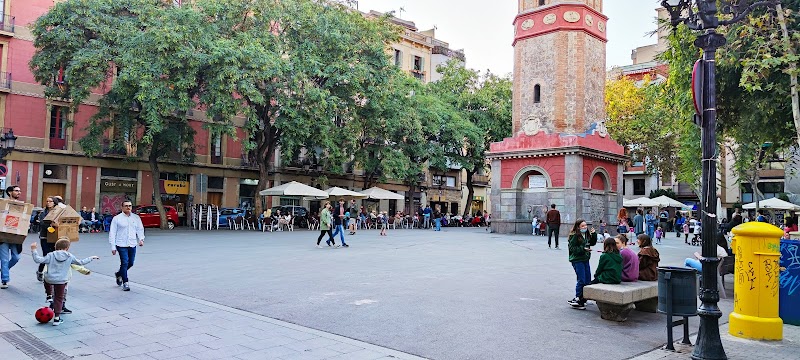
Photo: Google
How was the Roman Necropolis at Plaça de la Vila de Madrid preserved for over sixteen hundred years?
Look at this square. Cafés on one side, boutique shops on the other, children playing nearby. And right here, sunk below street level... eighty-five graves from nearly two thousand years ago. Welcome to the Via Sepulcral Romana, the Roman funeral road of Barcino. Why is there an ancient cemetery sitting in the middle of a city square? The answer begins around fifteen B.C., when the Romans founded a small colony here called Julia Augusta Faventia Paterna Barcino. Roman law was very clear... the dead could not be buried inside the city walls. So cemeteries were placed along the roads leading out of town. This particular road connected Barcino to the outlying district of Sarrià, and on both sides of that five-meter-wide path, the dead were laid to rest. Now look closely at the stone markers. Most of them are Cupae... barrel-shaped funeral monuments, half-cylinders carved from solid rock. These were the graves of ordinary people. Slaves. Freedmen. The working poor. This was a Secondary cemetery, far from the main walls, reserved for those who could not afford a grander resting place. One inscription still reads: "Faustianus, of Tertullina and Tertiola."
Here is something remarkable. Of twenty-eight monolithic Cupae ever found in all of Barcelona, only six were discovered here in their original positions. Everywhere else, the Romans themselves recycled gravestone after gravestone, building them into the city walls during the fourth century expansion. So how did these survive? A lucky accident of nature! After the cemetery fell out of use in the third century, streams flowing down from Collserola buried the entire site under layers of river sediment. The mud preserved everything... for over sixteen hundred years. Then came fifteen eighty-eight, when a Carmelite convent was built right on top. That convent was destroyed during the Spanish Civil War in nineteen thirty-six. And when workers began clearing the rubble in nineteen fifty-six to create this new plaza... they struck ancient stone. The dead of Barcino had been waiting all along, just beneath the surface, protected by centuries of earth and silence.