Monument to the Great Fire of London
Why is it significant?
The Monument to the Great Fire of London is a 202-foot isolated stone column in London, standing exactly as far from where the 1666 blaze began on Pudding Lane as it is tall. Designed by Christopher Wren and Robert Hooke between 1671 and 1677, it doubles as a scientific laboratory where Hooke proved in 1678 that air pressure decreases with altitude. A flaming golden urn tops its 311-step staircase.
Key Facts
| Place | Monument to the Great Fire of London |
|---|---|
| Address | The Monument, Monument Street, London EC3R 8AH |
| Geo Coordinates | 51.51014, -0.08594 |
| Audio Duration | ~3 min |
| Part of Walk | London's Big Kid Adventure |
| Generated | Generated |
What to look for?
- Christopher Wren and Robert Hooke designed the Monument to the Great Fire of London between 1671 and 1677.
- The 202-foot Monument to the Great Fire of London is considered the tallest isolated stone column in the world.
- In 1678, scientist Robert Hooke used a barometer at the Monument to confirm that air pressure decreases with altitude.
- Visitors who climb all 311 spiral steps inside the Monument to the Great Fire of London receive a certificate.
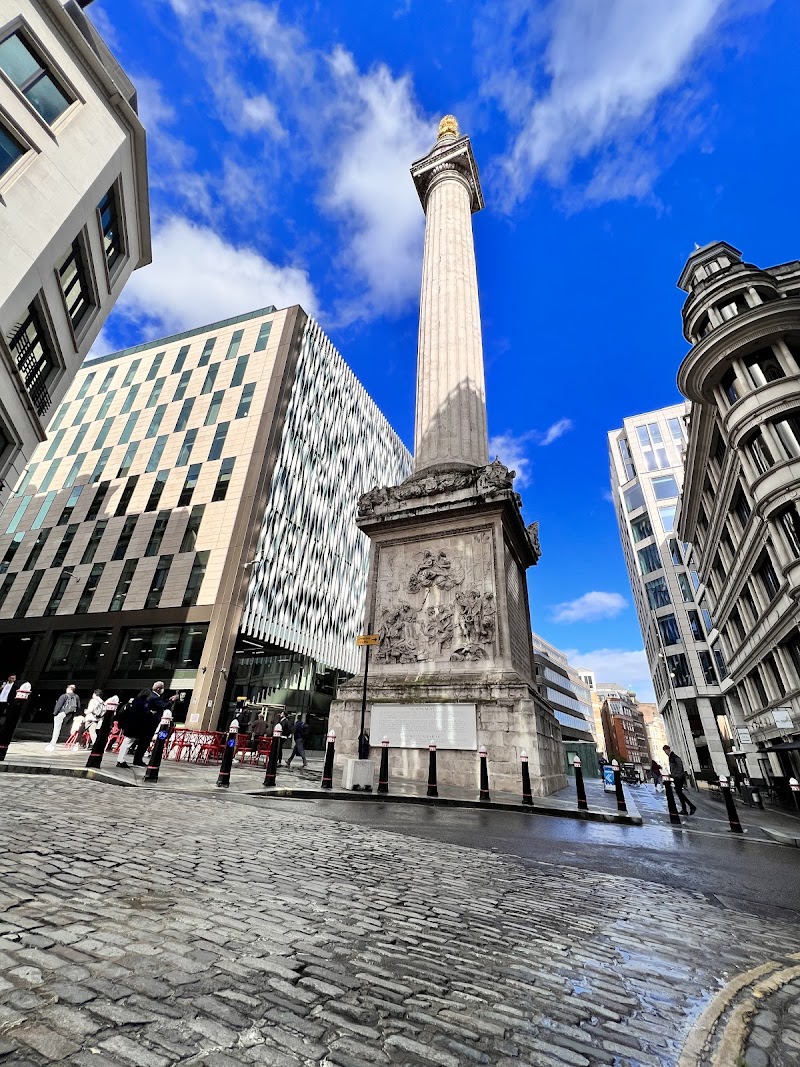
Photo: Google
What scientific experiment did Robert Hooke successfully perform at the Monument to the Great Fire of London in 1678?
Okay, here's a riddle for you. What's two hundred and two feet tall... and if you tipped it over like a giant domino, it would land exactly on the spot where London's biggest-ever fire started? That's right — it's this incredible column right in front of us... the monument to the Great Fire of London! The fire began in a baker's house on Pudding Lane on Sunday the second of September, sixteen sixty-six, and wasn't put out until Wednesday the fifth. And can you guess what "Pudding" Lane was named after? Not dessert! Pudding Lane actually refers to blood sausage that was made in the area. Gross, right? Now picture this. That fire destroyed over thirteen thousand tightly packed wooden houses, eighty-seven churches, and even Saint Paul's Cathedral. Remarkably, fewer than ten people were recorded to have died, but the four-day-long blaze made around one hundred thousand people homeless. Almost the entire city... gone. So after all that destruction, they decided to build this column to remember what happened. It was constructed between sixteen seventy-one and sixteen seventy-seven, and it's considered to be the tallest isolated stone column in the World. It was designed by Robert Hooke together with his friend Christopher Wren. But here's the part most people don't know. This column has a secret. The monument was built with a second purpose — to be the site for scientific experiments. Hidden beneath it is a tiny laboratory where the column was once used as a giant telescope! That's right — Hooke built this telescope-monument to try to prove that the Earth orbits the Sun. He was looking for observational evidence of Copernicus's theory! The whole column is hollow, and scientists would peer up through it at the stars from an underground room. How cool is that — a monument that Doubles as a space telescope! Sadly, vibrations from heavy traffic on Fish Street Hill made the experimental conditions unsuitable. Too many horses and carts rumbling past! But Hooke didn't give up. In sixteen seventy-eight, he finally conducted a successful experiment at the monument, using a barometer to confirm that air pressure decreases with altitude. One more thing before you start climbing. Wren originally wanted a statue of a phoenix with outstretched wings on top — a bird rising from the ashes. King Charles the Second wanted a simple copper ball with flames. But it was actually Hooke's idea for the flaming golden urn that won out. And that's what you'll see glowing up there at the very top. Now... three hundred and eleven spiral steps are waiting for you. And here's the best part — everyone who makes the climb is awarded a certificate to mark the occasion. So you'll have proof that you conquered the tallest stone column in the world. Ready? Let's go!