Campo de' Fiori — The Field of Flames
Why is it significant?
Campo de' Fiori in Rome is a historic public square where philosopher Giordano Bruno was burned at the stake for heresy on February 17, 1600. In 1889, a bronze statue of Bruno was dedicated at the execution site, positioned to face the Vatican in silent defiance. Nearby stands the former Taverna della Vacca, once owned by Vannozza dei Cattanei, mistress of Pope Alexander VI.
Key Facts
| Place | Campo de' Fiori — The Field of Flames |
|---|---|
| Address | Campo de' Fiori, Rome |
| Geo Coordinates | 41.89541, 12.47220 |
| Audio Duration | ~4 min |
| Part of Walk | Blood & Shadows: Rome's Dark History |
| Generated | Generated |
What to look for?
- Giordano Bruno was burned at the stake in Campo de' Fiori on February 17, 1600, following seven years of imprisonment.
- The bronze statue honoring Giordano Bruno was unveiled in Campo de' Fiori on June 9, 1889.
- Writers Victor Hugo and Henrik Ibsen helped conceive the monument to Giordano Bruno in 1885.
- Vannozza dei Cattanei, mistress of Pope Alexander VI, owned the Taverna della Vacca near Campo de' Fiori.
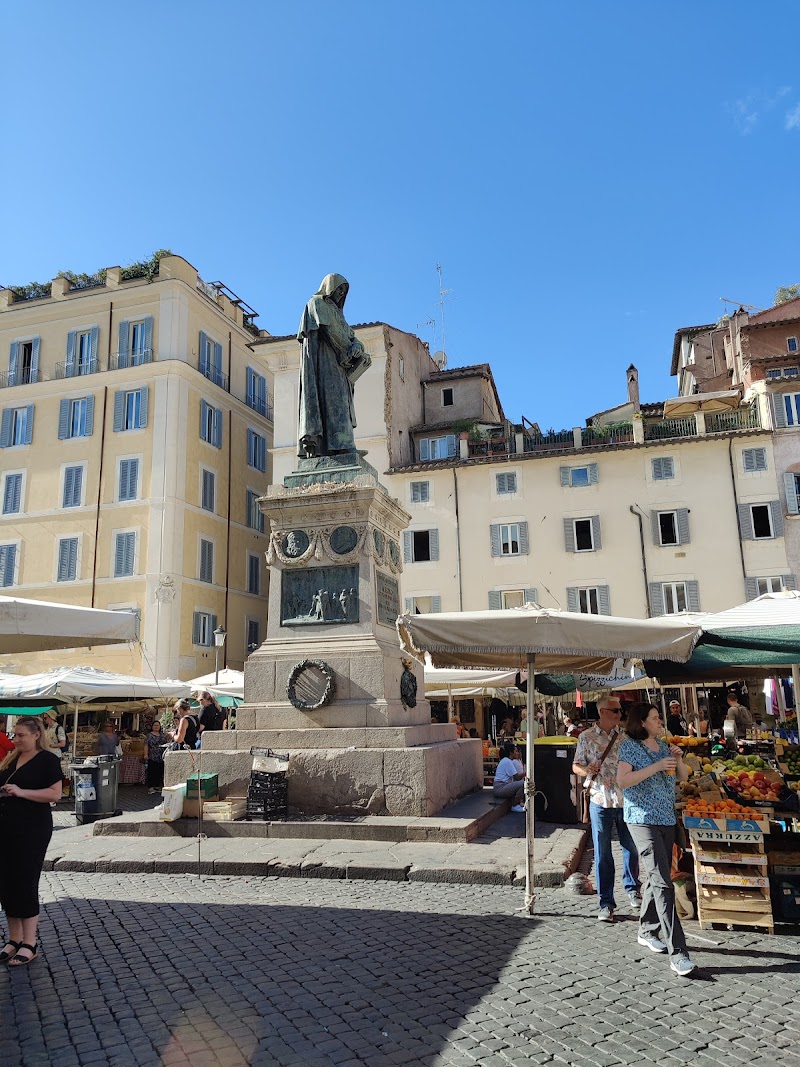
Photo: Google
Why is there a statue of Giordano Bruno in Campo de' Fiori in Rome?
Look around you. Campo de' Fiori... the Field of flowers. Sounds lovely, doesn't it? Peaceful, even. But don't let the name fool you. This was where the pyres of the Roman Inquisition burned Brightest in the sixteenth and seventeenth centuries, where free-thinkers of all kinds would meet their fiery ends. See that dark, hooded figure in the center of the square? That's Giordano Bruno... philosopher, poet, former Dominican friar. And the man who may have been four hundred years ahead of his time. He proposed that the stars were distant suns surrounded by their own planets, and he raised the possibility that these planets might foster life of their own. He insisted that the universe is infinite and could have no centre. In fifteen ninety-nine, that wasn't science. That was a death sentence. And here is where it gets truly dark. In fifteen ninety-two, Bruno was denounced to the Inquisition. He spent the next seven years in confinement, much of it in the infamous prison of Tor di Nona. Seven years of interrogation. Seven years of pressure to take it all back. He refused. Every. Single. Time. When he received his death sentence, Bruno told his inquisitors in a menacing tone: "You may be more afraid to bring that sentence against me than I am to accept it."
On February seventeenth, sixteen hundred... in the early morning light, on the day after Ash Wednesday, Bruno rode into this very square on a mule. Stripped naked and gagged with a leather bridle to prevent him from shouting out heresies. Tied to the stake, Bruno turned his head away in anger when a crucifix was held up to his face. His ashes were thrown into the Tiber river. But here's what the Inquisition didn't count on. They couldn't burn his ideas. In eighteen eighty-five, a group of international writers and academics, including Victor Hugo and Henrik Ibsen, conceived the idea of honoring Bruno right here... at the exact site of his execution. The statue was unveiled on the ninth of June, eighteen eighty-nine, surrounded by about one hundred Masonic flags — a deliberate provocation to the Vatican. The inscription on the base reads: "To Bruno... the century predicted by him... here where the fire burned."
And notice where he's looking. Bruno's bronze figure has stood facing the Vatican since the date of its dedication. A silent, eternal act of defiance. And while the Vatican has issued apologies for its persecution of Galileo... to this day they have refused to remove Bruno's label of heretic. Now, one more secret about this square before you go. See the southwest corner, the beginning of Via de' Cappellari? The building there was once the Taverna della Vacca... the Cow's Inn. It belonged to Vannozza dei Cattanei, the most famous lover of Pope Alexander the Sixth Borgia, mother of his four children — Lucrezia, Cesare, Giovanni, and Goffredo. Sex, power, and poison... steps away from where they burned a man alive for thinking. Every year, on the anniversary of his execution, freethinkers — Masons, atheists, pantheists — gather at this monument, and a representative of Rome's mayoralty places a wreath at its feet. Four centuries later... the fire is still burning.