Oxford Castle & St George's Tower
Why is it significant?
St George's Tower at Oxford Castle in Oxford is the city's oldest standing building, dating to around 1020 AD as a Saxon watchtower. Expanded by Norman baron Robert D'Oyly, the site saw Geoffrey of Monmouth write the King Arthur legends around 1136. In December 1142, Empress Matilda famously escaped a siege at the castle disguised in white against the snow.
Key Facts
| Place | Oxford Castle & St George's Tower |
|---|---|
| Address | Oxford Castle Unlocked, 44-46 Oxford Castle, Oxford OX1 1AY |
| Geo Coordinates | 51.75161, -1.26341 |
| Audio Duration | ~4 min |
| Part of Walk | Oxford's Best-Kept Secrets |
| Generated | Generated |
What to look for?
- St George's Tower at Oxford Castle was constructed around 1020 AD, making it Oxford's oldest standing structure.
- Geoffrey of Monmouth wrote the Historia Regum Britanniae at Oxford Castle around 1136, popularizing the King Arthur legend.
- Empress Matilda escaped a siege at Oxford Castle in December 1142 by disguising herself in white against snow.
- In 1650, servant Anne Green survived her execution by hanging at Oxford Castle and received a full pardon.
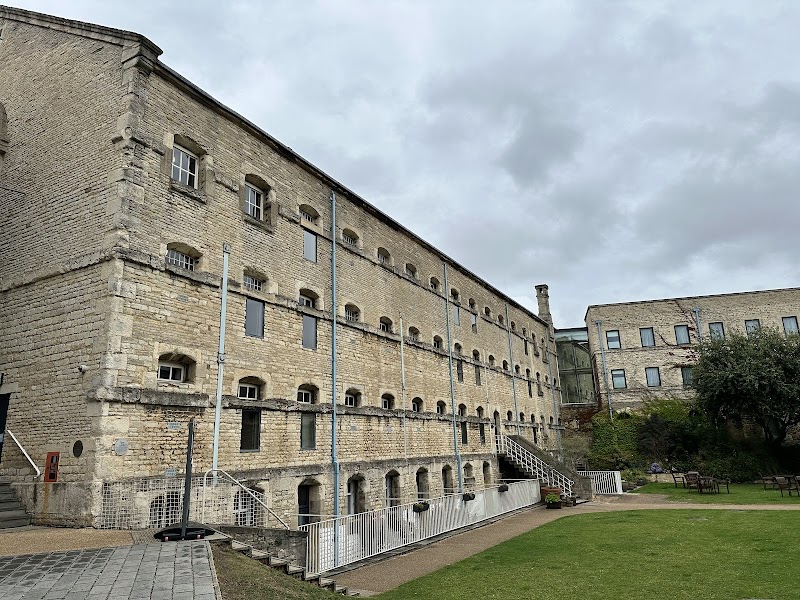
Photo: Google
How did Empress Matilda escape from Oxford Castle in 1142?
Look at this tower. Rough, weathered stone... tapering upward like a clenched fist against the sky. This is Saint George's Tower, and it is now believed to be a survival from late Saxon times, dating to around ten twenty A.D. — a watchtower associated with the west gate of the Saxon city. That makes it the oldest standing building in all of Oxford... and it was already ancient when the Normans arrived. The castle around it was built by a Norman baron named Robert D'Oyly, who arrived with William the Conqueror and was granted vast lands in Oxfordshire. But here's what most people walk right past without knowing. Geoffrey of Monmouth was a serving canon in Saint George's Chapel on this very site, and he would have been based here when he wrote his famous Latin chronicle around eleven thirty-six. That chronicle? It was the Historia Regum Britanniae... the book that gave the world King Arthur and Merlin. The legends we all know were born right here, in the shadow of this tower. But the most extraordinary story happened on a freezing December night in eleven forty-two. After nearly three months of siege, conditions for the garrison were dire. Empress Matilda — daughter of King Henry the First, fighting her cousin King Stephen for the English crown — was trapped inside these walls, starving. One early December evening, she crept out of a postern door in the wall — or, more romantically, possibly shinned down on a rope out of Saint George's Tower — dressed in white as camouflage against the snow. She slipped right through Stephen's watch fires... crossed the frozen River Thames... and vanished into the night. The castle surrendered the day after Matilda's escape. But it didn't matter. She was free. Years later, they signed the Treaty of Wallingford — Stephen could keep his throne, but Matilda's son would be next. Stephen died a year later, and that boy became King Henry the Second, founder of the Plantagenet dynasty. Every English monarch since — down to King Charles the Third — descends from the woman who escaped this tower. Now, fast forward five centuries. This place had become a brutal prison. In sixteen fifty, a young servant named Anne green was found guilty of murder and hanged at Oxford Castle. At her own request, friends pulled her swinging body, and a soldier struck her four or five times with the butt of his musket. After half an hour, she was pronounced dead. Her body was given to university physicians William petty and Thomas Willis for dissection. But when they opened the coffin... they discovered she had a faint pulse and was weakly breathing. Anne green was alive. They revived her. The authorities pardoned her, believing the hand of God had saved her. She took the coffin away with her as a souvenir... married, and had three children. A thousand years of stories, pressed into these stones. Saxon watchmen, a fugitive empress, a woman who cheated death itself. Not bad for a building most visitors to Oxford never even notice.