Palace of Holyroodhouse
Why is it significant?
The Palace of Holyroodhouse in Edinburgh is the official Scottish residence of the British monarch, famous as the site where Mary, Queen of Scots’ secretary was murdered in 1566. Founded as an Augustinian abbey by King David I in 1128 at the end of the Royal Mile, it expanded into a royal palace. In 1566, eighty conspirators stabbed private secretary David Rizzio 57 times inside the queen's supper chamber.
Key Facts
| Place | Palace of Holyroodhouse |
|---|---|
| Address | Palace of Holyroodhouse, Canongate, Edinburgh |
| Geo Coordinates | 55.95271, -3.17227 |
| Audio Duration | ~4 min |
| Part of Walk | Voices of the Old Town |
| Generated | Generated |
What to look for?
- King David I founded Holyrood Abbey at the Palace of Holyroodhouse site in 1128.
- On March 9, 1566, Lord Darnley and 80 conspirators confronted David Rizzio at the palace.
- David Rizzio suffered 57 dagger wounds during the political coup at the Palace of Holyroodhouse.
- After escaping Holyroodhouse, Mary, Queen of Scots reclaimed Edinburgh supported by 4,000 soldiers.
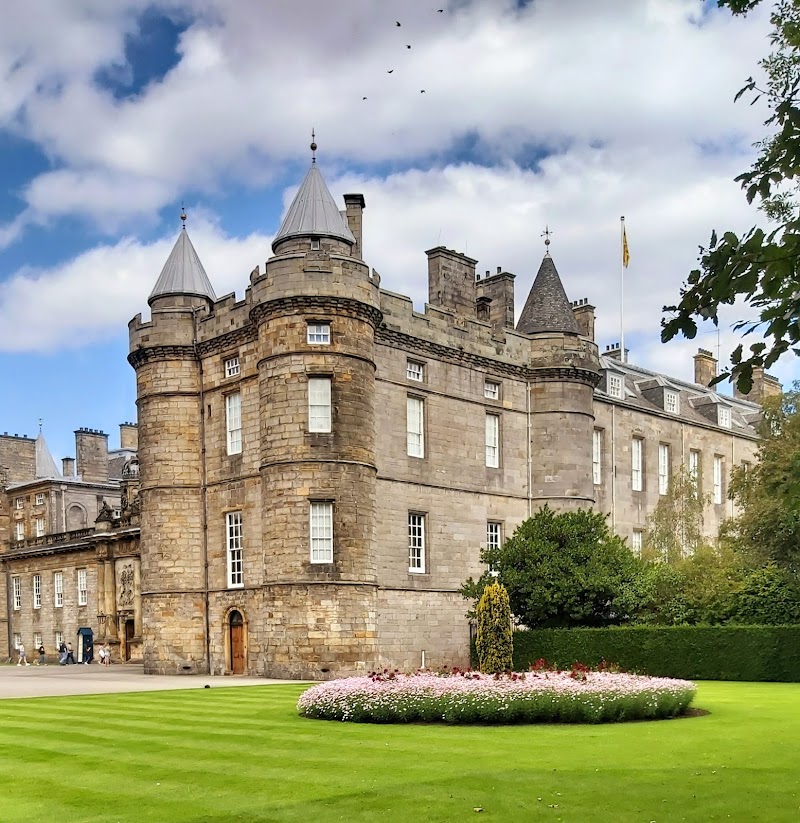
Photo: Google
Who was murdered at the Palace of Holyroodhouse on March 9, 1566?
Look at this magnificent palace before you... the Palace of Holyroodhouse. It's the official residence of the monarch of the United Kingdom in Scotland, and it sits here at the bottom of the Royal Mile like a full stop at the end of a dramatic sentence that begins up at Edinburgh Castle. But this place didn't start as a palace at all. It began as an Augustinian abbey, founded in eleven twenty-eight by King David the First, who — legend has it — saw a vision of a great stag with a shining cross between its horns. The name itself, "Holy Rood," simply means "Holy Cross." As Edinburgh grew into Scotland's capital, kings preferred living down here, surrounded by parkland, rather than up in the bleak castle, exposed to the elements on its rock. Now... the story everyone wants to hear. Look up at that northwest tower — the oldest surviving part of the palace. Those are the chambers of Mary, Queen of Scots, and when you climb those steps, you enter a world of intrigue, tragedy, and murder. It was a Saturday evening, the ninth of March, fifteen sixty-six. Mary was six months pregnant with the child who would become King James the Sixth. She was dining in a tiny supper room, just off her bedchamber, with her private secretary, David Rizzio — an Italian musician from Turin who had first come to Scotland as part of a diplomatic mission from Savoy in fifteen sixty-one, and who caught Mary's attention, rising from court musician to her most trusted confidant. Then, at eight o'clock... the door burst open. Lord Darnley — Mary's own husband — and a group of around eighty conspirators made their way through the palace to the Queen's supper chamber. The rebels, led by Lord Ruthven and George Douglas, demanded that Rizzio be handed over. The Queen refused. Rizzio hid behind Mary, clinging to her. One of the intruders pointed a gun at her pregnant belly, while another threatened to stab her. But they dragged him away regardless. His body took fifty-seven dagger wounds. Darnley refused to stab Rizzio himself, but his dagger was left in the body to ensure his complicity could never be denied. Here's what most people don't know. The whole plot wasn't really about jealousy at all. A group of lords facing treason charges manipulated Darnley's insecurities, convincing him he was being cuckolded — which he almost certainly was not. It was a political coup... disguised as a crime of passion. But Mary was no helpless victim. She managed to see Darnley alone, and beguiled him with soothing words, persuading the very man who betrayed her to help her escape. Under cover of darkness, they rode to Dunbar Castle, where the Earl of Bothwell was waiting with an army of four thousand men. Within days, Mary marched back into Edinburgh with her troops, and her enemies fled to England. And Rizzio? He was first buried in the cemetery of Holyrood Abbey, and then — on the Queen's orders — his body was moved into the tomb of the kings of Scotland. An extraordinary honor for an Italian musician... and a defiant act by a queen who would not be broken. Visitors to the palace can still see the chamber where it happened, and to this day, red stains mark the floor where Rizzio fell. Whether those stains are truly his blood... well, that's a question the palace leaves for you to decide.