Sultanahmet Hippodrome (At Meydanı)
Why is it significant?
The Hippodrome of Constantinople in Istanbul was the vast sporting center of the Eastern Roman Empire where Emperor Justinian's forces suppressed the 532 AD Nika Riots by slaughtering 30,000 spectators. First built around 203 AD by Septimius Severus and expanded by Constantine the Great, the 450-meter-long arena features ancient monuments such as the 1479 BC Obelisk of Theodosius and the fifth-century BC bronze Serpent Column.
Key Facts
| Place | Sultanahmet Hippodrome (At Meydanı) |
|---|---|
| Address | Sultan Ahmet Meydanı, Sultanahmet |
| Geo Coordinates | 41.00633, 28.97571 |
| Audio Duration | ~4 min |
| Part of Walk | Spice, Stone & Sultans |
| Generated | Generated |
What to look for?
- Roman emperor Septimius Severus first constructed the Hippodrome of Constantinople around 203 AD before Constantine expanded it.
- The Hippodrome of Constantinople featured a track measuring 450 meters long and 130 meters wide for chariot racing.
- Pharaoh Thutmose the Third erected the Hippodrome's Egyptian obelisk around 1479 BC at the temple of Karnak.
- Constantine brought the bronze Serpent Column, commemorating the 479 BC Battle of Plataea, to the Hippodrome in 324 AD.
- General Belisarius crushed the Nika Riots in January 532 AD, resulting in 30,000 deaths at the Hippodrome.
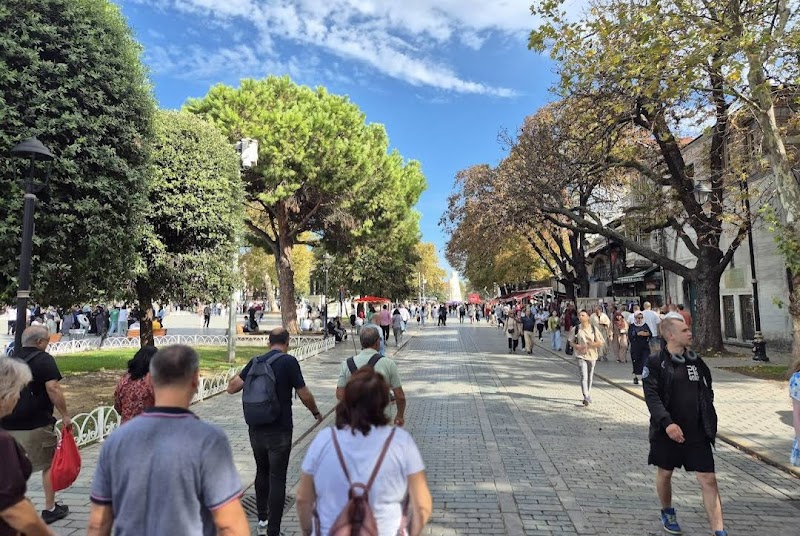
Photo: Google
How many people died during the Nika Riots at the Hippodrome of Constantinople?
You are standing on one of the most extraordinary pieces of ground in the world. Beneath your feet... about two meters down... lies the original racing surface of the hippodrome of Constantinople. This was not just a stadium. It was the sporting and social center of the entire Eastern Roman Empire. The Roman emperor Septimius Severus first built a hippodrome here around the year two hundred and three. But it was Constantine the Great who, in preparation for making this city his new capital, commissioned an expansion and linked it to an imperial palace, making the hippodrome central to every ceremony. When finished, the track was about four hundred and fifty meters long, one hundred and thirty meters wide, and could hold forty to fifty thousand screaming spectators. Now look at that tall pink granite column. That is the Obelisk of Theodosius... and it is staggeringly old. Pharaoh Thutmose the Third first erected it around fourteen seventy nine B.C. at the great temple of Karnak in Egypt. It was built to commemorate a successful military campaign in Syria. Emperor Constantius the Second had already removed it from Egypt and left it abandoned on the banks of the Nile. It lay there for decades... until Theodosius the First finally had it shipped to Constantinople and raised on this very spot in three ninety A.D. And here is a detail most people miss. Look closely at the marble base. The name Proculus on the Latin inscription was once chiseled off... because the man fell out of favor and was executed. But four years later his reputation was restored, and his name was re-carved back into the stone! Now, that twisted bronze stump nearby? That is the Serpent Column. It was originally built to celebrate the Greek victory over the Persian Empire at the Battle of Plataea in four seventy nine B.C. Constantine himself had it brought from Delphi in three twenty four. Imagine... three intertwined bronze serpents, with three open-jawed heads supporting a golden tripod! The Byzantines believed it was a talisman. The Ottoman writer Evliya Çelebi described it as protecting the city from snakes, scorpions, and other vermin. Then, on the night of October twentieth, seventeen hundred... the heads vanished. A French traveler reported that the Polish ambassador's entourage, lodged in the nearby Palace of Ibrahim Pasha, included a drunken nobleman who may have hacked them off. But an Ottoman source claims all three heads simply fell to the ground on their own, with a noise like a powerful man chopping down trees. The truth? Nobody knows for certain. And this ground witnessed the deadliest sports riot in history. In January five thirty two, the Blues and the Greens... rival chariot racing factions that were really political Gangs... united under a single chant: Nika! Victory! That word, once shouted to urge on charioteers, was now directed against Emperor Justinian himself. For five days, Constantinople burned. Justinian prepared to flee... until he ordered his general Belisarius to attack the rioters, resulting in the slaughter of around thirty thousand people... right here, in this very arena. Because the city was so extensively damaged by fire, Justinian was able to rebuild, giving us Hagia Sofia as it stands today. So pause for a moment. You are surrounded by three thousand five hundred years of layered history. An Egyptian obelisk. A Greek war trophy. A Roman arena. A Byzantine massacre. And Ottoman legends. All in one square.