The Lonely Palm Tree
Why is it significant?
The Lonely Palm Tree is a 15-meter-tall artificial palm tree on a roundabout on Warsaw's Jerusalem Avenue, installed on December 12, 2002, by artist Joanna Rajkowska to recall the area's forgotten 18th-century Jewish history. Constructed with steel and real date palm bark, the installation ignited public controversy, survived removal threats by President Lech Kaczyński, and received symbolic Polish citizenship in 2020.
Key Facts
| Place | The Lonely Palm Tree |
|---|---|
| Address | Rondo Charles'a de Gaulle'a, Warszawa |
| Geo Coordinates | 52.23198, 21.02101 |
| Audio Duration | ~4 min |
| Part of Walk | Warsaw Untold: From Royal Stones to Hidden Courtyards |
| Generated | Generated |
What to look for?
- Polish artist Joanna Rajkowska erected the 15-meter-tall Lonely Palm Tree in Warsaw on December 12, 2002.
- The Warsaw installation references Aleje Jerozolimskie, named after an 18th-century Jewish settlement that lasted just two years.
- Warsaw President Lech Kaczyński attempted to remove the sculpture, prompting activists to form a Palm Protection Committee.
- In 2019, Rajkowska temporarily replaced the fronds of The Lonely Palm Tree with withered leaves to address climate change.
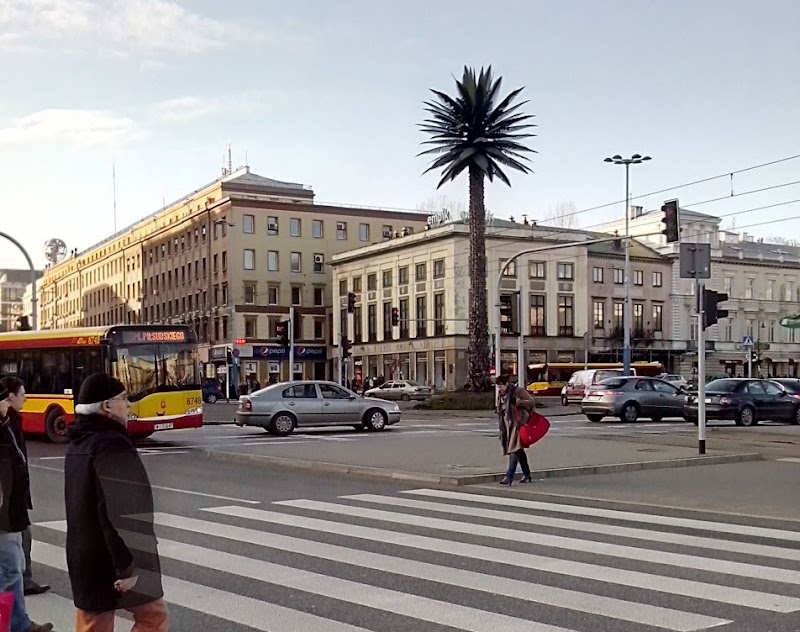
Photo: Google
Why was The Lonely Palm Tree built on Jerusalem Avenue in Warsaw?
Look at this roundabout. Cars swirling past, trams clattering through... and right there in the middle, fifteen meters tall... a palm tree. An obviously, deliberately fake palm tree, standing in the heart of Warsaw like it owns the place. But why on earth would someone plant a plastic palm in Central Europe? The answer begins in two thousand one, when Polish artist Joanna Rajkowska traveled to Israel during the Second Intifada with fellow artist Artur Żmijewski. She witnessed explosions, heard helicopters over Bethlehem... and returned to Warsaw carrying, in her words, "an omnipresent sense of fear and powerlessness." Back home, she began researching the street you're standing beside... Aleje Jerozolimskie, Jerusalem Avenue. And she discovered something most Warsovians had forgotten. The street was named after an eighteenth-century Jewish settlement called New Jerusalem, established at what is now plac Zawiszy. That settlement thrived... but only for two years, before it was dismantled by Christian merchants jealous of its prosperity. Rajkowska asked herself a haunting question: what would it be like if Jerusalem Avenue was suddenly lined with palms... like the real Jerusalem? She couldn't afford a whole row. So she built one. It was erected on December twelfth, two thousand two... right here, on the spot where Warsaw traditionally placed its Christmas tree. And the reaction? It was explosive. The palm divided the entire city. Rajkowska herself recalled hearing about a family in Kielce that couldn't finish their Christmas dinner because of an argument about it! Taxi drivers on this very roundabout hated her... they were, she said, "completely embarrassed by the misfit." The traffic police stationed here even earned the nickname "Miami Vice."
Then it got political. Lech kaczyński, as president of Warsaw, publicly vowed to remove it once the permit expired. A Palm Protection Committee was formed to save her... because yes, in Polish, the palm tree is a she. Her creator always described her as "a cheeky girl... who appears out of the blue, stamps her feet, demands attention."
And here's the strangest detail. Despite being entirely artificial... birds have actually nested in her crown. The steel trunk is wrapped in real date palm bark, so convincing that nature itself was fooled. In twenty nineteen, Rajkowska replaced the green fronds with real, withered, dying leaves overnight... and Warsaw woke up Baffled. People were outraged that the city had let their beloved tree die... forgetting, for a moment, that she was never alive to begin with. It was, of course, a statement about climate change. And to celebrate her eighteenth birthday in twenty twenty, the Palm Protection Committee arranged for her to receive symbolic Polish citizenship... as a she-person, naturally. She's still here. Still fake. Still impossible. And still the most iconic piece of public art in Poland since nineteen eighty-nine.