Oxford for Students, by Students
The real Oxford — essay deadlines, secret pubs, legendary spots and life between lectures
Oxford · 10 stops · 2.9 km · ~1.0 h · 20 min audio · Generated
-
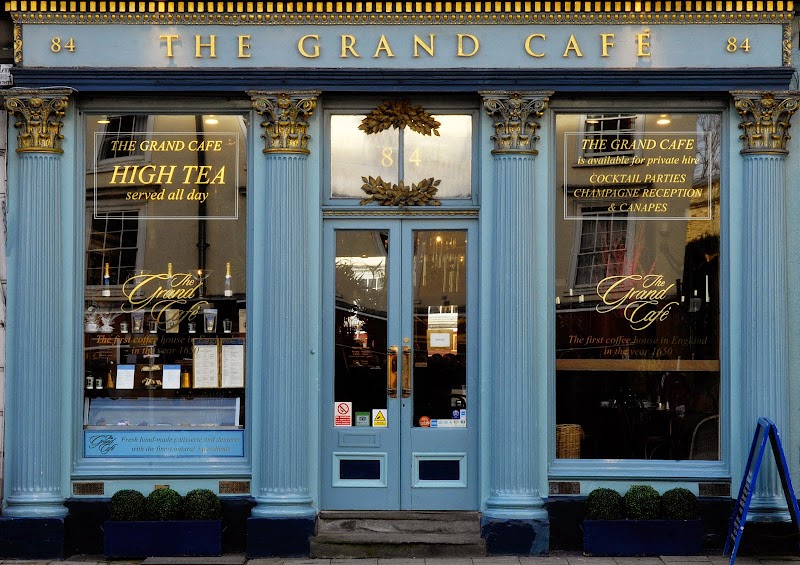
1. The Grand Café — England's First Coffee House
The Grand Café, 84 High Street, Oxford
Photo: Google
Alright, so you're standing at eighty-four High Street, staring at marble pillars and gold leaf, probably thinking... overpriced lattes, right? But this spot? This spot is where England's entire coffee culture began.
We're talking sixteen fifty. A Jewish immigrant from Lebanon, known to history only as "Jacob the Jew," opened the very first coffeehouse in England right here... at what was then a coaching inn called the Angel. Think about that. This was during the Commonwealth, when the Puritan government had basically banned the sale of alcohol. People needed something to drink. And Jacob had the answer.
The coffeehouses offered an alternative to the rigid world of academic lectures, while still attracting Oxford's greatest minds. And here's the wild part... admission cost just one penny. One penny got you in the door, a cup of coffee, and access to newspapers. That's why they earned the nickname "penny universities." Students, dons, travellers, locals... all arguing about science and politics over the same dark, bitter brew.
The antiquarian Anthony Wood, who actually lived just down the road near Merton College, recorded that physicians, sons of bishops, and university students all gathered at Oxford's coffeehouses... including a young Christopher Wren, while he was studying Latin and physics. Yeah... the guy who designed Saint Paul's Cathedral was basically a coffeehouse regular. Just like you.
The coffeehouses became so associated with equality and free-thinking republicanism that King Charles the Second actually considered banning them in sixteen seventy-five... but backed down after massive public outcry. Coffee was literally too dangerous for the monarchy.
Now here's the plot twist. This site actually goes back even further than Jacob. The earliest record of a building here was penned in thirteen ninety-one, when it was an inn called the Tabord, leased by Saint John's Hospital. By fifteen ten, it had been expanded and renamed the Angel, becoming Oxford's most important coaching inn. During the eighteenth century, ten coaches left from here headed for London each day. The horses were grazed in the meadow next to Magdalen College... which is why it's still called Angel Meadow.
And after Jacob left? This address bounced through identities like a student switching majors. It became a marmalade shop, then a Twinings grocer, then an ironmonger, a CO-OP, a Post Office, a teddy bear shop... until finally, in nineteen ninety-seven, the Grand Café opened and brought things full circle.
So next time you're nursing a flat white here at two in the morning before a tutorial... just know that you're part of a tradition that is nearly four hundred years old. Jacob would approve.
-
2. Vaults & Garden Café — Study Inside a Church
Vaults and Garden Café, University Church of St Mary the Virgin, Radcliffe Square, Oxford
-
3. The Bear Inn — Oldest Pub, Weirdest Ceiling
The Bear Inn, 6 Alfred Street, Oxford
-
4. The Covered Market — Student Snack HQ Since 1774
Oxford Covered Market, Market Street, Oxford
-
5. The Turf Tavern — Hidden Down a Medieval Alley
Turf Tavern, 4 Bath Place, Oxford
-
6. Blackwell's Bookshop — 125,000 Books and a Secret Basement
Blackwell's Bookshop, 48-51 Broad Street, Oxford
-
7. Najar's Place — The Falafel Queue Worth Joining
Najar's Place, St Giles', Oxford
-
8. Thirsty Meeples — Oxford's Only Board Game Café
Thirsty Meeples, 37 Gloucester Green, Oxford
-
9. Common Ground — The Students' Living Room
Common Ground, 37-38 Little Clarendon Street, Oxford
-
10. FREUD — A Bar Inside a 19th-Century Church
Freud Bar, 119 Walton Street, Oxford