London's Best-Kept Secrets
From hidden alleys to founding fathers — central London as you've never heard it
London · 13 stops · 2.4 km · ~1.4 h · 48 min audio · Generated
-
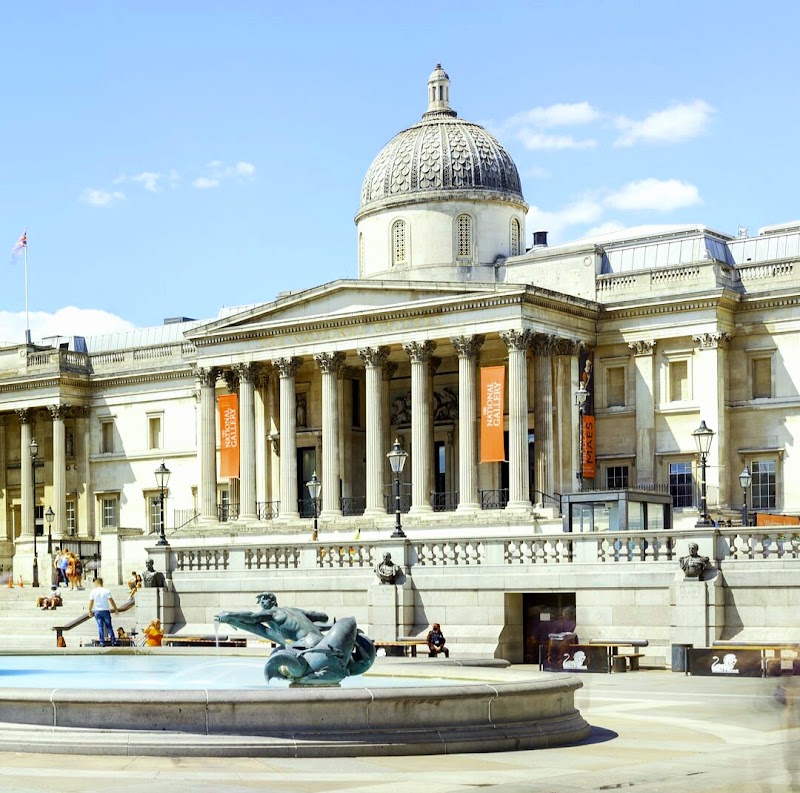
1. Trafalgar Square's Tiniest Police Station
Trafalgar Square, south-east corner lamppost, London WC2N 5DN
Photo: Google
Now take a look at that ornate round pillar right here, at the south-east corner of Trafalgar Square. It looks like an ordinary lamppost, doesn't it? Just a granite column topped with an elegant lantern. But step closer... and peer through those narrow slits carved into the stone. You're looking at Britain's smallest police station.
This structure started life as a gas lamp back in eighteen twenty-six. But a century later, it took on a very different purpose. During the General Strike of nineteen twenty-six, the authorities decided they needed a permanent way to keep a close eye on the striking workers who were gathering in Trafalgar Square. The plan to build an obvious police box was met with howls of public indignation, and it was officially shelved.
But the police weren't about to give up. In nineteen twenty-seven, the head of the Office of Works came up with a brilliant idea... hollow out the base of this very lamppost plinth so that a single officer could keep watch over the entire square. And that's exactly what they did! Slits were ingeniously cut into the sides to provide three hundred and sixty degree vision, and a direct telephone line connected it to Scotland Yard.
Now, imagine being that lone bobby, squeezed into this stone tube while an angry crowd of thousands swirled around you. When the officer lifted the telephone receiver, the ornamental light on top would flash, alerting nearby constables that something was amiss. Think about that for a moment... you're hiding inside a lamppost, spying on a crowd, and the second you call for help, a great big light starts flashing above your head. Not exactly the stealthiest design, is it?
There's a popular legend that the ornamental lamp on top came from Admiral Nelson's flagship, HMS victory. A wonderful story... but it's actually a Bude light, designed by Sir Goldsworthy Gurney, who also replaced two hundred and eighty candles in the House of Commons with just three of his revolutionary lights... a technology so successful it illuminated that chamber for sixty years.
Now, here's a detail that true London insiders know. This was never officially a police station. Some call it a police box, but technically, it was always an observation post. It served that purpose right up through the nineteen seventies, when radio communications finally made it unnecessary.
And today? This once-secret nerve center of law enforcement is used as a broom cupboard by Westminster Council cleaners. From covert surveillance... to storing mops. That, my friends, is the most London ending to a story you'll ever hear.
-
2. Nelson's Column
Nelson's Column, Trafalgar Square, London WC2N 5DN
Look up. Way up. That figure standing one hundred and sixty-nine feet above you is Admiral Horatio Nelson... and the story of how he got up there is almost as dramatic as the battle that killed him.
In eighteen oh five, Nelson led the Royal Navy against a combined force of thirty-three French and Spanish ships at the Battle of Trafalgar... destroying about twenty of them without losing a single British vessel. It was a total triumph. But Nelson never saw his victory celebrated. He was killed by a French sniper during the battle.
Now, here's something most people walk right past. The statue of Nelson faces south, down Whitehall, toward the Admiralty... and ultimately in the direction of Cape Trafalgar in southern Spain — forever gazing toward the scene of his greatest and final battle. And if you could somehow get close enough, you'd see the sleeve of his amputated right arm neatly tucked into the lapel of his coat — a subtle detail most visitors never notice from the ground.
But here's my favourite story. See those four bronze panels around the base? Despite Nelson's Column celebrating France's defeat, France unintentionally provided material for it. The reliefs were fashioned from captured French guns that were melted down and remoulded. Talk about adding insult to injury!
And the lions... oh, the lions have a tale of their own. The commission went to Sir Edwin Landseer in eighteen fifty-eight. He was, after all, a painter, not a sculptor. However, he was the age's foremost animal artist. He made sketches of lions at London Zoo and eventually received a corpse of one to work with. But delays in completing the work meant that the corpse started to decompose. And so by the time Landseer got around to sculpting the paws... the paws were based on those of a cat, and the lions' backs ended up concave when they should be convex. Next time you're close, take a good look at those paws... they're House Cat paws on a seven-ton bronze beast!
And according to London legend, these seven-ton statues will awaken if Big Ben ever chimes thirteen times.
One last secret. A few days before Nelson's statue was hoisted into place, a party of fourteen people ate a perilous steak dinner on top of the column. Just imagine... sitting one hundred and seventy feet in the air, no railings, carving into a sirloin. Victorian Londoners clearly had nerves of steel.
And it's no secret that Adolf Hitler was fascinated by Britain and its empire. If Operation Sea Lion — the Nazi plan for invading the UK — had been successful, he planned to relocate Nelson's Column to Berlin. Thankfully... it's still standing right where it belongs.
-
3. Benjamin Franklin House
36 Craven Street, London WC2N 5NF
Look at this unassuming Georgian townhouse... just steps from Trafalgar Square, tucked away on quiet Craven Street. It looks perfectly respectable. But this building holds one of the most extraordinary double lives in London's history.
For nearly sixteen years between seventeen fifty-seven and seventeen seventy-five, Doctor Benjamin Franklin... scientist, diplomat, philosopher, inventor, and Founding Father of the United States... lived right here, at thirty-six Craven Street. During his time in London, this house served as the first de facto American Embassy, earning it a special place in Anglo-American history.
Franklin arrived as a colonial agent for Pennsylvania, tasked with negotiating with the British government. He became such a star witness before Parliament that the controversial Stamp Act was duly repealed. But politics was only half of what went on inside these walls.
Upstairs, Franklin was inventing. He created the glass Armonica... right here in London, in seventeen sixty-one. Thirty-seven glass bowls of varying sizes, threaded on an iron spindle, turned by a foot pedal. You played it by touching the spinning glass with wet fingers. Franklin later said, "Of all my inventions, the glass armonica has given me the greatest personal satisfaction." Mozart and Beethoven would later compose music for it.
But now... let's go downstairs. In nineteen ninety-eight, during renovations, a worker noticed something strange... a thigh bone sticking out of a pit in the basement, about three feet by three feet wide. Police were called. From that pit, over twelve hundred pieces of bone were retrieved. They belonged to at least fifteen people, some of whom had been children.
A murder house? Not quite. The bones are the remnants of an anatomy school run from the house by William Hewson, son-in-law of Franklin's landlady, Margaret Stevenson. Hewson is best known for his research on blood and the lymphatic system. He opened his own anatomy school here in September seventeen seventy-two.
Here's the dark twist. There were strict laws about cadaver usage. The only dead bodies educators could legally use were those of criminals who'd been hanged at the gallows. That was nowhere near enough. So pioneers like Hewson had to turn to grave robbing... either paying professional "resurrection men" to procure cadavers, or digging them up themselves. Thirty-six Craven Street was the perfect location... Hewson was married to the landlady's daughter, Franklin was a trusted friend, and the house lay between two sources of material.
Key evidence linking the bones to Hewson's school is a portion of a turtle spine and mercury found in the pit. In seventeen seventy, Hewson had demonstrated the flow of mercury through a turtle at the Royal Society to highlight the lymphatic system. A smoking gun... from a dead turtle.
Tragically, anatomy was a hazardous area of study. During a dissection in seventeen seventy-four, Hewson contracted septicaemia and died, aged just thirty-four. Franklin was devastated. And within months, Franklin himself fled London as relations between Britain and the colonies collapsed beyond repair. He never returned.
So next time you see someone on the hundred-dollar bill... remember that behind that famous face lies a London address with twelve hundred bones buried in the garden... and the ghost of a brilliant young surgeon who gave his life to science.
-
4. The Adelphi Theatre Stage Door
Adelphi Theatre, 409 Strand, London WC2R 0NS
Take a look at the wall just here, on the Mayden Lane side of the Adelphi Theatre. You'll spot a green plaque... and behind it lies one of the most dramatic true crime stories in Victorian London.
William Terriss — born William Charles James Lewin — was an English actor known for his swashbuckling hero roles. The New York Dramatic Mirror called him "one of the greatest and next to Henry Irving undoubtedly the most popular actor in England." People called him "Breezy Bill." He was handsome, athletic, wildly charismatic... the Tom cruise of the eighteen nineties.
But before he ever set foot on stage, he attempted various business ventures around the world, including tea planting, sheep farming, and horse breeding. Eventually he settled on acting and became the star of the Adelphi, the theatre famous for its melodramas.
Now... here's where it turns dark. One of his colleagues was Richard Archer Prince, a young actor. Terriss supported Prince financially. But with every performance, Prince became more and more jealous of the well-liked, generous Terriss. Prince was mentally unstable, and his bad-tempered outbursts and erratic behaviour left him without roles, facing extreme financial hardship.
On the evening of December the sixteenth, eighteen ninety-seven... Prince was waiting right here, in this narrow lane, with a knife. Terriss arrived at the stage door and was in the act of unlocking it when somebody rushed across from the opposite side of the street and stabbed him. Three times. His lover, leading lady Jessie Millward, was present. He died in her arms... and according to his daughter, his last words were, "I will come back."
And here is where the story takes an extraordinary turn. Up to fifty thousand people lined the route or filled Brompton Cemetery for his funeral. Queen Victoria herself sent condolences and a wreath. Prince was arrested and found guilty, but he was not sentenced to death — instead he was committed to Broadmoor asylum, where he died in nineteen thirty-seven.
But Terriss? He kept his promise. In nineteen twenty-eight, an actress starring in the musical Clowns in Clover reported that the couch in her dressing room vibrated and she felt a ghastly grip on her arm. Two workmen in the Adelphi auditorium one night in nineteen sixty-two said a green light took the shape of a body crossing the stage. Another workman, an electrician, said he saw the ghost of a man in a grey suit while all the seats were tipping mysteriously.
And then... he moved to the tube. Jack Hayden worked at Covent Garden Underground Station in November nineteen fifty-five. One night, he saw a tall distinguished-looking man on the platform. It was past closing time. The man wore a grey suit, white gloves, and had a cane in his hand. Then he simply... vanished. Pictures of William Terriss were sought out. Not only did they match the medium's sketch, but when shown to Hayden, he cried out, "That's him."
According to author Peter Underwood, Terriss's ghost appeared regularly at Covent Garden Station until nineteen sixty-five. He never answered questions but always wore the same clothes and usually appeared during November and December. The last sighting was probably in nineteen seventy-two.
So the next time you pass through Covent Garden station... and you catch an unexpected whiff of old-fashioned cologne on the platform... remember Breezy Bill. He told them he would come back. And it seems he was a man of his word.
-
5. Rules Restaurant
Rules Restaurant, 35 Maiden Lane, London WC2E 7LB
Look at the building across the street... number thirty-five Maiden Lane. Behind that elegant yellow brick facade lies London's oldest restaurant... and one of its most scandalous love stories.
In seventeen ninety-eight... the same year Napoleon launched his campaign in Egypt... a man named Thomas Rule promised his despairing family that he would say goodbye to his wayward past, settle down, and open an oyster bar right here in Covent Garden. To everyone's surprise and disbelief, the enterprise proved not only successful but lasting. Contemporary writers were soon singing the praises of Rules' "porter, pies and oysters," and the "rakes, dandies and superior intelligences" who made up its clientele.
And this little lane? It was already famous. Just steps away, at number twenty-one, Joseph Mallord William Turner was born in seventeen seventy-five... above his father's barber shop. So when Thomas Rule set up here, he was opening his doors on a street already touched by genius.
But the real story is upstairs. On the first floor, by the lattice window, was once the most celebrated "table for two" in all of London. This was the Prince of Wales's favourite spot for wining and dining the beautiful actress Lillie Langtry. To maintain the secrecy of their assignations, the restaurant allowed Edward and Lillie to use a private side entrance. The Prince frequently smuggled Mrs. Langtry up a back staircase to a private room where they could dine alone, far from prying eyes. Today, that upstairs space is a cocktail bar... and yes, you can still sit where a future king whispered sweet nothings to the most famous actress of her age.
Now, the guest list over two centuries reads like a who's who of British culture. The tables of Rules have been crowded with writers, artists, lawyers, journalists, and actors... Charles Dickens, William Makepeace Thackeray, H.G. Wells... and the restaurant has appeared in novels by Graham Greene, Evelyn Waugh, John le Carré, and Dick Francis. It became an unofficial green room for the entertainment world, hosting legends from Henry Irving to Laurence Olivier, Buster Keaton, and Charlie Chaplin.
And Rules is a survivor. Not even World War Two could shake its resolve... the owners reinforced the structure with thick wooden planks to guard against the Blitz and served compulsory rationed meals at five shillings apiece, alongside non-rationed game like rabbit, grouse, and pheasant. In nineteen seventy-one, when the building faced demolition, Poet Laureate John Betjeman himself complained to the Greater London Council to save it. He called the interior "unique and irreplaceable."
Over its remarkable history... spanning the reigns of ten monarchs... Rules has been owned by just four families. It even owns its own estate, the Lartington Estate in Teesdale, which supplies the game for its kitchen. So if you ever step inside for a steak and kidney pie or a plate of roast pheasant... just remember, you're eating where Dickens ate, where Chaplin laughed, and where a prince fell in love.
-
6. Covent Garden Market Building
Covent Garden Market, The Piazza, London WC2E 8BE
Take a look around you. This elegant iron and glass building... this is Covent Garden Market. And its story stretches back over eight centuries.
The first historical record of this place dates to the year twelve hundred, when it was nothing but open fields owned by Westminster Abbey, referred to as "the garden of the Abbey and Convent" — and that is where the name Covent Garden comes from. A monk's vegetable patch.
In fifteen forty, the land was granted to John Russell, first Earl of Bedford. And nearly a century later, with the support of King Charles the First, the fifth Earl commissioned the great architect Inigo Jones to create the first public square in England — right here. The piazza was an Italian-style residential square, the first of its kind in London.
But here's where things get... colorful. After the Great Fire of London in sixteen sixty-six, the entire square was given over to selling fresh fruit and vegetables, and Covent Garden became London's largest market. As wealthier residents moved away, coffee shops, taverns, boarding houses, and Turkish baths transformed the genteel atmosphere into a decidedly raffish one.
And then came the brothels. London was a city rife with prostitution, and more than two thirds of its disorderly houses were concentrated right here — around Covent Garden and the Strand. So notorious was this area that it produced its own bestseller. Harris's List of Covent Garden Ladies, published annually from seventeen sixty to seventeen ninety-four, was a pocket-sized directory of prostitutes... selling roughly eight thousand copies a year. And who was behind it? A tavern waiter at the Shakespeare's Head named Jack Harris, who styled himself "The Pimp General of All England."
Now, the building you see today came later. Charles Fowler was commissioned to design it, and he took a revolutionary approach — rather than making it look like a fairytale castle, he concentrated on making it fit for purpose. Though the Greco-Roman design seems rather ornate to us, in Victorian times it was considered quite plain when it was erected in eighteen thirty.
In nineteen seventy-four, the fruit and vegetable market moved south to Nine Elms in Battersea. There were plans to demolish everything — a council scheme proposed mass demolitions for a conference centre, hotels, and a sunken four-lane carriageway. But Londoners fought back... and won.
And here's a detail most visitors never discover. The Covent Garden Area Trust pays a yearly rent of one red apple and a posy of flowers for each of the buildings and market halls — reflecting the history of the area as a fruit and vegetable market. Every summer, there's an actual ceremony with a Town Crier marching through the piazza!
One more thing. If you look toward St Paul's Church over there... on the ninth of May, sixteen sixty-two, the diarist Samuel Pepys recorded seeing an Italian puppet play in Covent Garden, performed by Pietro Gimonde, otherwise known as Signor Bologna. That date is traditionally reckoned as Mr. Punch's UK birthday — making this spot the birthplace of Punch and Judy in England. From monks' cabbages to puppet shows to the world's most scandalous guidebook... Covent Garden has always known how to put on a show.
-
7. London Transport Museum
London Transport Museum, Covent Garden Piazza, London WC2E 7BB
Take a look at the elegant iron and glass building just across the piazza. That's the London Transport Museum... and it's hiding something extraordinary. This Victorian structure was designed as a dedicated flower market by William Rogers in eighteen seventy-one, and it was part of the Covent Garden vegetable, fruit, and flower market. For close to a century, it was the epicentre of London's wholesale flower industry — imagine this entire space overflowing with roses, lilies, and orchids, the air thick with perfume. The market moved out in nineteen seventy-one, and the building was reopened as the London Transport Museum on the twenty-eighth of March, nineteen eighty.
Now, inside those walls is something that changed the world... and almost nobody got credit for it.
Have you ever looked at a subway map... in any city... and wondered who came up with that clever design? The answer is a man named Harry Beck. He'd been a draughtsman for the Underground since nineteen twenty-four, working his way up from the signalling department. Then he lost his job. During that spell out of work in nineteen thirty-one, he created a new diagrammatic design based on the sequence of stations and where lines intersect... rather than actual geography. He limited it to horizontal, vertical, and forty-five degree lines, magnifying the central area and compressing the outer reaches.
Here's the twist. When Beck submitted his design to the publicity office in nineteen thirty-one... it was rejected. But after minor revisions, it was accepted a year later. In nineteen thirty-three, seven hundred and fifty thousand copies were printed — and riders loved it. It's thought he was paid only five guineas for the original design — that's about five pounds and twenty-five pence.
And the story gets darker. Beck tried to regain control of the map through threatening legal action, but in nineteen sixty-five he abandoned the attempt, bitter and betrayed. He died in nineteen seventy-four without proper recognition. It wasn't until nineteen ninety-seven that Beck's importance was posthumously recognized, and now the statement crediting his original nineteen thirty-one design is printed on every London Underground map.
That design you see on every tube carriage, every station wall... it became the template for metro maps in Paris, New York, Tokyo, and hundreds of cities worldwide. The BBC's Culture Show and London's Design Museum voted it the second-favourite British design of the twentieth century — beaten only by Concorde.
And one more thing. The museum's collection runs to some half a million items. Inside, you can see the only surviving eighteen-sixties steam engine that once ran through tunnels so choked with smoke that passengers reportedly grew their beards long... just to use them as makeshift air filters. Whether that's true or just a legend... well, I'll leave that to your imagination.
-
8. Theatre Royal Drury Lane
Theatre Royal Drury Lane, Catherine Street, London WC2B 5JF
Look at the grand cream portico ahead of you. That is the Theatre Royal Drury Lane... and this spot has been home to live performance since sixteen sixty-three. That makes it the oldest continuously operating theatre site in all of London.
The original playhouse was built by a man named Thomas Killigrew, right after the Puritan Interregnum... eleven years during which all pastimes considered frivolous, including theatre, had been banned. England had lived without plays, without comedy, without applause. When King Charles the Second returned to the throne, he gave just two men permission to form new acting companies. Killigrew held one of those precious permits... and built his theatre right here on Drury Lane.
Now, here's where the story gets extraordinary. Among the first employees was a young girl selling oranges to audience members... a girl named Nell Gwyn. Her charm and talent caught the eye of the leading actor, Charles Hart, who helped launch her acting career. By the age of fifteen, she'd made her stage debut. The diarist Samuel Pepys called her "pretty, witty Nell." By sixteen sixty-nine, she had become the mistress of King Charles the Second himself.
And if you look across Catherine Street, you'll see a small pub called the Nell of Old Drury. Legend has it there's a secret tunnel connecting the pub to this very theatre... supposedly used by King Charles the Second to visit Nell Gwyn without attracting attention. It was also apparently used by other theatregoers who were warned to return when intermission was over by a bell inside the pub. The present-day pub cheerfully admits the tunnel cannot actually be found! But the legend endures.
Now... the ghosts. This theatre is rumoured to be the most haunted theatre in the world. And the strangest part? There are so many ghosts lurking within these walls that it's considered good luck for a play if an apparition is spotted before a production.
The most famous is the Man in Grey. He appears as a limping young man in a powdered wig, grey riding cloak and three-cornered hat. He invariably appears during daylight... and seldom strays from his timeworn route. He materialises on one side of the upper circle, crosses to the other, and astonishes witnesses by melting into the wall. In nineteen thirty-nine, more than half the cast of "The Dancing Years," on stage for a photo call, watched his ghost cross the upper circle and vanish.
But here's the chilling detail. During renovations in the eighteen forties, workmen broke into a hidden room behind the exact wall where the ghost always vanishes. Inside... they found a skeleton, surrounded by remnants of grey cloth, with a dagger protruding from its rib cage. It has been speculated that the remains belonged to a young man who had won the affections of an actress at the theatre... and was murdered by her actor lover in a fit of jealous rage.
And he's not alone. The ghost of actor Charles Macklin appears backstage, wandering the corridor that now stands on the spot where, in seventeen thirty-five, he killed fellow actor Thomas Hallam in an argument... over a wig. Then there's Dan Leno, the first great pantomime dame, said to haunt the corridors still, rapping his walking stick on dressing room doors and trailing the scent of lavender oil.
Four theatres have stood on this ground. The first burned in sixteen seventy-two. The third burned in eighteen oh nine. The building you see today opened in eighteen twelve... and nearly four centuries of drama, scandal, love, and a ghost or two have seeped into every stone.
-
9. St Paul's Church, Covent Garden
St Paul's Church, Bedford Street, London WC2E 9ED
Take a look at that grand portico ahead of you... those tall columns, that classical pediment. It looks like the entrance to a temple, doesn't it? Well, here's the first surprise. That magnificent front has never actually been the main entrance to the church. The altar sits just behind that wall, and the real door is all the way round the back.
This is St Paul's Church, Covent Garden... and it has one of the best origin stories in London. In sixteen thirty, the Fourth Earl of Bedford was given permission to demolish buildings on his land north of the Strand, creating the Covent Garden piazza... London's very first formal square. He hired the brilliant architect Inigo Jones to design it all. But when it came to the church, the Earl was famously tight with his money. He told Jones he wanted it "not much better than a barn." The architect's reply? "You shall have the Handsomest barn in England!"
And what a barn it is. Jones faithfully followed the ancient Roman architect Vitruvius's design for a Tuscan temple, making this the first wholly classical church built in England.
Now, here's where the story gets truly theatrical. On the ninth of May, sixteen sixty-two, the diarist Samuel Pepys noted seeing the first "Italian puppet play" right here, under this very portico. That show was performed by an Italian showman named Pietro Gimonde from Bologna, who went by the stage name "signor Bologna." And unlike today's Punch and Judy, he used marionettes... stringed puppets, not glove puppets. Pepys called it "very pretty, the best that ever I saw." He was so impressed, he came back two weeks later to show his wife! And Gimonde must have made quite the impression on London society, because by October that year, he was performing a Royal Command show for King Charles the Second at Whitehall... and the delighted king rewarded him with a gold chain and medal worth twenty-five pounds. To this day, May the ninth is celebrated as "Mr. Punch's birthday" because of that diary entry.
But the church's nickname... the Actors' Church... that runs much deeper. The Theatre Royal, Drury Lane was built just thirty years after the church, in sixteen sixty-three, with a Royal Charter from King Charles the Second. George Bernard Shaw set the opening scene of Pygmalion... the play that became My Fair Lady... right under this portico.
And if you step inside... look for one particular memorial plaque. It commemorates Charles Macklin, one of London's most famous eighteenth-century actors. He once killed a fellow actor during a backstage argument... by stabbing him in the eye. Though found guilty of manslaughter, Macklin never went to prison. And his memorial plaque? It depicts a knife plunging through the eye of a theatrical mask. The argument, believe it or not, was over a wig.
The painter J. M. W. Turner and W. S. Gilbert of Gilbert and Sullivan fame were among the many famous people baptised right here at St Paul's. And one more remarkable fact... buried in these very grounds is Margaret Porteous, the first recorded victim of the Great Plague of London, who died on the twelfth of April, sixteen sixty-five.
From the birth of Mr. Punch to a murder over a wig to the first victim of the Plague... not bad for the handsomest barn in England.
-
10. Goodwin's Court
Goodwin's Court, St Martin's Lane, London WC2N 4LL
Now look carefully at this one... Step down from Saint Martin's Lane into a passage so narrow that two people can barely walk abreast... and you've just slipped through a crack in time.
This is Goodwin's Court. The houses on the south side were built in sixteen ninety, though the gorgeous bow-fronted shopfronts you see came later, in the late eighteenth century. The alley is about two hundred and eighty feet long and barely two metres wide. Look at those polished black doors with their brass knockers. Those bulging bay windows. And notice the gas lamps... these are among the few remaining gas lamps in London, and they still work today.
But this wasn't always so charming. Goodwin's Court once sat bang in the middle of one of London's most notorious slum areas, known as the Bedfordbury Slums, whose residents were the lowest paid working-class families. Victorian journalist George Augustus Sala described the alleys off Bedfordbury as "reeking courts." The eighteen eighty-one census shows this tiny passage housed tailors, coachmakers, waiters, clockmakers, an oysterman, a printer, and an upholsterer... all crammed together in these miniature buildings.
Now, here's a legend the alley keeps alive. One of the rumoured early residents was actress and royal mistress Nell Gwyn, who was linked to Covent Garden and this parish during her short life. She was the famous orange seller at nearby Drury Lane Theatre who became the sweetheart of King Charles the Second. But here's the catch... Nell Gwyn died in sixteen eighty-seven. That's three years before these houses were even built. So she couldn't have lived in any of the buildings you see now. Still, number nine on the north side bears a plaque with her name, and the legend persists.
By the nineteen thirties, this court had deteriorated so badly it was deemed unfit for human habitation. A man named Leslie Sympson of the West End stepped in, bought the whole street, and restored the houses. Without him, everything you see would have been demolished.
And here's a detail most people walk right past. For her entire career, legendary theatrical agent Peggy Ramsay ran her business right here in Goodwin's Court. Her clients included Alan Ayckbourn, Joe Orton, David Hare, and even Eugène Ionesco. She was so fierce and brilliant that Vanessa Redgrave played her in the nineteen eighty-seven film Prick Up Your Ears. Imagine... some of the greatest playwrights of the twentieth century climbed these very steps to pitch their work.
And yes... the Harry Potter connection. It's never been confirmed by J. K. Rowling which street truly inspired Diagon Alley. It IS rumoured that Goodwin's Court was considered as a filming location for the Harry Potter franchise but rejected because it was too narrow for the equipment. Whether or not Rowling ever walked this passage, you can understand why thousands of fans come here wearing cloaks and wizard hats. In an alley this narrow, this old, still lit by gaslight... a little magic doesn't feel far-fetched at all.
-
11. Seven Dials Monument
Seven Dials Monument, Seven Dials, London WC2H 9HZ
Look up at that golden orb glinting in the sunlight. You're standing at the very heart of Seven Dials... and you're looking at one of London's most Cunning pieces of urban design.
This whole layout was created around sixteen ninety-three by a man named Thomas Neale, Member of Parliament... a man they called "The Great Projector." Neale was a renowned entrepreneur — the organiser of England's first lottery, a member of sixty-two parliamentary committees, and his projects ranged from mining in Maryland to lotteries after the Venetian manner.
Now here's the trick. Count the roads meeting at this junction. You'll find seven. But look closely at the sundial column... and count the dial faces. Only six. Why?
Because Neale's original planning submission to Sir Christopher Wren showed only six streets and an estate church. In the event, Neale built seven streets... and no church. He essentially cheated — squeezing in an extra road and skipping the church entirely. The column itself was simply declared the seventh dial, and everyone moved on.
But why this strange star-shaped design? At the time, rents were charged by the length of a house's frontage. Neale's clever layout generated more rental income than the fashionable squares of the day. Pure financial genius.
The first wave of tenants were respectable lawyers, merchants, and gentlemen. But it didn't last. A subsequent owner broke up the freehold and sold off plots individually. That's when Seven Dials began a headlong slide into decline — becoming one of London's worst slums.
Now, for years, every London history book repeated the legend that an angry mob tore the original column down in seventeen seventy-three, searching for buried gold beneath it. But research revealed something quite different. The column was deliberately removed by the Paving Commissioners in an attempt to rid the area of undesirables. It didn't work... the troublemakers stayed, and the beautiful column was gone.
The remains were acquired by architect James Paine, who kept them at his house in Surrey, and they were eventually re-erected in Weybridge as a memorial to a Prussian princess. The original dial stone was so heavy it was removed and — believe it or not — used as a mounting block for horse riders.
What you see today is a meticulous nineteen eighty-nine replica. Creating it required sixty-foot-deep foundations and trainee masons who needed three attempts to carve the one-tonne dialstone with absolute accuracy. All six faces tell the time accurately to within ten seconds.
And here's one last detail most people walk right past. At one point, each of the seven buildings facing this monument housed a pub — and their cellars were connected underground, providing handy escape routes should the need arise. A whole network of tunnels, right beneath your feet!
-
12. Neal's Yard
Neal's Yard, Short's Gardens, London WC2H 9AT
Look around you. Electric blue, sunny yellow, vivid pink... this explosion of colour is Neal's Yard. But here's what most people don't realize. Until the mid nineteen seventies, this place didn't even appear on the London A to Z. It was literally off the map.
Back in the nineteen seventies, this was little more than a derelict, rat-ridden alleyway. A rat-infested yard surrounded by crumbling warehouses... whose only human visitors were the tramps who used it as a lavatory. It had once been storage for the Covent Garden fruit and vegetable market, which had moved out to Vauxhall two years before.
And then... one man changed everything. His name? Nicholas Saunders. His father was Sir Alexander Carr-Saunders, director of the London School of Economics. His family was wealthy, living in a sixteenth-century mansion near Oxford. Nicholas attended Ampleforth College, nicknamed the Catholic Eton. But he wanted nothing to do with that world.
In nineteen seventy four, Saunders purchased a rundown banana-ripening warehouse at number two Neal's Yard for just seven thousand pounds, funded by an inheritance from his great-aunt. He'd spent most of the previous year living in Christiania, a large squatter community in Denmark, hauling bags of nuts and beans back to London. He was a dreamer... but a dreamer who got things done.
In nineteen seventy six, he opened a wholefood shop named the Whole Food Warehouse. And that same year... Michael Palin and Terry Gilliam bought offices at number eleven Neal's Yard — two years after the TV series finished, they set up recording studios and an editing suite for the Python films and other projects, using them right up until nineteen eighty seven. A blue plaque on the building commemorates this. Look for it on the wall above... that's where the legendary animations for Life of Brian and The meaning of Life were cut together.
But Saunders wasn't finished. He founded Monmouth Coffee Company in nineteen seventy eight, Neal's Yard dairy in nineteen seventy nine, and the apothecary dispensing alternative and natural remedies — now known worldwide as Neal's Yard Remedies. And here's a delicious detail about the dairy. It was founded after Saunders returned from a trip to Greece and couldn't find Greek yoghurt anywhere in London. He met a young graduate named Randolph Hodgson... and when they finally opened in July nineteen seventy nine, their yoghurt tasted terrible. It was eventually traced to the varnish on the curing cupboards.
From that disastrous yoghurt, Hodgson went on to almost single-handedly revive British artisan cheesemaking. As he later recalled... "When I started in nineteen seventy nine, there were really only a handful of farmers left. The tradition was close to being lost."
So take a moment. Breathe it in. This kaleidoscope of colour, these dangling flower boxes, the scent of fresh coffee and artisan cheese... all of it grew from a forgotten, rat-infested courtyard and one eccentric visionary who paid seven thousand pounds for a banana warehouse. Not bad for a place that wasn't even on the map.
-
13. The Monty Python Plaque
13 Monmouth Street, London WC2H 9DA
Look up at number thirteen Monmouth Street... and you'll spot a blue plaque on the wall above you. This little patch of Seven Dials is where the worlds of The Beatles and Monty Python practically overlap.
Brian Epstein's management company Nems moved from Liverpool to London in nineteen sixty-three, setting up right here at thirteen Monmouth Street. Nems — that stood for North End Music Stores — named after his family's record shop back in Liverpool.
Now here's the thing most people don't know. The Beatles would come here for press conferences, so they were seen on this street often. But the offices were above a dirty bookstore! Not exactly the glamorous image Epstein wanted for the biggest band in the world. So when Nems eventually moved to a better location on Argyll Street, this building became the headquarters for the official Beatles Fan Club... which grew at such an extreme pace it took over the entire second floor. Imagine... bags upon bags of fan mail arriving here daily, and secretaries upstairs signing autographs on behalf of John, Paul, George, and Ringo.
Paul McCartney himself once said, "If anyone was the fifth Beatle, it was Brian." But Epstein's story has a darker side. Artistic and deeply private, he had briefly studied at the Royal Academy of Dramatic Arts — his classmates included Albert Finney and Peter O'Toole. Great success followed with the Beatles, but his personal life was troubled... and he was found dead in nineteen sixty-seven at just thirty-two years old.
Now, turn and look toward Neal's Yard — that colorful alleyway just around the corner. In nineteen seventy-six, Monty Python members Terry Gilliam and Michael Palin bought offices there to use as studios and editing suites for the Python films. And what does the blue plaque say? Simply... "Monty Python, Filmmaker, lived here, nineteen seventy-six to nineteen eighty-seven." The plaque was opened by Andre Jacquemin, the Pythons' record and sound producer.
So within just a few steps of each other, you have the nerve center of Beatlemania... and the creative workshop behind Life of Brian and The Holy Grail. Two blue plaques, two revolutions in British culture — one in music, one in comedy — hiding in plain sight in this remarkable little neighborhood.