London Through the Eyes of a Black Cab Driver
Stories they don't tell tourists — from the Knowledge boy's moped to the Devil's courtyard
London · 15 stops · 12.6 km · ~3.9 h · 55 min audio · Generated
-
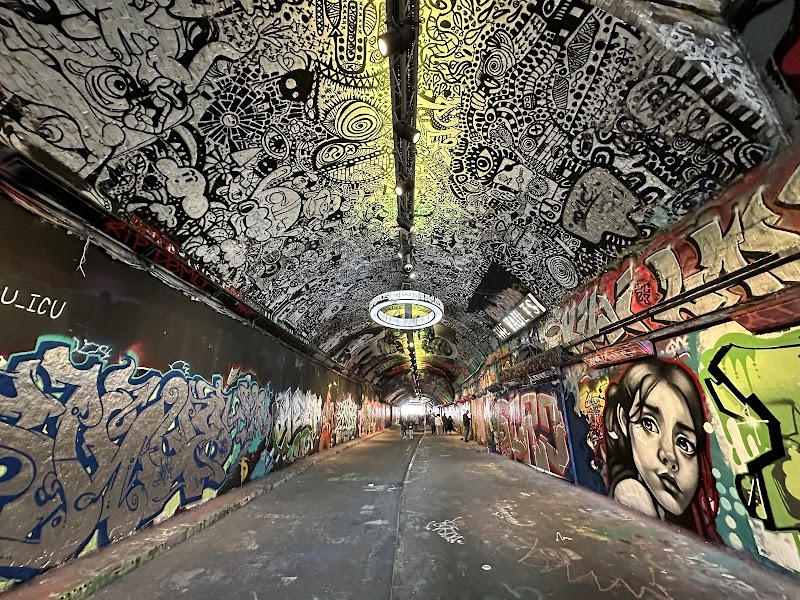
1. The Banksy Tunnel: Where Eurostar Met Graffiti
Leake Street, London SE1 7NN
Photo: Google
Listen carefully. You're standing inside three hundred metres of living, breathing art. This is Leake Street... London's legendary graffiti tunnel, hidden right beneath the platforms of Waterloo Station.
But before the spray cans... this was a road. From nineteen ninety-four to November two thousand seven, the Eurostar ran from Waterloo, and Leake Street was an access road used by taxi drivers ferrying passengers to and from the continent. The first Eurostar departure was on the fourteenth of November nineteen ninety-four, and the last service left on the thirteenth of November two thousand seven. Then the trains moved to Saint Pancras, and this tunnel... fell silent. It was a pretty dismal place, notorious for reeking like a toilet... the kind of underpass you'd hurry through without looking back.
And then, Banksy arrived.
First, the tunnel was shuttered off at both ends to prevent access while Banksy got to work creating several new pieces, before hosting, in collaboration with Pictures On Walls, a bunch of curated stencil artists from all over the UK and around the world. The festival was semi-curated, with strict rules that only stencils could be used on the walls... no freehand graffiti was permitted. The name? The Cans Festival. A cheeky play on the Cannes Film Festival.
And here's a detail most people miss. Among the twenty-nine artists personally invited by Banksy was one of the godfathers of stencil art... Blek le rat. This is the French artist who started painting stencils of rats on the streets of Paris back in nineteen eighty-one... his name comes from the comic book Blek le Roc, using "rat" as an anagram for "art." Banksy himself once admitted, "Every time I think I've painted something slightly original, I find out that Blek le rat has done it as well. Only twenty years earlier." Having the master and the student painting side by side in this very tunnel... that was something special.
Over those three days, the tunnel attracted more than thirty thousand visitors. On the fourteenth of November two thousand eight, ownership of the road passed from Eurostar to Network Rail, and through traffic was restricted to pedestrians. And just like that... a forgotten taxi road became London's largest legal graffiti wall.
Now look around you. You can watch someone dedicate the best part of a day to creating a masterpiece... and then, a few weeks, sometimes just a few days later, along comes another spray can artist and paints over it. Nothing here is permanent. That is the entire point.
And one more thing. This tunnel's name has nothing to do with graffiti at all. Leake Street takes its name from Doctor John Leake, a prominent obstetrician, or "Physician Man-Midwife" as they were known at the time, born in seventeen twenty-nine. At a time when about one in a hundred women died during childbirth in London, Doctor Leake built the Westminster Lying-In Hospital on this very site in seventeen sixty-seven. From a place that brought life into the world... to a place where art is born, destroyed, and reborn again every single day.
-
2. The Mall's Red Carpet Nobody Notices
The Mall, London SW1A 2WH
Right. Now look at the road beneath your feet. Go ahead, look down. Notice anything? That tarmac isn't grey, it's not black... it's red. And that, my friend, is one of the best-kept open secrets in London.
The surface of The Mall has been coloured red since the nineteen fifties, giving the effect of a giant red carpet leading up to Buckingham Palace. Every cabbie worth their badge knows this, but most tourists walk right over it without a second thought. You're standing on the only road in London that's been deliberately dressed up to look like a carpet fit for a king.
And here's the detail that even some cabbies don't know. It was David Eccles, as Minister of Works from nineteen fifty-one to nineteen fifty-four, who chose the colour. He didn't just pick any old paint, either. The red was obtained using synthetic iron oxide pigment from Deanshanger Oxide Works, created using a process devised by a chemist named Ernest Lovell. So one man in Northamptonshire invented the chemical recipe that turned a London road into a royal red carpet. Not bad for a bloke in a small village.
Now, here's a proper cabbie fact for you. Scheduled buses are not allowed to use The Mall and go past Buckingham Palace except by permission of the monarch. This has only happened twice in history... in nineteen twenty-seven and in nineteen fifty. Both times due to roadworks nearby. So if you ever see a big red double-decker rolling down this road... something has gone very, very wrong. Or very, very right.
But this road's history goes back much further than the fifties. The walk in Saint James's Park, now called The Mall, received its name from having been appropriated to the purpose of playing at mall, where King Charles the Second himself and his courtiers frequently exercised themselves in this pastime. That's right... this grand avenue was once a sports pitch. The game was like a cross between croquet and golf, played with wooden mallets and boxwood balls on a long alley. And that game? It gave us the word "mall"... which is how American shopping centres eventually got their name.
The Mall we see today was designed in nineteen eleven by Sir Aston Webb, who also designed Admiralty Arch, the Queen Victoria Memorial, and a new frontage for Buckingham Palace. He essentially built the entire stage set. And beneath the road you're standing on right now... there is said to be a network of tunnels connecting Buckingham Palace to Number Ten Downing Street and the Foreign Office. Officially, nobody confirms it. Unofficially... well, every cabbie has a theory.
One more thing before you take in the view. On Victory in Europe Day, the eighth of May, nineteen forty-five, a vast crowd packed this very road to cheer the King, Queen, and Princess Elizabeth on the Palace balcony. The teenage Princess even snuck out into the crowd that night, walking right here on The Mall, anonymous among the celebrations. Next time you stand on a red carpet... remember, London rolled out the biggest one first.
-
3. Pickering Place: Duels, Bears & the Last Texan Embassy
Pickering Place, London SW1A 1EA
Right, now look at this... See that narrow passageway with the little number three above it? Most people walk straight past. Even half the cabbies I know have never set foot in here. But step through that dark, oak-panelled tunnel and you'll find yourself in Pickering Place... London's smallest public square.
This land was once part of Henry the Eighth's real tennis courts, annexed to his residence at Saint James's Palace. But the square you're standing in now? It's the covered remains of a garden from the mid sixteen sixties, when the Earl of Saint Albans secured a lease from King Charles the Second.
Now. Have a look around. The original Georgian architecture, the quaint railings, and those gaslights... they still work. One of the few spots in London still lit by gas. At night, this place glows like something out of a Dickens novel.
But don't let the prettiness fool you. Despite its high society neighbours, Pickering Place was a hotbed of illicit activity in the eighteenth century... renowned for gambling, bear baiting, cock fighting, bare-knuckle boxing, and duelling. The proximity of the gentlemen's clubs, where immense fortunes were won or lost on the throw of a dice, meant there were plenty of scores to settle among the young bucks.
Legend has it that Beau Brummell himself... the dandy who took five hours to get dressed every day... once fought a duel right where you're standing. Though like many London legends, it's slightly uncertain whether that duel took place at all. Other sources say the last London duel actually happened in a field near Camden in eighteen forty-three... and those sources come complete with the names of the duellists, while the Pickering Place battlers always remain nameless.
Now here's the bit that really gets people. See the wine shop you just walked past? That's Berry Brothers and Rudd... Britain's oldest wine and spirits merchant, founded in sixteen ninety-eight. Around seventeen sixty-five, they started weighing customers on their giant grocer's scales. This free service, offered to notable patrons who previously had to pay a doctor for a weigh-in, became a social ritual among the elite. Their weight books still record the likes of Lord Byron, Beau Brummell, and William Pitt the Younger.
But here's the story that'll stop you in your tracks. Look for the plaque at the entrance to the alley. It reads: "Texas Legation... In this building was the legation for the ministers from the Republic of Texas to the Court of Saint James, eighteen forty-two to eighteen forty-five." That's right... the Republic of Texas had its Embassy right here, above that wine shop. President Houston sent Secretary of State Doctor Ashbel Smith to serve as the Texas representative, establishing legations in Washington, Paris, and London.
And when Texas joined the Union in eighteen forty-five? The Texan delegation departed the capital leaving a one hundred and sixty pound rent bill outstanding. That debt hung over the books for over a century... until nineteen eighty-six. To mark the Texas sesquicentennial, twenty-six members of the Anglo-Texan Society visited the wine shop, dressed in full buckskins, to settle the outstanding debt.
Oh, and one more thing. Louis Napoleon, later Emperor Napoleon the Third, held clandestine meetings in the cellars beneath this very building during his exile in the eighteen forties, plotting his return to France. So at the exact same time Texas was running its embassy upstairs... a future emperor was scheming in the basement. You couldn't make it up.
-
4. Trafalgar Square's Tiniest Police Station
Trafalgar Square, London WC2N 5DN
Right, now look over there... see that lamp post on the southeast corner? Looks like any other bit of street furniture, doesn't it. That's because it's meant to look like any other bit of street furniture. But every cabbie in London knows the truth about that one. That, my friend, is Britain's tiniest police station... or more accurately, a police observation box. And the story behind it is pure London.
Trafalgar Square has long been a focal point for public gatherings and, well, a fair amount of rowdiness. This little structure was created in the late nineteen twenties by hollowing out the plinth of a gas lamp that had stood here since eighteen twenty six.
See, here's how it happened. A temporary police box had been put up in the square just before World War One. Then during the General Strike of nineteen twenty six, the authorities decided to make it permanent, to keep an eye on all those striking workers. But the public kicked up such a fuss that the idea was officially shelved.
So what do you do when you need to spy on the public... but the public won't let you build a spy box? You get Sir Lionel Edwards, head of the Office of Works, to come up with the bright idea of hollowing out the base of one of the square's lamppost plinths. Genius. Hide it in plain sight.
Final approval came in July nineteen twenty seven to carve out the lamp and convert it into a police observation box. Construction was completed on the nineteenth of March, nineteen twenty eight. They fitted it with narrow slits cut in the side to provide three hundred and sixty degree vision and a direct telephone line to Scotland Yard.
Now here's the part I love. If a protesting crowd got particularly disorderly, the officer inside could pick up the phone to call Scotland Yard... and the moment the phone was lifted, the light on top of the box would start flashing to alert any nearby officers that there was trouble. Think about that for a second. You're one lone copper, crammed inside a stone tube, a riot's kicking off around you... and your hiding spot starts flashing like a lighthouse. Not exactly ideal, is it.
They say this tiny box could accommodate up to two prisoners at a time, although its main purpose was to hold a single police officer. Think of it as nineteen twenties CCTV.
It stayed in use right up to the nineteen seventies, when radio communications finally made it unnecessary. And today? If you peer through those narrow windows, you won't see a bored bobby. Just lots and lots of mops. The station is now used as a storeroom for Westminster Council cleaners.
Oh, and one more thing. Legend has it that the ornamental lamp on top came from Nelson's flagship, H M S victory. It's a wonderful tradition... but sadly, it's just that. A tradition that simply isn't true.
From the most powerful admiral in British history... to a broom cupboard. That's London for you. Always hiding something extraordinary inside the ordinary.
-
5. St Etheldreda's: London's Oldest Catholic Church
St Etheldreda's Church, 14 Ely Place, London EC1N 6RY
Right, now I've got you standing at the end of a dead-end street called Ely Place, and I need you to look around for a second. Notice those gates at the entrance? The little gatehouse? See, this is one of those stories I love telling passengers, because it's properly weird... even by London standards.
Ely Place was until relatively recently considered to be a part of Cambridgeshire. For centuries, it was an enclave — an area of land physically located in the City of London but not under its jurisdiction. Instead, it was privately owned by the Bishops of Ely, and even today the street has its own gatehouse and beadles. That's right... a street in the middle of Holborn that didn't technically belong to London.
Now, there's a legend the cabbies love — that in times past, the City of London police could not enter to arrest someone as it was legally still part of Cambridgeshire. Truth is, that's mostly a myth. There are reports in the news of police chasing criminals into Ely Place without any hesitation. But it's a cracking tale, and every cabbie worth his salt will tell it.
Now look at this church beside you. This is Saint Etheldreda's. The building is one of only two surviving in London from the reign of Edward the First, and dates from between twelve fifty and twelve ninety. Think about that. When this chapel was built, there was no Tower Bridge. No Saint Paul's Cathedral — not the one you know. London's population was about forty thousand people.
In thirteen eighty-one, John of Gaunt moved to the palace here, after the Savoy Palace was destroyed during the Peasants' Revolt. Shakespeare made this the setting in Richard the Second where John of Gaunt delivers his famous "sceptered isle" speech. And in Richard the Third, the Bard has the Duke of Gloucester ask the Bishop of Ely to send over some of his famous strawberries from these very gardens!
But here's the bit the tour buses never mention. In sixteen twenty, the Spanish Ambassador moved into Ely Palace, and once again the chapel was used to celebrate Catholic mass — this at a time when Catholic worship was illegal in England. The embassy gave it diplomatic protection... a loophole that desperate Catholics across London exploited. A tragedy occurred on the twenty-sixth of October, sixteen twenty-three, when three hundred Catholics crowded into the upper floor of Hunsdon House on the site of the former Blackfriars monastery. The floors collapsed and ninety-five people died, and nineteen of them are buried in the crypt of Saint Etheldreda's.
The Great Fire of London swept through the City and destroyed everything in its path until it reached Saint Etheldreda's. Then the wind changed and the ancient church was saved. Seven hundred years of history... and it survived by a shift in the breeze.
Oh, and one more thing. If you fancy a pint after all this, tucked down a nearly invisible alleyway just beside us is Ye Olde Mitre — believed to have been established in fifteen forty-six by one of the Bishops of Ely to provide refreshment for the servants working at Ely House. It is said that the pub received its licence from Ely, not from the local licensing authorities, and this anomaly seems to have continued until the early nineteen seventies. Good luck finding it, though. Even some cabbies can't.
-
6. Bleeding Heart Yard: The Devil's Dance Floor
Bleeding Heart Yard, London EC1N 8SJ
Right. Now, if you're driving a cab through Holborn late at night... and a fare asks you to drop them at Bleeding Heart Yard... you'd be forgiven for checking the mirror twice.
This little cobbled courtyard, tucked just off Greville Street behind Hatton Garden, is one of London's most quietly sinister addresses. It's a historic cobbled courtyard off Greville Street in the Hatton Garden area of Holborn. Looks innocent enough in the daytime — old warehouse walls, a French bistro, a few office workers having lunch. But the name? That's where it gets dark.
Now, every cabbie worth his licence knows the legend. The scene is a grand ball at Hatton House, January the twenty-sixth, sixteen twenty-six. Lady Hatton — young, beautiful, very wealthy — is the star of the evening. Partway through the festivities, the ballroom doors swing open, and in walks a finely dressed man... slightly hunched of shoulder, with a clawed right hand. Some say it was the Spanish Ambassador. Others say it was someone far worse.
He took Lady Hatton by the hand, danced her once around the room, and the pair waltzed straight out through the doors into the garden. The guests gossiped all night, waiting for the couple to return... but they never did.
The next morning... her body was found in the cobblestone courtyard, torn limb from limb, with her heart still pumping blood onto the cobblestones.
Now here's the thing most people don't know. Historical evidence thoroughly debunks the legend. The real Lady Elizabeth Hatton died of natural causes on the third of January, sixteen forty-six, at the age of about sixty-eight, at her estate in Stoke Poges, Buckinghamshire. Not exactly ripped apart by the Devil, was she? And here's the really awkward bit — the yard itself didn't even exist when the murder was supposed to have taken place. A carpenter named Abraham Arlidge built the yard in the early sixteen eighties — on what had been the Bishop of Ely's dung heap. That's right. The Devil's dance floor... was a pile of pig muck.
So where does the name actually come from? Most scholars believe it was an old inn sign showing the heart of the Virgin Mary pierced by five swords — a common Catholic image before the Reformation. Not nearly as exciting, is it?
But the legend stuck. The tale gained a wide audience when it appeared in eighteen thirty-seven as one of The Ingoldsby Legends, ghost stories written by Richard Harris Barham. And then Charles Dickens sealed the deal. Bleeding Heart Yard features in his eighteen fifty-seven novel Little Dorrit as the home of the Plornish family. Dickens even played both sides — he wrote that the more practical inmates of the yard believed in the tradition of a murder, while the gentler inhabitants preferred the legend of a young lady imprisoned by a cruel father, who could be heard murmuring "Bleeding Heart, Bleeding Heart, bleeding away" until she died.
And just around the corner from here, down Greville Street? That links Bleeding Heart Yard to Saffron Hill — which Dickens used as the home of Fagin in Oliver Twist. Two of London's darkest fictional addresses, practically neighbours.
So next time you're here after dark... listen carefully. You might just hear the cobblestones... beating.
-
7. The Knowledge Boy's Corridor of Fear
15 Penton Street, London N1 9PU
Look at this unremarkable building. Fifteen Penton Street. If you didn't know what happened inside these walls, you'd walk straight past. But for generations of London's black cab drivers... this was the most terrifying address in the city.
The Public Carriage Office moved here in nineteen sixty-six, and from that moment on, this became the place where dreams were made... or shattered. Every aspiring cabbie — known in the trade as a "Knowledge Boy" or "Knowledge Girl," regardless of their age — had to walk through these doors and sit face to face with an examiner in a ritual called an "Appearance."
Now, let me tell you what they were up against. The whole thing traces back to the Great Exhibition of eighteen fifty-one at the Crystal Palace in Hyde Park, when hundreds of thousands of visitors complained to the authorities about how bad their cab journeys were because the drivers didn't know the routes. So a system was created to test their knowledge of London's principal streets, squares and public buildings.
And that system became a Monster. Today, candidates must memorize twenty-five thousand streets, sixty thousand points of interest, and around twenty thousand monuments — a process which, on average, takes four years to complete.
But the real terror? It wasn't the studying. It was this building. The old Pco offices were an incredibly intimidating place — like the most oppressive characteristics of a typically traditional school. Most cabbies who went through their apprenticeship here have rather unpleasant memories of the place.
Until the early two thousands, the Knowledge was run by the Metropolitan Police, and most examiners were retired bobbies. The Public Carriage Office was not-quite-affectionately known as... "the last bastion of the British Empire."
Appearances were highly ritualized. Candidates wore suits and ties and addressed the examiners formally — one wrong turn in your route could send you back months. These Appearances were designed to be a test of character as well as topographical knowledge. And the examiners? They had nicknames. One was called "the Smiling Assassin" — because he'd grin while failing you.
And here's a detail most people never hear. Legend has it that one examiner, spotting a candidate who'd recently been released from prison, opened his appearance by saying: "Right then... leave HMP Pentonville, and take me to..." The man had to call his first route starting from the very jail he'd just left — which, by the way, is barely half a mile from where you're standing now.
But here's what makes all of this extraordinary. Neuroscientist Eleanor Maguire at University College London discovered that cab drivers who completed the Knowledge had more grey matter in their posterior Hippocampus than people of similar age and intelligence who didn't drive taxis. The Knowledge literally changes their brains. The more years of experience a cabbie had, the larger their Hippocampus grew. Learning London's streets physically reshaped the organ responsible for memory and navigation.
The Pco moved away from Penton Street in twenty ten, and this building took on a quieter life. But every working cabbie who passed through these doors carries a scar... and a badge. A yellow one for the suburbs, or the coveted green one for all of London — proof that they conquered the hardest geography test on Earth, right here in this corridor of fear.
-
8. Ely Place: The Private Street Where London's Law Doesn't Apply
Ely Place, London EC1N 6RY
Right, pull up a seat for this one, because we're standing outside one of the strangest little streets in London... and most cabbies will tell you it's their favourite piece of trivia to drop on a fare.
See that gatehouse? See those gates? This is Ely Place. And here's the thing... London's law doesn't quite work the same on the other side.
This land has been separate from the rest of London since twelve ninety, when it became the official residence of the Bishops of Ely. In medieval times, the estate spanned about fifty eight acres... gardens, orchards, buildings... all of it outside the City's jurisdiction, functioning as an independent ecclesiastical estate.
Now every cabbie knows the legend. The oft-repeated tale is that for many years, the police could not lawfully enter Ely Place to arrest suspected criminals. Because of this quirky situation, criminals would supposedly hide out here to avoid capture. The truth? As we approach the middle of the nineteenth century, reports appear of police chasing suspects into Ely Place without hesitation... a suspect was convicted at the Old Bailey in eighteen forty eight after being arrested right here. So the story's a bit of a legend. But here's what IS real...
A local Act of Parliament from eighteen forty two established a body of commissioners for paving, lighting, watching, cleansing and improving Ely Place. They still retain their watching duties, with a beadle discharging them to this day. They shut the gates at ten PM each night from that little gatehouse.
And here's a detail that'll make you smile. Until the late nineteen sixties, the beadles would announce the time and weather on an Hourly basis, from seven AM until ten PM. But the practice was stopped after complaints about the noise they were making!
Now, tucked down a narrow alley off this street is what every London cabbie considers the city's best kept secret... Ye Olde Mitre. Built in fifteen forty six for the servants of the Bishops of Ely. Step inside, and in the corner of the front bar, you'll spot something odd... a tree trunk, sealed behind glass. The story goes that it's the remnant of a cherry tree marking the boundary between Hatton's property and the bishop's. That tree stump is said to be the very one Queen Elizabeth the First danced around with her courtier, and rumoured lover, Sir Christopher Hatton. Hatton was known as a passionate dancer... his nickname was "The Dancing Chancellor!"
And that man... he gave his name to Hatton Garden, which occupies part of this very site... London's diamond quarter, right next door. All because a queen fancied a man who could dance.
Even Shakespeare wrote about this place. In Richard the Third, Gloucester tells the Bishop: "My Lord of Ely, when I was last in Holborn, I saw good strawberries in your garden there." Those gardens were said to produce the finest strawberries in all of London.
So next time you're in a black cab and the driver points down a quiet cul-de-sac near Holborn... you'll know. This isn't just a street. It's seven hundred years of London being gloriously, Stubbornly odd.
-
9. St Bartholomew's Hospital Staircase: Hogarth's Secret Paintings
St Bartholomew's Hospital, West Smithfield, London EC1A 7BE
-
10. Postman's Park: Ordinary Heroes Nobody Remembers
Postman's Park, King Edward Street, London EC1A 7BT
Right, I'm going to take you somewhere that most Londoners have walked past a thousand times and never noticed. This little green patch right here... Postman's Park. And before you ask — no, it's got nothing to do with posting letters through doors. Back in eighteen twenty-nine, the General Post Office moved into a massive building just over there on Saint Martin le Grand, and the postal workers started coming here on their lunch breaks. The name just stuck.
Now here's the thing most people don't know. The ground you're standing on is actually higher than the streets around it... because so many bodies were buried here over the centuries that corpses were just laid on the ground and covered with soil, raising the whole park above street level. Cheerful, right?
But the real reason I bring people here... is that wall over there. Under that wooden shelter. Go on, have a look. Those fifty-four ceramic plaques each remember an ordinary man, woman, or child who died trying to save someone else's life.
This was the brainchild of an artist called George Frederic Watts. Son of a piano maker, reportedly Despised the wealthy and powerful — turned down a baronetcy twice. In eighteen eighty-seven, he wrote a letter to The Times proposing a monument to celebrate everyday heroism for Queen Victoria's Golden Jubilee. Nobody cared. The letter was applauded and... forgotten.
But Watts didn't give up. When the memorial was finally unveiled in nineteen hundred, it was a fifty-foot wooden loggia with space for a hundred and twenty plaques. Only four were actually in place on opening day. And poor old Watts? He was eighty-three and too ill to even attend his own ceremony.
Now let me tell you about some of the names on that wall, because these are the stories that get me. In the early hours of April eighteen eighty-five, a fire broke out in an oil shop on Union Street. A young woman named Alice Ayres was sleeping upstairs with three little girls. Escape through the burning building was impossible. She threw a feather mattress from the window, then carried each child to the ledge and dropped them down to the crowd below. Alice herself fell from the window, missed the mattress, and died at Guy's Hospital. Her last words were... "I tried my best and could try no more."
And then there's the one that breaks every cabbie's heart. Little Solomon Gelman — the plaque spells it Galaman, but that's wrong — he pulled his four-year-old brother out of the way of a horse and cart on Commercial Street, but fell between the wheels himself. He was eleven years old. His parents were immigrants who needed interpreters when giving their account of what happened, and the newspapers just spelled the name however it sounded. His dying words to his mother? "Mother, I saved him, but I could not save myself."
Work on the memorial stopped altogether in nineteen thirty-one with only fifty-three of those hundred and twenty planned tiles in place. And then... silence. For seventy-eight years, nothing. Until two thousand and nine, when a plaque was added for Leigh Pitt, a print technician from Surrey who died in two thousand and seven rescuing a nine-year-old boy drowning in a canal in Thames-Mead.
Now here's what I always think about, sitting in the cab on a long fare... there are still sixty-six empty spaces on that wall. Watts designed it for a hundred and twenty names. It's an unfinished masterpiece — sometimes called "The People's Westminster Abbey." No kings. No generals. Just... ordinary people who ran toward danger when everyone else ran away.
-
11. The Temple of Mithras: 2,000 Years Under Bloomberg
London Mithraeum, 12 Walbrook, London EC4N 8AA
So here's the story. This spot once sat on the east bank of the River Walbrook, a key freshwater source in Roman Londinium. That river's long gone now — buried under centuries of city — but back in around two forty AD, a Roman Londoner built a temple to the god Mithras on this reclaimed ground, right next to that river.
Now, Mithras... this was no ordinary religion. Even in antiquity the rites were kept shrouded in secrecy, and male-only membership was proven with secret passwords and handshakes. Followers were organised into seven ranks, with the most senior being Pater, meaning father. Think of it as the original secret society of the City of London... long before the Freemasons ever turned up.
The original temple was built partly underground, recalling the cave of Mithras where the Mithraic epiphany took place. Dark, windowless, lit by torches. And it sat here, forgotten, for over seventeen hundred years.
Then comes nineteen fifty-four. London's still covered in bomb sites from the Blitz. Workers are clearing rubble to build a new office block, and the archaeologist W. F. Grimes is running a dig on a shoestring budget. Funds were growing short — it was reported that Grimes had only found the temple because a grant from the Ministry of two thousand pounds a year had kept him going. And here's the thing... on Saturday the eighteenth of September, nineteen fifty-four, on the final day of planned excavation, the marble head of a statue of Mithras was uncovered from beneath the rubble. One more day and it would have been buried under concrete forever.
What happened next was extraordinary. Over a two-week period, an estimated four hundred thousand people flocked to the city to see the remains. On the first day alone, thirty-five thousand showed up! The News Chronicle reported — and I love this — "Sightseers Storm the Cordon." When darkness came, hundreds were still queuing. They got angry and dozens stormed through police barriers. So much for polite British queuing! The temple was twice discussed in Cabinet at the request of Prime Minister Churchill.
But here's the bit that makes a cabbie's blood boil. After all that fuss... the temple was partially, and Poorly, reconstructed for visitors on a nearby car park roof. The reconstruction was built a hundred yards from the original site, and it had been re-orientated north-south whereas it should have been east-west. At one point, this priceless piece of history was stored in a builder's yard in New Malden. New Malden! I've dropped fares there — it's a nice enough place, but it's no home for a Roman temple.
It wasn't until Bloomberg bought the site in twenty ten that things were finally put right. The temple now sits seven metres below modern street level in an exhibition space beneath the Bloomberg building. And when they were digging the foundations... guess what else they found? Archaeologists from Mola found over four hundred fragments of ancient Roman writing tablets — the largest and earliest collection of its kind in Britain, including the first known reference to London and the earliest hand-written document in Britain. The earliest dated tablet is a financial transaction from January the eighth, fifty-seven AD. A financial document... found right here in the heart of the City. Some things never change, do they?
You can go down there for free, by the way. Seven metres underground, into the dark... where the haze and the light and the chanting take you back nearly two thousand years. It's one of London's best-kept secrets... and now you're in on it.
-
12. The London Stone: Brutus's Altar and the City's Soul
111 Cannon Street, London EC4N 5AR
Right, now look at this wall here... one hundred and eleven cannon Street. Most people walk straight past it. Thousands of commuters every single day, heads down, earbuds in, and they have NO idea that they're passing the soul of London.
See that glass case, set right into the building? That battered lump of limestone behind the glass... that's the London Stone. And mate, let me tell you, there's a story in this rock that most guidebooks won't touch.
Nobody knows when it was put here, or what it was actually for. Geologically, it's a block of oolitic limestone from Rutland — meaning someone hauled it here on purpose. Back in fifteen ninety-eight, the historian John Stow described it as a great stone, pitched upright, fixed in the ground very deep, fastened with bars of iron. It used to stand right in the Middle of the road... much bigger than what you see now.
Here's the bit your average cabbie loves. In fourteen fifty, Jack Cade, leader of a rebellion against the corrupt government of Henry the Sixth, struck this stone with his sword and claimed to be Lord of London. Shakespeare put that moment right into Henry the Sixth, Part Two... Cade sits himself on the stone like a throne and orders that every water fountain in the city should run with claret wine! Great theatre. But as the Museum of London points out... it IS great theatre. It is also fiction.
Now here's what the tourists never hear. In sixteen seventy-one, the Worshipful Company of spectacle Makers smashed two hundred and sixty-four pairs of dodgy spectacles on this very stone — condemned as bad and deceitful, broken to pieces with a hammer right here on cannon Street. Imagine that. This rock was London's official quality control anvil.
And the indignities this stone has suffered... Until twenty sixteen, the ground floor was a Whsmith newsagent, and the stone in its glass case was hidden behind a magazine rack, not usually accessible. Before that, it sat in the wall of a Sportec sports shop, surrounded by modern sports equipment. The supposed heart of London... buried behind running shoes and tabloid newspapers.
But here's the legend that keeps this stone alive. There's an old proverb that says... "So long as the stone of Brutus is safe, so long shall London flourish." It ties the London Stone to the mythical figure of Brutus of Troy, who according to legend, founded Britain. Think of it as London's version of the ravens at the Tower — remove them, and the kingdom falls.
And someone's taking that seriously. Every May, the Worshipful Company of Maysons and the Worshipful Company of spectacle Makers conduct a formal inspection of the stone — verifying its continued existence and assessing its condition. They then write a letter to the Lord Mayor, reporting their findings. A six-hundred-year-old lump of limestone... with its own annual medical checkup.
So next time you're in a black cab rolling down cannon Street, have a look out the window. That modest little rock in the glass box? It survived the Great Fire. It survived the Blitz. It survived being hidden behind a magazine rack. And if the legend holds... as long as IT survives, so does London.
-
13. St Dunstan in the East: The Church That Became a Garden
St Dunstan in the East, St Dunstan's Hill, London EC3R 5DD
Now, take a look around you. See these crumbling stone walls with ivy threading through the empty Gothic windows? Most people walk right past this place. Even Londoners who work in these office blocks have no idea it's here. But any cabbie worth his salt knows St Dunstan in the East... because this little garden is one of the best-kept secrets in the Square Mile.
This church was first built around eleven hundred. That's almost a thousand years ago. It survived the Black Death, the English Civil War... and then came the Great Fire of sixteen sixty-six. The fire severely damaged it, but rather than tear it down, they patched it up between sixteen sixty-eight and sixteen seventy-one. And here's where it gets interesting. Christopher Wren himself added that steeple you can see up there, between sixteen ninety-five and seventeen oh one. Now, Wren built it in a Gothic style, which was unusual for him. It has a needle spire carried on four flying buttresses, modelled after Saint Nicholas in Newcastle. Most cabbies will tell you Wren was all about the classical domes and columns, but here... he showed he could do Gothic too.
Then came the night of the tenth of May, nineteen forty-one. A bomb destroyed the nave, the roof, and blew out the stained glass windows. A direct hit destroyed everything apart from the north and south walls... and Wren's steeple. That tower survived. Still standing, still defiant, right through the worst of the Blitz.
Now here's the part that gets me. After lying abandoned for twenty-five years, the city decided to turn the ruins into a public garden. In nineteen sixty-seven, the City of London Corporation made it official, and the garden opened in nineteen seventy-one. They didn't bulldoze it. They didn't build another office tower. They just... let nature take over. And she did.
But here's a story most people don't know. The bells. This church had eight bells in its tower. All eight bells were damaged during the bombing. New ones were cast in the nineteen fifties, but when they were installed and rung... the vibrations were too much for the bomb-weakened tower. Those bells were sold back to John Taylor and Company, the bell founders, and somehow found their way to hang at Sterling Vineyards in nineteen seventy-three... in Napa Valley, California. That's right! Those bells ring every fifteen minutes at a winery on a hilltop in California wine country. London church bells, ringing over grapevines. You couldn't make it up.
And the name itself — Saint Dunstan? There's a brilliant legend behind it. Dunstan supposedly nailed a horseshoe to the Devil's own cloven hoof, causing him such agony that the Devil swore never to enter a place where a horseshoe hangs above the door. This is claimed as the origin of the lucky horseshoe.
So next time you see a horseshoe nailed above a pub door... you can thank the saint whose ruined church you're standing in right now. It's one of the last Blitz-damaged buildings left in the United Kingdom, and instead of being a monument to destruction... it became something rather beautiful. A cabbie's secret garden, hidden in plain sight.
-
14. Leadenhall Market: From Roman Forum to Diagon Alley
Leadenhall Market, Gracechurch Street, London EC3V 1LT
Now, here's a cabbie's nugget for you. When Sir Horace Jones began excavations to rebuild the market in eighteen eighty-one, he unwittingly discovered part of that Roman basilica buried beneath. And the fella who designed this place? His final legacy is one of the most recognised buildings in the world... Tower Bridge. That's right. Same man designed Smithfield, Billingsgate, and Leadenhall. Three of London's great markets, plus the bridge. Yet few people have ever heard of Horace Jones.
But the story every cabbie loves to tell here is about Old Tom. Who's Old Tom? According to an eighteen sixty-four newspaper account, Tom was hatched at Ostend and trained to act as a Decoy goose... his job was to lead other geese onto boats bound for London's slaughterhouses. One day, by mistake, Tom boarded the vessel with his doomed fellow geese and found himself right here, at Leadenhall Market. But instead of meeting the chop... a combination of luck and tenacity meant he escaped several times, and endeared himself to the market traders, who allowed him to live out his days here. And Old Tom didn't just survive... he was accustomed to strut into the Rose and Crown every morning and ask for his dram, and by the time he'd gone the round of the inns, he'd occasionally show himself the worse for his potations. Several times Tom was apparently apprehended by police for being drunk and disorderly! A goose. Arrested for being drunk. He lived to the ripe age of thirty-seven and died of natural causes. So beloved was Old Tom that he even made it into the Times... his obituary was published on the sixteenth of April, eighteen thirty-five.
Now, one more thing before you wander through. This market featured in Harry Potter and the Philosopher's Stone as the entrance to the Leaky Cauldron. If you walk down to Bull's Head Passage, you'll spot the blue door at forty-two Bull's Head Passage that was used for filming. And next time you look up at the painted ironwork... look closely at the shop fronts and you'll see the original wrought iron hooks where animal carcasses used to hang. That's the real Leadenhall. Not magic wands and wizard robes... but decoy geese, Roman ruins, and butcher's hooks hiding in plain sight.
-
15. The Garden at 120: London's Secret Rooftop Nobody Books
120 Fenchurch Street, London EC3M 5BA
Now here's something most people walk right past. You're standing at one hundred and twenty Fenchurch Street... and right above your head, fifteen floors up, is London's best-kept secret viewpoint. No booking. No tickets. No queue. Completely free. And yet most Londoners have never heard of it.
See, any cabbie worth their salt knows the real London isn't where the tourists go. While everyone's fighting for timed tickets at the Sky Garden in that big ugly building down the road — the one we call the Walkie Talkie — you can just stroll in here, go through a quick bag check, step into a lift, and... sixty five metres later... you're in the largest public rooftop garden in the City of London.
The garden was designed by German landscape architects Latz and Partner, and it's home to eighty five Italian wisteria trees, over thirty fruit trees, and a two hundred foot long flowing water feature. It opened on the fifteenth of February, twenty nineteen. And here's the beautiful thing — the space is limited to just two hundred people, and the sheer "little known" nature of the roof means that few people visit at any one time.
Now, speaking of the Walkie Talkie... every cabbie in London remembers twenty thirteen. A ray of light reflected by the Walkie Talkie building melted parts of a Jaguar XJ parked in a nearby street! Sky News managed to fry an egg in the glare. We started calling it the Walkie Scorchie. In twenty fifteen, the building won the Carbuncle Cup for the worst new building in the UK. From up on this rooftop, you can look right at that building and have a quiet laugh about it.
But here's the deeper story, the one that gives this place real weight. The ground beneath your feet has layers. The archaeological potential of this site was enormous — it sits within Roman Londinium, less than a hundred metres from the Roman Forum. Excavations confirmed Roman archaeology surviving below the concrete, with features dating from fifty AD all the way through to four ten AD. Over time, a small cremation cemetery emerged here. Archaeologists unearthed three cremation burials and an inhumation. You're standing above nearly two thousand years of continuous London history.
And at street level, just next to the entrance, there's something most people miss entirely. A sculpture called the Gilt of Cain, by Michael Visocchi with poetry by Lemn Sissay, was unveiled by Archbishop Desmond Tutu on the fourth of September, two thousand and eight. The work comprises seventeen granite columns shaped like sugarcane stems, but they also suggest a group of people — a congregation, a group of buyers at an auction, or even the enslaved people offered for sale. The title is a triple pun... gilt as in gold, or guilt. Cain as in the biblical killer, or cane, from which sugar is made.
Why here, of all places? Because the nearby church, Saint Mary Woolnoth, had a rector from seventeen eighty to eighteen oh seven named John Newton — a former slave trader who became a fierce advocate for abolition and inspired William Wilberforce himself. That same John Newton... wrote Amazing Grace.
So next time someone asks a cabbie for the best view in London, the smart ones don't say the Shard, and they don't say the London Eye. They bring you here. A secret garden in the sky, sitting on top of Roman bones and the conscience of an empire.