Heights, Heaths & Hidden Lanes
A leisurely stroll through Hampstead Village's cobbled secrets and the wild wonder of the Heath
London · 10 stops · 2.0 km · ~1.0 h · 32 min audio · Generated
-
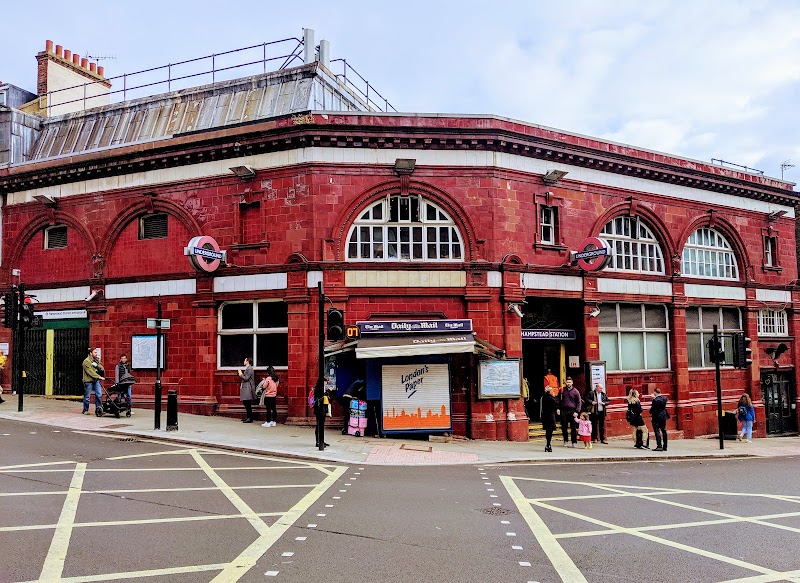
1. Hampstead Underground Station
Hampstead Underground Station, Hampstead High Street, London NW3 1QB
Photo: Google
Take a look at the charming red building in front of you. Those ox-blood glazed terracotta tiles... that distinctive façade with its sweeping semi-circular windows. It looks like a perfectly preserved piece of Edwardian London. But what lies beneath it is anything but ordinary. Because Hampstead sits on a steep hill, this station's platforms are the deepest on the entire London Underground network... fifty-eight and a half metres below ground level. That's roughly the height of a nineteen-storey building... straight down. Designed by architect Leslie green, it was opened on the twenty-second of June, nineteen oh seven. Now here's something most people don't know about Green. In just four short years, he was responsible for the design of over fifty stations spread across three separate Tube lines... a remarkable achievement for a man who was only twenty-nine when he started. He died of tuberculosis in nineteen oh eight at the tragically young age of thirty-three. Overwork is thought to have contributed. The stations outlived their creator by more than a century. And here's a lovely detail. Each station was given a unique colour geometric pattern so that even illiterate passengers could recognise their stop by the colours of the tiles. If you ride down to the platform, look carefully at the old tiled signs on the walls. They still read "Heath Street"... the station's original proposed name, never changed! Now, about getting down there. Access relies entirely on twin high-speed lift shafts, the deepest on the system at fifty-five metres, and a spiral emergency staircase comprising three hundred and twenty steps. That three hundred and twenty step climb beats Covent Garden's one hundred and ninety-three steps by a significant margin. There's a warning sign that actually says climbing this staircase is equivalent to climbing a fifteen-storey building! But the deepest secret lies further up the Northern line, between here and Golders Green. There's a never-completed station called North End, commonly known as Bull and Bush, that would have been sixty-seven metres deep... the deepest on the entire network. It was abandoned in nineteen oh six. During World War Two, its tunnels were used to store secret archives, with access only available from the cabs of passing service trains. Then, during the Cold War... access from the surface was finally provided. A spiral staircase of one hundred and ninety-seven steps was installed to give access to a floodgate control room, which would have become operational in the event of a nuclear attack. Its existence was kept secret and the entrance building was disguised as an electricity substation. So next time you ride the Northern line north from here... peer out the window into the darkness between Hampstead and Golders Green. You might just catch a glimpse of a platform-width gap in the tunnel wall... the shadow of London's deepest secret.
-
2. Churchill & Roosevelt Bench
Hampstead High Street, London NW3 1LJ
Take a look at this bronze bench right here on Hampstead High Street. Two of the most powerful leaders of the twentieth century... just sitting together, chatting, like old friends who've bumped into each other on a Sunday stroll. Churchill holds his trademark cigar, Roosevelt leans back casually... and there, right between them, is an empty space. That space is for you. Go ahead, take a seat. Thousands of people have done exactly that.
This sculpture is called "Allies," and it was the vision of British-American sculptor Lawrence Holofcener, who wanted intimacy rather than grandeur. And here's the remarkable thing about Holofcener... he wasn't even a sculptor for most of his life! He was a Broadway actor, playing Cornelius Hackl in "Hello, Dolly!" alongside Carol Channing. He wrote songs for Sid Caesar's legendary television show and co-wrote the Broadway score for "Mister Wonderful," which introduced Sammy Davis Junior to the stage. Sculpture came late to him, at age fifty one, and he was entirely self-taught.
The original "Allies" sits on New Bond Street in central London, unveiled by Princess Margaret on the second of May, nineteen ninety five, to mark fifty years of peace after World War Two. Holofcener created the work at his own expense, and at first it remained unsold. Then the Bond Street Association gave it a trial run... and it was SO popular they purchased it permanently.
Now, look closely at Roosevelt. The sculpture shows him as he would like to have been seen... sitting casually as if he'd just wandered over. In truth, he was paralysed by polio and mostly used a wheelchair, but he refused to be seen in public in one. There are almost no photographs of him seated in a wheelchair. This bench gives him the dignity he always fought for.
And here's a detail most people miss. During the war, these two leaders spent around one hundred and thirteen days together and exchanged nearly two thousand messages. After one of their meetings, Roosevelt cabled Churchill with a wonderful line... "It is fun to be in the same decade with you."
But the story of this particular copy has its own Hampstead chapter. Holofcener later made seven copies of the sculpture, and one stood outside the Catto Gallery right here in Hampstead in twenty sixteen before it was sold to a hotel in the Lake District. And those miniature quarter-size versions? In twenty twelve, one sold at Bonhams auction house for over four hundred and nine thousand pounds... double its estimate!
And there's one last mischievous detail. When Holofcener needed to create those miniatures, he drove from his Isle of Wight home to Bond Street with clay, tools, and a tiny bench, set up right in front of his own sculpture, and got to work. Passers-by asked if he had permission. He told them... "The artist is dead."
So go on... squeeze in between Winston and Franklin, snap a photo, and for just a moment, join the most important friendship of the twentieth century.
-
3. Burgh House & Hampstead Museum
Burgh House, New End Square, London NW3 1LT
-
4. Flask Walk
Flask Walk, London NW3 1HE
-
5. The Flask Pub
The Flask, 14 Flask Walk, London NW3 1HE
-
6. The Holly Bush Pub
The Holly Bush, 22 Holly Mount, London NW3 6SG
-
7. Admiral's House
Admiral's House, Admiral's Walk, London NW3 6RJ
Look up at this whitewashed building on Admiral's Walk... and notice something unusual about the rooftop. Does that look like the deck of a ship to you?
This house was built in seventeen hundred by a man named Charles keys. But back then, it looked nothing like what you see today. It served as a Masonic lodge between seventeen thirty and seventeen forty-five, and was called Golden Spikes — a name likely drawn from the lodge's own symbol.
Everything changed when a naval officer named Fountain North moved in around seventeen seventy-five. North missed life at sea so much that he constructed a ship's quarterdeck on top of his house. But he didn't stop there. He added bulwarks and portholes to the property, and even mounted cannons on the roof. North fired salutes on the king's birthday and after Britain's naval victories. Imagine the neighbors' reaction... boom at dawn on a quiet Hampstead morning!
Now here's where it gets truly strange. The house's name is a misnomer — no admiral has ever lived here. Fountain North was only a lieutenant, or possibly a captain. The quarterdeck was built sometime before seventeen ninety-six, when it appeared in a print by James Peller Malcolm... but that print was incorrectly titled "Admiral Barton's Hampstead." You see, there was a real Admiral Matthew Barton living nearby in Hampstead, and reports of cannons being fired from rooftops got confused — the cannons may actually have been Barton's doing, fired from his roof, not North's. But the mix-up stuck... and the name Admiral's House was born.
The painter John Constable lived just around the corner on Lower Terrace. He painted this very house from the upper window of his home, around eighteen twenty-one to eighteen twenty-two. He exhibited a version in eighteen thirty-two entitled "A Romantic House at Hampstead" — and you can still see his paintings of this building at the Victoria and Albert Museum.
The architect Sir George Gilbert Scott — the man behind Saint Pancras Station and the Albert Memorial — occupied the house from eighteen fifty-six to eighteen sixty-four. But his wife Caroline found the place rather cold and the location isolated... the Hampstead Underground station wouldn't open for another forty years!
And perhaps the most beloved connection of all... This strange-looking house is said to have inspired P. L. Travers' Mary Poppins series, where a retired naval officer called Admiral boom lives next door to the Banks family in a house shaped like a ship, and fires his cannon every once in a while. There's even an old legend that through the garden ran a tunnel which was said to communicate with the Heath — supposedly the escape route of highwayman Dick Turpin.
Take a moment to look up at that rooftop one more time. Three centuries of eccentric sailors, great painters, legendary architects... and a cannon-firing character who sailed straight into one of the most beloved children's books ever written — all from this one quiet corner of Hampstead.
-
8. Fenton House
Fenton House, Hampstead Grove, London NW3 6SP
-
9. Church Row
Church Row, London NW3 6UU
-
10. St John-at-Hampstead Churchyard
St John-at-Hampstead, Church Row, London NW3 6UU