Hampstead Uncovered: Village Secrets & Heath Legends
From literary ghosts to Bond villains — two hours in London's most extraordinary village
London · 15 stops · 3.5 km · ~1.7 h · 56 min audio · Generated
-
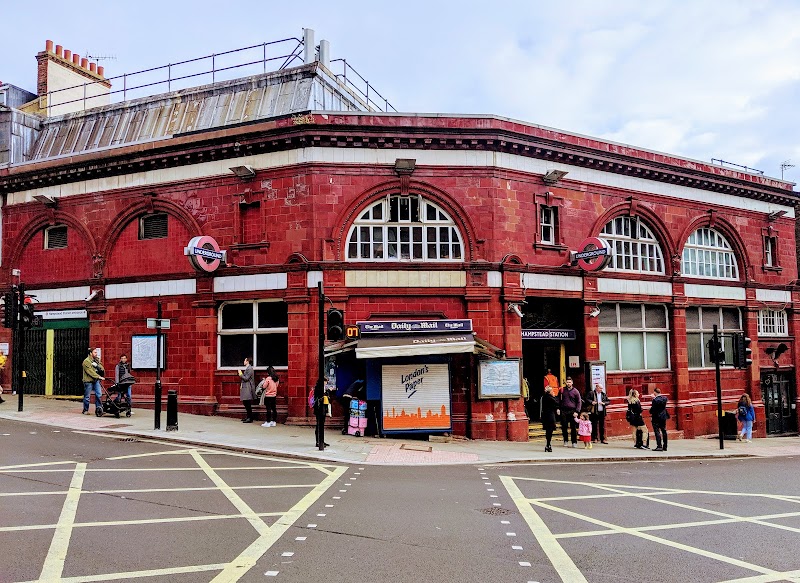
1. Hampstead Underground Station
Hampstead Underground Station, Hampstead High Street, NW3 1QB
Photo: Google
Take a look at the charming red building in front of you. Those ox-blood glazed terracotta tiles... that distinctive façade with its sweeping semi-circular windows. It looks like a perfectly preserved piece of Edwardian London. But what lies beneath it is anything but ordinary.
Because Hampstead sits on a steep hill, this station's platforms are the deepest on the entire London Underground network... fifty-eight and a half metres below ground level. That's roughly the height of a nineteen-storey building... straight down.
Designed by architect Leslie green, it was opened on the twenty-second of June, nineteen oh seven. Now here's something most people don't know about Green. In just four short years, he was responsible for the design of over fifty stations spread across three separate Tube lines... a remarkable achievement for a man who was only twenty-nine when he started. He died of tuberculosis in nineteen oh eight at the tragically young age of thirty-three. Overwork is thought to have contributed. The stations outlived their creator by more than a century.
And here's a lovely detail. Each station was given a unique colour geometric pattern so that even illiterate passengers could recognise their stop by the colours of the tiles. If you ride down to the platform, look carefully at the old tiled signs on the walls. They still read "Heath Street"... the station's original proposed name, never changed!
Now, about getting down there. Access relies entirely on twin high-speed lift shafts, the deepest on the system at fifty-five metres, and a spiral emergency staircase comprising three hundred and twenty steps. That three hundred and twenty step climb beats Covent Garden's one hundred and ninety-three steps by a significant margin. There's a warning sign that actually says climbing this staircase is equivalent to climbing a fifteen-storey building!
But the deepest secret lies further up the Northern line, between here and Golders Green. There's a never-completed station called North End, commonly known as Bull and Bush, that would have been sixty-seven metres deep... the deepest on the entire network. It was abandoned in nineteen oh six. During World War Two, its tunnels were used to store secret archives, with access only available from the cabs of passing service trains. Then, during the Cold War... access from the surface was finally provided. A spiral staircase of one hundred and ninety-seven steps was installed to give access to a floodgate control room, which would have become operational in the event of a nuclear attack. Its existence was kept secret and the entrance building was disguised as an electricity substation.
So next time you ride the Northern line north from here... peer out the window into the darkness between Hampstead and Golders Green. You might just catch a glimpse of a platform-width gap in the tunnel wall... the shadow of London's deepest secret.
-
2. The Flask Pub
The Flask, 14 Flask Walk, Hampstead, London NW3 1HE
Take a look at this handsome pub in front of you. The Flask. A Grade Two listed public house, standing on the very site from where the trade in Hampstead mineral water was run over three hundred years ago.
Now, the name might make you think of something you'd sip whisky from. But the truth is far stranger. Why would a pub be named after a water bottle?
Well, rewind to sixteen ninety-eight. The infant Earl of Gainsborough and his mother, the Countess of Gainsborough, gave six acres of land near the chalybeate Well to benefit the poor of Hampstead. Chalybeate... that means water rich in iron. And people in the early seventeen hundreds believed this rusty-tasting spring water could cure everything from gout to shingles.
A man named John Dufffield began exploiting the waters commercially in seventeen oh one. The waters were bottled right here, on the site of this very pub, sealed into flasks, and then... shipped all the way down to London! The distribution, at three pence per flask, was arranged by a London apothecary called Mister Philips, who operated in Fleet Street from the Eagle and Child pub.
But here's a detail most people miss. To prevent counterfeits, Mister Philips ordered his servants to deliver a sealed ticket to each customer... bearing the image of a wolf rampant with seven crosslets. Think about that. An anti-fraud seal... for water. That tells you just how valuable this stuff was.
This pub was originally known as the Lower Flask, to distinguish it from the Upper Flask... a tavern near the top of Hampstead hill, which was patronised by Whig grandees and writers. That Upper Flask was actually the summer meeting place for the Kit Kat Club, whose members included literary figures and political personalities. The Lower Flask, where we're standing? Its clientele was considered rather... inferior. It even appears in Samuel Richardson's seventeen forty-eight novel Clarissa as the haunt of a drunk.
Before all this, the building here was called the Thatched House, and was rebuilt in eighteen seventy-four into the Victorian beauty you see today. And if you step inside, look for the magnificent timber and glass screen dividing the two bars. On the saloon side, it carries five chromolithographs of sentimental paintings by the Belgian artist Jan Van Beers... and yes, Camra has noted the delightful irony of an artist named Van Beers decorating a pub.
One more secret. During the building of a rear extension in nineteen ninety, a vaulted brick-built cellar was uncovered... hidden beneath the pub for who knows how long. Perhaps where those precious flasks were stored centuries ago, waiting for the morning coach to Fleet Street.
-
3. Flask Walk
Flask Walk, Hampstead, London NW3 1HE
Take a breath. Look at the cobblestones beneath your feet. This narrow lane called Flask Walk is one of Hampstead's best-kept secrets... and its story begins with water.
Back in sixteen ninety-eight, mineral wells were discovered here, and Hampstead transformed from a sleepy hilltop village into a fashionable spa town. The water was chalybeate... meaning it was rich in iron salts bubbling up from deep underground. It tasted absolutely Awful — like drinking rusty nails — but the worse it tasted, the more people believed it was doing them good!
Now here's where this little lane gets its name. On this very site stood the original Flask Tavern, where the mineral water business was run from at least seventeen hundred. The water was bottled and sold at three pence a flask, distributed by a London apothecary called Mr. Philips, who operated from the Eagle and Child pub on Fleet Street. The advertising boldly claimed that "eminent physicians" who had previously drunk the Tunbridge waters now preferred the Hampstead water. Imagine... London's first bottled water craze, born right here on these cobblestones.
But there were actually two Flask taverns in Hampstead. This one was known as the Lower Flask, to distinguish it from the Upper Flask — a grander tavern near the top of Hampstead hill, patronized by Whig grandees and writers. That Upper Flask was the summer meeting place of the famous Kit-Cat Club — powerful literary and political figures like Walpole, who some historians believe helped engineer the Glorious Revolution. Meanwhile, the Lower Flask — our Flask — had a rather rougher reputation. In Samuel Richardson's novel Clarissa, it's described as a place where second-rate persons are found... in a swinish condition.
But the humble Lower Flask had the last laugh. The Upper Flask closed in the seventeen fifties and was eventually demolished. This one was rebuilt in eighteen seventy-four, replacing a thatched-roof pub called the Thatched House, and survives as The Flask pub to this day. Step inside and you'll find remarkably intact Victorian interiors — glass and mahogany partitions, original cast-iron fireplaces, and beautiful tiled surrounds.
And one more gem. In nineteen thirty-seven, the artist Charles Ginner painted this exact view — Flask Walk decorated with flags and bunting for the coronation of King George the Sixth — from his window just across the high street. That painting now hangs in the Tate Gallery.
Look around you... While Hampstead High Street has been taken over by chains, Flask Walk keeps a quirkier, more independent identity. These wooden shopfronts, these flower boxes, this quiet hum of village life... three hundred years of history in a single cobblestoned lane.
-
4. St John-at-Hampstead & Constable's Grave
St John-at-Hampstead, Church Row, London NW3 6UU
Look up... at the sky above Hampstead. Do you see those clouds drifting overhead? The man buried just a few steps from where you stand spent years painting those very skies.
Welcome to Saint Johnat-Hampstead... one of London's most storied parish churches, standing on ground that has been a place of Christian worship for over a thousand years. The land was granted to Benedictine monks of Westminster Abbey by charter in nine eighty-six. The first documentary evidence of a church here dates to thirteen twelve, when John de Newport is recorded as priest.
Now, the church you see today was consecrated on the eighth of October, seventeen forty-seven. But here's a detail most visitors walk right past. Those magnificent iron gates and railings came from cannons... the Duke of Chandos' estate in Edgware, where Händel himself served as resident composer. From seventeen seventeen to seventeen nineteen, Handel lived at cannons, composing his first English stage works and the famous Chandos Anthems. Originally wrought around seventeen fifteen, these gates were restored in nineteen fifty-two. So every time you pass through them, you're touching metalwork from the very estate where Handel created some of his greatest music.
But the heart of this churchyard... is a grave against the southern wall, enclosed by iron railings. John Constable... the great English landscape painter, born in seventeen seventy-six, died in eighteen thirty-seven. He first took summer lodgings in Hampstead in eighteen nineteen and by eighteen twenty-seven had settled his family at forty Well Walk, where he stayed until his death.
And this is where the story gets remarkable. Constable produced around one hundred studies of the sky here in Hampstead between eighteen twenty-one and eighteen twenty-two. He called it "skying." He would annotate each study with the date, time of day, wind direction, and even the scientific cloud classification. No artist had done anything quite like it before. There are few comparable examples until Monet painted his Rouen Cathedral series... seventy years later.
But behind the art lay heartbreak. His wife Maria died tragically young in eighteen twenty-eight and was the first to be buried in this graveyard. Constable wrote to his brother Golding... "hourly do I feel the loss of my departed Angel." After her death, Constable never wore anything but black... and never remarried. He cared for his seven children alone for the rest of his life.
And there's one more secret this churchyard holds. Nearby, on Cannon Lane, you'll find one of the very few surviving parish lock-ups in all of London. Built around seventeen thirty into the garden wall of Cannon Hall, where local magistrates held court, prisoners were kept in this dark single cell until more lasting arrangements could be made for them. It was in use until eighteen thirty-two — soon after the formation of the police force in eighteen twenty-nine, business was transferred to the Watch House on Holly Walk.
So pause here a moment. Look at those clouds... and think of Constable, brush in hand, racing to capture the light before it changed forever.
-
5. Church Row
Church Row, Hampstead, London NW3 6UU
Take a look around you. This is Church Row... and it may be the most perfectly preserved Georgian street in all of London.
Mavis Norris, in her Book of Hampstead, called it "the show piece of Hampstead," and the Pevsner Architectural Guides simply declared it "the best street in Hampstead." Houses started to be built here from about seventeen ten onwards, and construction continued throughout most of the eighteenth century. Three hundred years on... and remarkably little has changed.
Now, look toward the far end of the street, where the spire of Saint John's Church rises above the rooftops. Those beautiful wrought iron gates at the churchyard entrance were purchased in seventeen forty seven from Cannots in Edgware, the seat of James, First Duke of Chandos — friend and patron of the composer Händel. Originally wrought about seventeen fifteen. So those gates once graced a palace where Händel himself composed!
But the stories on this street go far beyond architecture. Can you guess who once lived at Number thirty four, right at the end by the church? Between seventeen eighty two and seventeen eighty five, Henry Cavendish — the man who would later weigh the Earth — lived in that house. During his first winter here, he busied himself with experiments on the freezing temperature of mercury. And from his house, he sighted on the weathercock of the parish church next door, surveying the countryside with a quadrant. In seventeen eighty two, he used his eudiometer to compare the good air of Hampstead to used air from an oratorio concert. He was literally measuring whether Hampstead air was healthier than London's!
Further along, at Number seventeen, a very different kind of genius moved in. The writer H. G. Wells bought this house in nineteen oh nine and lived there with his wife Jane and two sons until nineteen twelve. When they first viewed the house, the Wells family hadn't noticed the proximity of the churchyard's overflow burial ground just steps from their front door. They had to contend with a constant stream of horse drawn funeral processions filing solemnly past their window. You'd think the author of The War of the Worlds could handle a few ghosts! Wells immersed himself in writing The History of Mister Polly here, though he later recalled he wrote much of it in emotional turmoil. He relaxed by pedaling out classical music on a pianola recommended to him by his great friend and frequent visitor... George Bernard Shaw.
And that same Number seventeen? The comedian Peter cook lived there from nineteen sixty five to nineteen seventy one. One house... two comic geniuses... a century apart.
Now, if you walk down to the churchyard at the end... it becomes one of the most extraordinary burial grounds in London. You'll find the graves of painter John Constable, inventor of the marine chronometer John Harrison, and architect Norman Shaw. The comedian Peter cook and Labour leader Hugh Gaitskell are also buried here, as are the Llewelyn Davies family, who as children inspired J. M. Barrie's classic, Peter Pan. And here's the wonderful twist — the villain Captain Hook was played by Gerald Du Maurier in the original nineteen oh four production... and he's buried right next to the Llewelyn Davies graves. Gerald was the brother of Sylvia Llewelyn Davies and uncle to the boys who inspired Peter Pan. Captain Hook and the Lost Boys... reunited forever in Hampstead earth.
-
6. Holly Bush Pub
The Holly Bush, 22 Holly Mount, Hampstead, London NW3 6SG
Look at this quiet lane you've just climbed. Holly Mount... a hidden stairway that most of London never discovers. And tucked right here at the top, the Holly Bush... one of the most atmospheric pubs in the entire city.
Now, this building has a rather surprising origin. It was originally built as stables for Romney's House in the seventeen nineties. That's George Romney, the portrait painter... and here's where the story gets juicy. In seventeen eighty two, Romney was introduced to Emma Hamilton, then known as Emma Hart, who became his muse. He painted more than sixty portraits of her — as goddesses, as sorceresses, as ancient heroines. Romney described her as "the divine lady... superior to all womankind." Whether his obsession was purely artistic... has never been confirmed.
In seventeen ninety seven, Romney left his studio at Cavendish Square, where he had worked for more than twenty years, to move here to Holly Bush Hill. He built a great house and studio to exhibit his Grand Tour finds and his own artworks — an effort that almost made him bankrupt. His health crumbled. In the summer of seventeen ninety nine, after an absence of almost forty years, Romney returned to his wife, Mary, in Kendal — the woman he had left behind four decades earlier. She nursed him until his death.
After Romney was gone, his stables were adapted in eighteen oh seven to provide catering facilities for the Hampstead Assembly Rooms. In the mid nineteenth century, this became the pub as we know it today.
And inside? Look for the details. The interior retains a fixed snob screen and a nineteenth century counter. What's a snob screen, you ask? It's a device from the Victorian era — an etched glass pane in a movable wooden frame, designed to allow middle class drinkers to see working class drinkers in the next bar... without being seen themselves. Class snobbery, literally built into the furniture!
Famous customers have included Doctor Samuel Johnson and his biographer James Boswell, and fast forward to the nineteen sixties — the Rolling Stones went to the Holly Bush because it was their local. Mick Jagger and Keith Richards lived on Holly Hill, just steps away. Rod Stewart and Britt Ekland were also regulars.
And there's one more gem. The "Holly Bush" name itself nods to that age old tradition of hanging a branch or bush above the door of a pub to indicate that a drink could be had there. Before pub signs, before neon lights... a simple green branch said "come in, stranger."
So take a moment. Step inside if you like. A series of oaken rooms with etched glass panels and tactile wallpaper invite you to go back in time. You're standing where a heartbroken painter kept his horses... where Victorian snobs hid behind glass screens... and where rock and roll royalty came to escape the spotlight.
-
7. Fenton House
Fenton House, Hampstead Grove, London NW3 6SP
Look at you, Fenton House... hiding quietly behind those tall garden walls. This is thought to be the oldest surviving residential property in Hampstead. And it has one of the strangest origin stories of any house in London.
In the sixteen eighties, during the last years of James the Second's reign, a builder named William Eades designed and constructed this house as a speculative investment... meaning he intended to sell it the moment it was finished. You see, London had just suffered the dual disasters of the Great Plague in sixteen sixty five and the Great Fire the following year, and Hampstead... up on this hill, with its clean air... became the place where wealthy merchants fled to escape the grime below.
Now here's a detail most people walk right past. The house was known in the early eighteenth century as Ostend House, suggesting its first owner may have been a City merchant with Flemish trading connections. Then it was called Clock House. The name Fenton only came later.
And who bought it in seventeen oh six? A Quaker linen merchant named Joshua Gee... who was also involved in the iron trade and co-founded a company in America. One of his early partners was a man called Augustine Washington... the father of George Washington. That's right. In seventeen fifteen, Gee and Augustine Washington founded the Principio Company, backed by British iron-masters and merchants, producing pig iron in Maryland and Virginia for sale in England. The future first president of the United States may well owe part of his family fortune to deals hatched by a man who once lived in this house.
But the real magic inside is what you can hear. One of the treasures of the house is the internationally significant collection of early keyboard instruments, dating back to fifteen forty, kept in playing condition with weekly tuning and played by volunteer musicians. This is the legacy of Major George Benton Fletcher, who believed that music should be played on the instruments for which it was written, and set out to revive the neglected art of harpsichord playing. His first purchase was a harpsichord from a second-hand shop. He found an eighteenth century spinet in a Welsh outhouse and rescued a virginals that was being used... as a carpenter's workbench.
In nineteen thirty four he found an elegant but dilapidated Charles the Second town house called Old Devonshire House in Holborn, restored it, and filled it with his growing collection. He gave this and his instruments to the National Trust in nineteen thirty eight. Then tragedy struck. Old Devonshire House was totally destroyed in a Luftwaffe bombing raid on Holborn in May nineteen forty one. Some priceless instruments were lost forever. But the core of the collection survived... and eventually found its permanent home right here.
The last private owner was Lady Katherine Binning, the wealthy widow of the heir to the Earl of Haddington. She bought Fenton House in nineteen thirty six and filled it with her large collection of porcelain, furniture and embroidery. When she passed in nineteen fifty two, she gave it all to the nation.
So take a moment. Stand still. If you're lucky, you might just hear the faint notes of a four hundred year old harpsichord drifting through these walls... music played exactly as it was meant to be heard.
-
8. Admiral's House
Admiral's Walk, Hampstead, London NW3 6RS
Look up at this tall, white-washed house with its peculiar roofline... and let me tell you a story of mistaken identity, eccentric sailors, and a little literary magic.
This house was built in seventeen hundred by a man named Charles Keys. Nothing nautical about him at all. In fact, the house was originally called "Golden Spikes," likely named after the Masonic Lodge that met here between seventeen thirty and seventeen forty-five. A landlocked building with a very landlocked name.
But then, in seventeen seventy-five... everything changed. Lieutenant Fountain North bought the house and renamed it "The Grove." Now, Fountain North was a retired naval captain who desperately missed the sea. So what did he do? He added a quarterdeck to the roof... then bulwarks and portholes to the property. He essentially turned a Hampstead townhouse into a landlocked warship! And from that rooftop quarterdeck, he is reputed to have fired cannons to celebrate naval victories and royal birthdays. Imagine the neighbours' reaction.
Now here's where the story gets wonderfully tangled. In the late eighteenth century, the house was mistaken as belonging to Admiral Matthew Barton... because a print of The Grove was incorrectly entitled "Admiral Barton's Hampstead." The cannons were actually Barton's doing, fired from his own roof nearby — but everyone muddled the two eccentrics together. And so the house became known as Admiral's House... though no admiral has ever lived here.
The painter John Constable adored this building. He painted it from the upper window of his own house at two Lower Terrace, just nearby. Ten years later, Constable exhibited a painting of this subject titled "A Romantic House at Hampstead." You can see his paintings of this very house at both the V and A and the National Gallery.
The great Gothic Revival architect Sir George Gilbert Scott lived here between eighteen fifty-six and eighteen sixty-five — this is the man who designed the Albert Memorial and the Midland Grand Hotel at Saint Pancras. But his wife Caroline found the place rather cold and the location isolated — the Hampstead Underground wouldn't open for another forty years!
And then there's the most famous connection of all. This house inspired the similarly eccentric home of Admiral boom in P. L. Travers's "Mary Poppins," published in nineteen thirty-four. In the books, a retired naval officer called Admiral boom lives next door to the banks family, in a house shaped like a ship, and fires his cannon every once in a while.
And one last delicious detail — according to legend, through the garden ran a tunnel which was said to communicate with the Heath, and was allegedly the escape route of highwayman Dick Turpin. Almost certainly fiction... but then again, truth has never been this house's strongest suit.
-
9. Whitestone Pond & Judges' Walk
Whitestone Pond, Heath Street, Hampstead, London NW3 1QS
Take a deep breath. You are standing at the very summit of inner London... and you probably didn't even notice.
This flagstaff beside Whitestone Pond stands four hundred and forty feet above sea level — inner London's highest point. Look around you. On a clear day, the views from here stretch all the way to the hills of Surrey. And this modest pond at your feet? It has a history that reaches back centuries.
Originally, this was just a small dew pond called the Horse Pond, fed solely by rain and dew. Ramps were later added to allow horses to access the pond to drink and wash their hooves after the punishing climb up Hampstead Hill. The white stone itself — the milestone that gave this pond its name — marked the distance: four miles from Saint Giles's Pound, four and a half miles from Holborn Bars.
But here's what makes this hilltop truly extraordinary. This was the site of a beacon established to provide warning of the approach of the Spanish Armada in fifteen eighty-eight. Imagine it... A system of signal beacons had been erected along the English and Welsh coasts to warn London that the Armada was approaching. And this hilltop — the highest point for miles — was one of the final links in that chain. Fire blazing against the night sky, visible from Woodcock Hill to the north and the streets of London to the south.
Now... look just beyond the pond to that shaded, tree-lined path. That's Judges' Walk. And it hides one of Hampstead's most persistent legends. The story goes that during the Great Plague of London, the judges removed from Westminster and held their courts in this very airy spot. In the spring and summer of sixteen sixty-five, an outbreak of Bubonic Plague spread from parish to parish until thousands had died. Those who could, including most doctors, lawyers and merchants, fled the city. King Charles the Second and his courtiers left in July for Hampton Court and then Oxford.
The idea that judges came here — to this windswept ridge, far above the pestilent city — and dispensed justice under canvas tents... it's a magnificent image. But is it true? Historian Thomas Barratt noted that "no actual proof of this has hitherto been brought forward." He suggested instead that since so many judges had lived in this charming locality, it was only natural the walk should bear their name. Another historian, Christopher Wade, noted the path had previously been called Prospect Walk, King's Bench Avenue, and Upper Terrace Avenue before settling on its current name in the early twentieth century.
And one more detail you might have missed. This area, lying above the pond, is the source of one of London's lost rivers — the River Westbourne. The water that once gathered here eventually flowed all the way through Kilburn and Bayswater, filled the Serpentine in Hyde Park, and emptied into the Thames near Chelsea Bridge. You can still see its iron pipe crossing overhead at Sloane Square tube station!
So this unassuming pond... is a summit, a beacon site, a source of a lost river, and the backdrop to one of London's greatest plague legends. Not bad for a puddle on a hilltop.
-
10. Jack Straw's Castle
Jack Straw's Castle, North End Way, Hampstead, London NW3 7ES
Look up at this striking white building with its turrets and battlements. It looks like something from a fairy tale... but its story begins with blood, rebellion, and a man whose very existence is still debated more than six centuries later.
This site is named after the rebel leader Jack straw, who led the Peasants' Revolt in thirteen eighty-one, and who is said to have taken refuge here until he was caught and executed. But here's the mystery... some historians argue the name was in fact a pseudonym for Wat Tyler, or one of the other peasant leaders. One legend says straw addressed groups of rebels right here on Hampstead Heath from a hay wagon, which became known as "Jack straw's Castle." Whether he was a real man or a ghost of history, even Geoffrey Chaucer mentioned him in The Canterbury Tales... so someone by that name left a mark.
The earliest record of a pub on this spot is as a coaching inn in seventeen thirteen. It was used by people travelling from London to water their horses at nearby Whitestone Pond. And what a guest list it attracted! Charles Dickens was known to visit, describing it as a place where he could get "a red-hot chop for dinner, and a glass of good wine." William Makepeace Thackeray and Wilkie Collins also visited. But it wasn't just novelists. Karl Marx and Friedrich Engels, living nearby in Hampstead during the eighteen fifties, frequented the pub during their outings, often visiting with family for snacks and refreshment. Imagine... the father of communism, drinking in a pub named after a medieval rebel. Some stories write themselves.
And then there's fiction. The pub is mentioned in Bram Stoker's Dracula, where Professor Van Helsing and Doctor Jack Seward stop to dine before heading out into the dark Hampstead night to hunt a vampire. It was also the final residence of the music hall singer Alec Hurley, who died here in nineteen thirteen.
Now... the building you see today is not the original. The old pub was destroyed by a land mine during the Blitz of World War Two. The present building, constructed between nineteen sixty-two and nineteen sixty-four, was designed by architect Raymond Erith in what he called a Georgian-Gothic style. Hampstead Council was appalled, calling the design "quite inappropriate to this charming and outstanding site." And yet here it stands, Grade Two listed, outlasting all its critics.
At one hundred and thirty metres above sea level, this was the highest pub in London. It served as a pub until two thousand and two, when it was converted into a flat complex. The pints are gone. The chops are gone. But six hundred years of stories... those remain, soaked into the very ground beneath your feet.
-
11. Churchill & Roosevelt Bench
New End Square, Hampstead, London NW3 1LT
Take a look at this bench. Two bronze figures, casually seated, chatting away as if they've got all the time in the world. On one side, Winston Churchill, leaning forward with his trademark cigar. On the other, Franklin D. Roosuh-velt, sitting back, relaxed. And right there between them... an empty space. That space is for you.
This sculpture is called "Allies," and it was created by the American-British artist Lawrence ho-Lof-ceh-ner, who had intimacy, not grandeur, in mind when he designed it. The original sits on Bond Street in central London, where it was paid for by the Bond Street Association and unveiled by Princess mar-Gar-et on the second of May, nineteen ninety-five, to mark fifty years of peace after World War Two. What you see here in Hampstead is one of several copies ho-Lof-ceh-ner later created.
But here's what makes this sculpture truly remarkable. Look closely at Roosevelt. He's shown sitting on this bench as if he had just wandered over and sat down. In truth, he was paralyzed due to polio and, while he could walk using leg braces and walking sticks, he more often moved around in a wheelchair. Although his disability was well known, there are very few photographs of him in a wheelchair, because he refused to be seen in public in one. Roosevelt had a so-called "gentleman's agreement" with the press that they would not photograph him in his wheelchair. So this bench... is Roosevelt exactly as he wanted to be seen. Just a man, sitting among equals.
And the sculptor himself? What a life! Ho-Lof-ceh-ner was a sculptor, poet, lyricist, playwright, novelist, actor and director. In nineteen sixty-four, he played Cornelius in Hello, Dolly! on Broadway, first with Carol Channing, then Ginger Rogers. He came late to sculpture and was entirely self-taught, holding his first exhibition in nineteen seventy-nine. And his daughter? None other than Nicole ho-Lof-ceh-ner, the acclaimed indie filmmaker who received an Academy Award nomination for the screenplay of "Can You Ever Forgive Me?"
Now, one more story. Ho-Lof-ceh-ner never made a maquette before sculpting the original... his "impetuous" nature made him too impatient for models. When he was later asked to create a quarter-size replica, he had a problem... the original was on Bond Street and he had no model. So he and his wife Julia drove from the Isle of Wight with a table, tools, clay, and a little bench, set it all up right IN front of the life-size sculpture, and got to work. Passers-by asked him questions. "Are you an art student?" He'd reply, "Do I look like a student?" "Have you got the artist's permission?" "The artist is dead." He told them all this... while being the artist very much alive.
So go ahead. Take a seat between two of the twentieth century's most powerful leaders. You're sitting in the space where the "special relationship" lives... right here in Hampstead.
-
12. Burgh House & Hampstead Museum
Burgh House, New End Square, Hampstead, London NW3 1LT
Take a look at the elegant building before you. Burgh House was constructed in seventeen oh four, during the reign of Queen Anne. But back then, nobody called it Burgh House. It was known as Brook House, built for a well-to-do haberdasher named Henry Sewell and his wife Hannah, who were members of the Society of Friends... the Quakers.
Now, here's what makes its early story truly remarkable. The house sat close to the fashionable Hampstead Wells Spa, where wealthy Londoners came to reinvigorate themselves. And in seventeen twenty, the spa's physician, Doctor William Gibbons, moved in and enlarged the place. If you look at the wrought-iron gate, his initials, W G, can still be seen on that distinctive Grade Two listed ironwork.
But Doctor Gibbons may have left an even bigger mark on history than those gates. According to William Wadd, the credit of making mahogany fashionable belongs to Gibbons. His brother, a West Indian shipmaster, brought home some of that wood as ballast. The carpenters found it too hard for their tools. But when Mrs Gibbons wanted a candle-box, the doctor insisted it be made from this strange wood. The candle-box was finished and approved... a bureau was then made, and the colour and polish were so pleasing that he invited his friends to come and see it. Among these was the Duchess of Buckingham, and the wood shortly after came into general use. So, every piece of mahogany furniture in Britain... may trace its origins to this house.
The residents only got more colourful from there. An upholsterer named Israel Lewis was found guilty of creating a nuisance by making an enclosed dung stall in his garden, and was fined five pounds!
Then came a stained glass artist named Thomas Grylls, who occupied the house from eighteen eighty four until nineteen oh six. He fathered twelve children here. And as a partner in the company of Burlison and Grylls, he designed the rose window above Poet's Corner in Westminster Abbey!
But the most poignant story belongs to Elsie Bambridge. Between nineteen thirty three and thirty seven, Rudyard Kipling's daughter lived here with her husband, Captain George Bambridge. She later wrote that their life in this house was "a source of happiness to my father to the end of his life." And that was tragically literal. On the twelfth of January, nineteen thirty six, Rudyard and his wife visited George Bambridge, who was in bed at Burgh House with bronchitis. It was to be Rudyard's last outing... because the following day he was admitted to Middlesex Hospital, where he died on the eighteenth of January.
The great storyteller's final journey into the outside world... ended at this doorstep.
When threatened with demolition in nineteen seventy seven, Melvyn Bragg and Judi Dench supported the campaign to save it, and the community raised the funds to keep it alive. Today, inside the museum, keep an eye out for a curious treasure... a large statue of a penguin that once stood outside the legendary High Hill Bookshop on the High Street to promote penguin Books. That bookshop is long gone, but the plaster penguin survives here, a charming relic of Hampstead's deep love affair with the written word.
-
13. Well Walk & John Constable's House
Well Walk, Hampstead, London NW3 1BX
Welcome to Well Walk... one of Hampstead's most elegant streets, and a place with two extraordinary stories woven into its cobblestones. One is about water. The other is about sky.
Let's start with the water. The chalybeate springs of Hampstead were generally agreed to have started being used around sixteen ninety-eight. Chalybeate... that's a fancy word meaning the water was rich in iron. In that year, the infant Earl of Gainsborough and his mother, the Countess, gave six acres of land around the well to benefit the poor of Hampstead. But what happened next was anything But charitable. On the second of June, seventeen oh one, a man named John Duffield was granted possession of the land... and he immediately started building. A Great Room, Assembly Rooms, a Pump Room. Soon came a tavern, a chapel, shops, formal gardens, and even a bowling green. This quiet street was once a Buzzing Georgian spa resort, rivaling Tunbridge Wells! The waters were bottled right on the site of the pub called The Flask, on Flask Walk, which leads directly into Well Walk.
But here's the twist. It wasn't until nineteen oh two that doctors finally announced that drinking chalybeate water was actually Harmful to your health... two centuries of supposed miracle cures, debunked in a single announcement.
Now. Look for the blue plaque on the Georgian townhouse across the way. The English landscape painter John Constable lived in this house from eighteen twenty-seven to eighteen thirty-seven, and it retains many original features from his time, including high ceilings and tall sash windows. But why did he come here? Constable moved from central London to take advantage of the clean air and spa water for his wife, who suffered from tuberculosis.
It was a race against time... and he knew it. The house on Well Walk offered a splendid view over London. He wrote that the little drawing room commanded "a view unequalled in Europe... the dome of Saint Paul's in the air." And from this hillside, something remarkable happened. Constable made a series of oil sketches of the sky alone, each one marked with the date, time, and a short description of the conditions. His interest in clouds was influenced partly by the work of the scientist Luke Howard, who had in eighteen oh three written a pioneering study classifying different types of cloud.
He didn't just paint pretty pictures. He was conducting a scientific investigation of the atmosphere... with a paintbrush. He regarded the sky as, in his own words, the chief "organ of sentiment" in landscape.
Sadly, his wife had been fighting a long battle with tuberculosis and died in eighteen twenty-eight. Constable was finally elected a full Royal Academician on February tenth, eighteen twenty-nine... by a single vote. His wife had died just three months before. He never remarried. He stayed right here on Well Walk, caring for seven children, painting these skies until his death in eighteen thirty-seven.
And here's a detail most people miss. He had only managed to sell about twenty paintings in his lifetime in England! The man we now call one of Britain's greatest landscape painters... was barely recognized in his own country. So next time you look up at the clouds over Hampstead Heath... remember. Constable saw them first.
-
14. 2 Willow Road
2 Willow Road, Hampstead, London NW3 1TH
Take a look at the house in front of you... number two Willow Road. It's modest, isn't it? Red brick, clean horizontal lines, a flat roof. You could almost walk past it without noticing. But this quiet little house sparked one of the most extraordinary feuds in British cultural history... a feud that gave the world one of cinema's greatest villains.
The man who built it was Ernő Goldfinger, born into a Hungarian Jewish family in Budapest in nineteen oh two. He moved to Paris in nineteen twenty-one, where he studied at the Beaux-Arts and fell in with some of the greatest architects of the twentieth century... including Le Corbusier and Auguste Perret. Then, in Paris, he met his future wife... Ursula Blackwell, heiress to the Crosse and Blackwell food fortune. Her money would help finance what you're looking at right now.
Goldfinger bought this plot in nineteen thirty-seven, which he claimed contained "four derelict worm-ridden cottages" in need of demolition. The neighbours... did not agree. His critics feared the imposition of an angular concrete block in a part of London celebrated for its fine Georgian architecture. Among the most vocal opponents was Henry Brooke, the future Home Secretary. And another local resident... a man named Ian Fleming.
Years later, a discussion on a golf course about Ernő with Goldfinger's cousin prompted Fleming to name his most famous Bond villain... Auric Goldfinger... after the architect. And here's where it gets delicious. When Ernő got wind of this, he was furious. He threatened to sue, arguing there were too few Goldfingers in Britain for the name to be anything but a personal attack. Fleming's response? He threatened to rename the character... Goldprick. Ernő eventually settled out of court, receiving his legal costs, six free copies of the book, and an agreement that the villain's first name Auric would always be used.
But the revenge didn't stop at the name. Through a golfing friend connected to the Goldfinger family, Fleming knew Ernő and Ursula personally... and in the novel, the architect's wife is thinly fictionalised into a minor character portrayed as a heroin addict.
For decades afterward, the Goldfinger family endured late-night prank calls... callers declaring "Goldfingah! This is oh-oh-seven!" in bad Sean Connery impressions, or belting out Shirley Bassey's theme song.
Now look closer at this building. The brick walls you see aren't actually structural... the three properties are supported by a reinforced concrete frame. That signature spiral staircase inside? It was engineered by none other than Ove Arup. And the walls held works by Goldfinger's cosmopolitan circle of friends... Henry Moore, Barbara Hepworth, and Max Ernst.
Goldfinger lived here with Ursula and their children until his death in nineteen eighty-seven. It's been managed by the National Trust since nineteen ninety-five... and was one of the first Modernist buildings they ever acquired, which itself caused quite a controversy. The man whom Fleming tried to humiliate... ended up with his home preserved as a national treasure. Now that is the best revenge.
-
15. Keats House
Keats House, Keats Grove, Hampstead, London NW3 2RR
Stop here, on this quiet lane beneath the trees of Hampstead. The white Regency villa before you... is Keats House. And the story that unfolded within these walls is one of genius, heartbreak, and a love that became legend.
This building was originally not one house but two — a pair of semi-detached homes known as "Wentworth Place." From the exterior, the two houses looked like one residence, but an interior partition wall created two separate living areas.
In December eighteen eighteen, a twenty three year old man arrived here, devastated. His brother George had emigrated to America, and his younger brother Tom had just died of consumption — what we now call tuberculosis. His friend Charles Brown invited him to move in, and Keats paid five pounds per month and half the liquor bill.
What happened next was extraordinary. His biographer Walter Jackson Bate called the seventeen months Keats spent here "the most productive in the life of any poet of the past three centuries." And then... love walked through the garden wall. In eighteen nineteen, the Dilke family moved out, and a widow named Mrs Brawne rented the other half of the house. Her eldest daughter, Fanny, then eighteen, was introduced to Keats.
Now, here's the thing — he did not fall for her immediately. In a letter to his brother, Keats called Fanny "ignorant" and "monstrous in her behaviour," saying he was forced to use the term "minx." They circled each other with uncertainty at first, and gave each other mixed reviews. But within months... he was completely consumed. He would write to her: "Love is my religion, and you are its only tenet."
According to his friend Brown, Keats wrote his masterpiece, Ode to a Nightingale, under a plum tree right here in this garden. Picture it — spring eighteen nineteen, the song of a real nightingale drifting from the Heath... and a young man scribbling furiously on scraps of paper.
Then came the night that changed everything. On the third of February eighteen twenty, Keats returned from London, having sat outside an open carriage in punishing winter rain to save money. He staggered upstairs to his bedroom... coughed... and saw blood on his pillow. Having trained as a surgeon, Keats knew exactly what he was looking at. He said to Brown: "I know the colour of that blood! It is arterial blood. I cannot be deceived in that colour. That drop of blood is my death warrant. I must die."
Fanny spent almost every day by his side that winter. When they could not be together, she sent a note every night to be put under his pillow. And here is a detail most people never hear — when Keats died in Rome on the twenty third of February eighteen twenty one, he was buried with several unopened letters from Fanny. It had pained him too much to read them.
Fanny mourned him as a widow. She cut her hair, dressed in black, wore a locket containing a piece of Keats's hair, and wore the ring he had given her. She did not come out of mourning until eighteen twenty seven — six years after his death.
And this house itself nearly vanished from history. In nineteen twenty, it was threatened with demolition, but a fundraising campaign in Britain and the United States saved it. About a third of the money came from America, and even Thomas Hardy donated a poem to the cause. If you go inside, you can see the actual engagement ring Keats offered to Fanny, and a copy of his death mask — the face of a man who died believing his name was, as he put it, "writ in water."
He could not have been more wrong.