From Islington Charm to Docklands Towers
A cross-city journey through bohemian streets, East End heritage, and maritime history
London · 12 stops · 8.6 km · ~2.4 h · 29 min audio · Generated
-
1. Gallipoli Restaurant
119–120 Upper St, London N1 1QP
Photo: Google
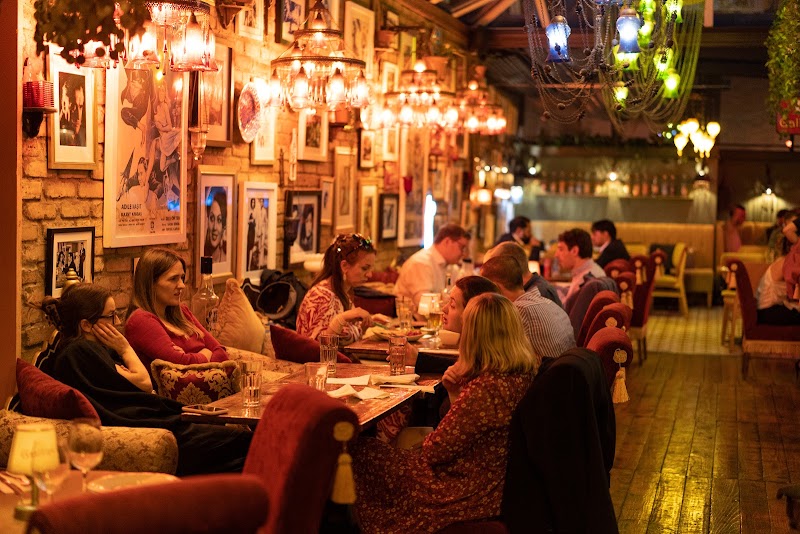
Look through the glass at numbers hundred and nineteen Upper Street, and you will spot what locals lovingly call the Aladdin's cave of Islington. Hundreds of mosaic glass lanterns, brass trinkets, and vintage photographs cover almost every single inch of the ceiling and walls. It feels less like a London dining room and more like stepping straight into a bustling Ottoman bazaar!
This neighborhood institution began back in nineteen ninety-six when two ambitious brothers, Enver and Erdal Ucar, opened a small Mediterranean bistro. Their charcoal-grilled meats, spiced aubergine meze, and warm Turkish hospitality became such a wild sensation that queues stretched down Upper Street every night. The demand was so overwhelming that one building could not hold the crowds. So they opened a second restaurant, and then a third, all within a few steps of each other on this exact same street!
Local lore says the owners spent years hunting through night markets in Istanbul to hand-pick every glowing lantern hanging overhead.
Over the years, these rooms have hosted endless family feasts, late-night celebrations, and live belly-dancing performances. As you stand here amidst the fragrant aromas of grilled spices and fresh mint tea, you are looking at a vibrant slice of London culinary history that has kept Islington fed for decades.
-
2. St Peter's Church
St Peter's Street, Islington, London N1 8KG
Look up at this striking stone building nestled along Saint Peter's Street. It looks like a classic medieval parish church, but its history is full of surprising twists and architectural ambition.
In eighteen thirty-four, a talented young architect named Charles Barry was commissioned to build this church. At the time, Barry was making a name for himself designing Gothic Revival churches across London, including four right here in Islington. But just one year later, in eighteen thirty-five, his entire life changed when he won the ultimate competition in British architectural history: rebuilding the Palace of Westminster, home to the Houses of Parliament. The very same mind that created Big Ben and the iconic riverfront of Parliament was working on this neighborhood church at almost the exact same moment.
Look closely at the soaring spire pointing toward the sky. Did you know that spire was not even part of Barry's original design? It was added nearly a decade later, between eighteen forty-two and eighteen forty-four, by the architectural firm of Roumieu and Gough. Local architecture enthusiasts often chuckle at its unusually sharp, slender silhouette, calling it the Thunderbird One spire because it looks like a vintage sci-fi rocket ready for blastoff!
As the decades went by, the neighborhood changed and congregation sizes fell. In nineteen eighty-two, the parish officially merged with nearby Saint James, and Saint Peter's closed its doors as an active place of worship. But rather than letting this grand structure fall into disrepair, developers stepped in with a clever preservation plan.
If you look up at the tall Gothic windows today, you might notice curtains and warm living room lights. The entire interior was converted into unique modern apartments! Imagine coming home every evening through a grand Victorian doorway, living inside a building crafted by the architect of Parliament himself.
-
3. Wharf Road Canal Basin
Wharf Road Bridge, Wharf Rd, London N1 7UX
Standing here on Wharf Road Bridge, look down at the quiet water stretching into the basin. Today, it feels like a tranquil oasis tucked between sleek modern flats and leafy towpaths, but two centuries ago, this very spot was a roaring, smoke-choked engine of British industry.
When the Regent's Canal opened in eighteen twenty, this basin became one of the most vital transport hubs in London. Before railways dominated the country, almost everything that built and fed the capital arrived by boat. Coal, building stone, timber, and grain were packed onto heavy iron barges and towed along these narrow waterways by muscular draft horses. At its peak in the mid-nineteenth century, the famous transport firm Pickfords ran a massive operation right here, coordinating over a hundred canal craft and armies of horses working around the clock.
Who could have guessed that a place once so thick with coal dust and heavy industrial noise would reinvent itself as a world-famous art quarter?
As commercial canal traffic faded away in the mid-twentieth century, artists and visionaries saw potential in these abandoned brick warehouses. In the year two thousand, the acclaimed art dealer Victoria Miro moved her gallery into a sprawling, converted Victorian furniture factory right here at sixteen Wharf Road.
She created a space unlike almost any other in London, complete with a breathtaking waterside sculpture garden where modern art installations float directly over the historic canal basin.
Over the years, internationally renowned artists like Yayoi Kusama, Grayson Perry, and Chris Ofili have displayed groundbreaking works inside these transformed industrial walls. Today, instead of soot-covered barge workers shouting across the docks, you will find art lovers, quiet narrowboats moored along the quay, and waterfowl gliding past waterside galleries.
The heavy iron barges are long gone, but the basin remains a living link between London's Victorian past and its creative present.
-
4. Moorfields Eye Hospital
162 City Rd, London EC1V 2PD
-
5. Wesley's Chapel
49 City Rd, London EC1Y 1AU
-
6. Village Underground
54 Holywell Ln, London EC2A 3PQ
-
7. Toynbee Hall
28 Commercial St, London E1 6LS
-
8. The George Tavern
373 Commercial Road, London E1 0LA
-
9. The Troxy
490 Commercial Rd, London E1 0HX
-
10. Limehouse Basin
Branch Rd, London E14 8EH
-
11. The Grapes
76 Narrow St, London E14 8BP
-
12. Westferry Circus
Westferry Circus, Canary Wharf, London E14 8RR