Docks, Deals & Dollars
From Caribbean sugar ships to global banking towers — Canary Wharf's double life
London · 15 stops · 5.3 km · ~2.0 h · 51 min audio · Generated · Free to listen
-
1. Westferry Circus
Westferry Circus, London E14
Photo: Google
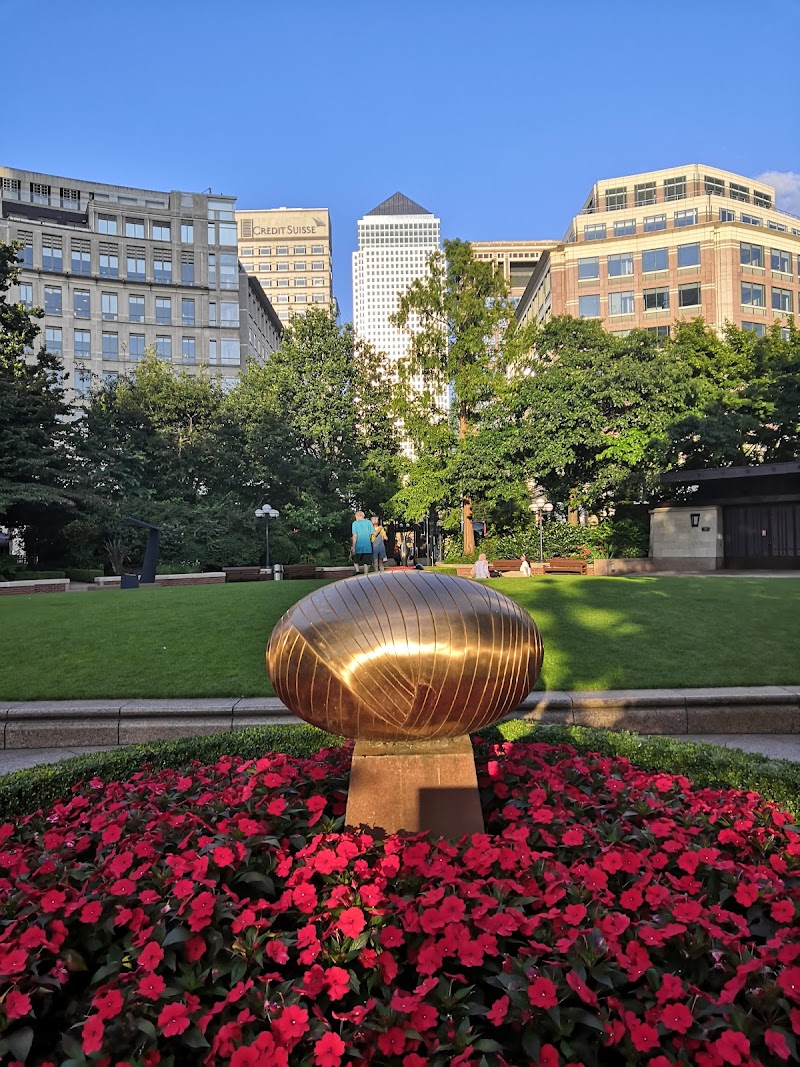
Now take a breath. Look around you. Where the glass towers of Canary Wharf now gleam, the river once lapped against muddy stairs... and this spot, Westferry Circus, holds the memory of that vanished waterfront. The very name gives it away. "West Ferry" — at the start of the nineteenth century, Westferry Road was called the Deptford and Greenwich Ferry Road. It was the route people walked to reach the ferry crossing, one of the only ways off this marshy peninsula for centuries. One road led across the marshes to an ancient ferry, at Ferry Road. That's how isolated this place was. The Isle of Dogs — surrounded on three sides by the Thames — was effectively cut off from London. And here's something most visitors never realize. You are actually standing on a giant roof garden. Can you feel it? Beneath your feet, there's an entire subterranean world. Most public spaces in Canary Wharf are on a roof of an entire subterranean town complete with shopping malls, gyms, and restaurants. But dig deeper into history, and you find something even more remarkable. In nineteen eighty-seven, construction started on Westferry Circus, which covered the northern section of the former Union Dock — a working shipyard where vessels were repaired for decades. And one of those vessels? The Cutty Sark, which had been renamed Fereira after being sold to a Portuguese firm... was in Union Dock for repairs in January nineteen twenty-two. That's right — the world's most famous tea clipper once sat right here, in a dry dock now buried beneath this elegant garden. And before the shipyard, before the docks, before anything... this was Limehouse Hole. This was one of the first parts of the parish of Poplar to be developed. As London's riverside grew, Limehouse Hole was built up with shipping-related enterprises — shipbuilders, barge-builders, boat-builders, ropemakers, sailmakers, mastmakers, blockmakers and ship-chandlers. Limehouse Hole was a plying place for watermen from the seventeenth century. There were two sets of river stairs in sixteen eighty-seven. Watermen would row you across the Thames for a penny or two — London's oldest taxi service! Westferry Circus is a road interchange and public space containing a two-level road interchange... with two roundabouts, one above the other. It was designed by Lorie Ohlin, the celebrated American landscape architect. Built high above the original quay and disguising the swirling roundabout traffic both around and beneath it, it was conceived in the manner of a traditional London crescent. And here's a wonderful detail — Ernie Bennett, who began Ernie's Snack Bar, was Canary Wharf's first retailer! When Olympia and York started the development, he moved his burger van to a pitch right here at Westferry Circus and became a favourite with the construction workers. Before the banks, before the trading floors, before the billions... there was Ernie and his cup of tea. From ancient ferry landing to shipyard, from watermen's stairs to a burger van, and finally to this grand circle of flowers and sculpture surrounded by towers of finance. Every layer of London is buried right beneath your feet.
-
2. Thames Riverfront Quay
Canary Riverside, Westferry Road, London E14 8RR
Take a deep breath. Look out at the Thames in front of you... and try to imagine this scene two hundred years ago. Before eighteen hundred, ships arriving to unload goods in London crowded into the stretch of river between London Bridge and Wapping. Cargoes often rotted before they could be unloaded. The chaos was staggering. Losses from pilferage alone were estimated at between two hundred and fifty thousand and five hundred thousand pounds a year during the seventeen nineties... a fortune in today's money. Gangs of river pirates known as "Heavy Horsemen" would literally stuff stolen sugar and coffee into hidden pockets sewn inside their coats.
Something had to change. And the man who forced that change was Robert Milligan... a wealthy West Indies merchant, slave trader and ship owner, who returned to London having managed his family's Jamaica sugar plantations. Outraged at losses due to theft and delay, Milligan headed a group of powerful businessmen who lobbied Parliament for something revolutionary... enclosed docks with walls.
The West India Docks, constructed between eighteen hundred and eighteen oh two, were the first commercial wet docks in London. And the scale was breathtaking. They were enormous... almost a kilometre long, with moorings for five hundred vessels. The whole complex was built like a fortress, with high spiked walls, a moat, and its own police force.
But here's the detail most people miss. The very road you're standing near... Westferry Road... gets its name from eighteen twelve, when a horse ferry was introduced alongside the passenger ferry to cross from this peninsula over to Greenwich. Before that road was built, the Isle of Dogs was practically wilderness... windswept marshland with barely a soul living on it.
Now... the name "Canary Wharf" itself. No, it has nothing to do with canary birds. Number thirty two berth of West Wood Quay in the Import Dock was built in nineteen thirty six with a two-storey transit shed for Fruit Lines Limited, a subsidiary of Fred Olsen Lines, for the Mediterranean and Canary Islands fruit trade... and that is how this entire financial district got its name. Bananas and tomatoes from the Cana-ry Islands!
And here's the most delicious irony of all. The Canary Islands are named from the Latin Islas Canarias, which in English means... Islands of the Dogs. So you are standing on the Isle of Dogs... named after nobody knows quite what... looking at a financial empire named after the Islands of the Dogs. The coincidence is almost too perfect.
The first modern buildings were completed in nineteen ninety one, including One Canada Square, which became the UK's tallest building... but by the time it opened, the London property market had collapsed, and Olympia and York filed for bankruptcy in May nineteen ninety two. The greatest docklands gamble in history nearly failed before it began. Today, over one hundred and twenty thousand people work here... on land where dockers once hauled rum barrels and sugar hogsheads off ships from Jamaica.
The Thames keeps flowing, as it always has. But what happens on its banks... that changes with every generation.
-
3. The Ledger Building (Wetherspoons)
The Ledger Building, 1 Hertsmere Road, London E14 4AS
Take a look at the building in front of you. It's a low, elegant structure... almost modest compared to the glass towers looming behind it. But this quiet little place? This Grade One listed building was erected in eighteen oh three to eighteen oh four, designed by West India Dock Company architects George Gwilt and son. And it was, quite literally, the Brain of the entire operation.
It takes its name from its original purpose... to house the ledgers of the West India Docks. It stands at the northwest corner of the former Import Dock, once the hub of everything.
Now picture this. The West India Docks were enormous... almost a kilometre long, with moorings for five hundred vessels. A vast, imposing project unlike anything seen before. An observer in eighteen oh two remarked that the history of the world could be "ransacked in vain" to find anything comparable. The docks were built like a fortress, with high spiked walls, a moat, and their own police force. And every single barrel of rum, every cask of Caribbean sugar, every bale of cotton that entered this fortress... was meticulously recorded by clerks working right here, in this building.
But here's something most people walk right past. The offices were originally Unheated... to avoid the risk of stray chimney sparks so close to the warehouses full of flammable goods. Imagine those clerks, hunched over their ledgers in the dead of a London winter, fingers numb, ink nearly freezing. They eventually persuaded the dock company to install a hot-air central heating system in eighteen twenty-nine, designed by R. Howden. A stove was placed in a brick cockle under the corridor, and the surviving chimney atop the perimeter wall marks the spot. That system proved dangerous and unreliable, so in eighteen forty-eight, a mister Perkins installed his patent hot-water system, running through a vaulted tunnel beneath the floor.
In eighteen twenty-seven, the building was remodelled by engineer John Rennie, who added the Greek Doric portico you see at the entrance... a surprising burst of architectural grandeur in a place where scale, not style, usually made the statement.
And what drove all this obsessive record-keeping? Robert Milligan, the man largely responsible for building these docks, was a wealthy West Indies merchant and slave trader who was outraged at the staggering losses from theft and delay at the old riverside wharves. To protect against pilfering, the entire complex was surrounded by a brick wall twenty feet high. And the ledgers kept in this building were the final line of defense... paper trails so precise that not a single barrel could vanish unaccounted for.
The building remained in use by the Port of London Authority right up until the nineteen seventies. The docks closed in nineteen eighty-one, and after years of decline, the area was reborn as Canary Wharf. This old administrative building was converted into a Wetherspoons pub in late June two thousand.
So next time you see someone ordering a pint at the bar... remember. They're standing where clerks once tracked the wealth of an empire, one careful line of ink at a time.
-
4. Museum of London Docklands
Museum of London Docklands, West India Quay, London E14 4AL
Look at the building in front of you. Those old brick walls, those elegant arched windows with ornate ironwork... this is Number One Warehouse, West India Quay. It was designed by George Gwilt and Son, and completed in eighteen oh two. And if you look closely above the ground-floor restaurants, you might notice something curious. Dotted between the upper windows are the chain remnants of several pulleys and winches reaching to the very roof... silent witnesses to what this building really was. This was a fortress of sugar. By the seventeen nineties, a quarter of Britain's entire income came from West Indies imports, and most of it landed right here in London. But the old riverside wharves were chaos. Robert Milligan, a wealthy West Indies merchant and slave trader, was outraged at the staggering losses from theft along eleven miles of open Thames-side wharves. His solution? Build an entire dock complex that operated like a prison. The docks were lined by enormous warehouses to keep goods safe, built like a fortress with high spiked walls, a moat, and its own police force. The entrance gate was equipped with two guardhouses and detachments of government troops who sounded a bell at regular intervals to confirm all was well. And what was locked behind those twenty-foot walls? Number One Warehouse alone was built to hold eighty thousand giant barrels of sugar, and twenty thousand smaller barrels of rum... all produced by enslaved Africans on Caribbean plantations. Now here's a detail most people walk right past. Each storey's height was dictated by the cargo to be stored. The ground floor held two tiers of hogshead barrels of clayed sugar. The upper floor stored a single tier of heavier muscovado sugar. The top floor held lighter goods like coffee, cocoa, cotton, and pimento. The building itself was engineered around barrels. Dock workers hated carrying sugar sacks. The moist, gritty sugar would crack and cut their hands, necks, and heads so badly that a passageway between two warehouses became known as Blood Alley. And here's a fact that connects this very spot to the name Canary Wharf. In nineteen thirty-six, a new warehouse was built nearby to handle fruits and vegetables from the Canary Islands, off the coast of Africa. That was the original Canary Wharf. Not bankers... bananas! Then came the night of September nineteen forty. Luftwaffe bombs fell on the eastern part of the warehouse row. Barrels of highly flammable rum were stored there, and the result was an explosion that destroyed Warehouses Three through Nine. Only Warehouses One and Two survived... and you are standing in front of Number One right now. The West India Docks thrived beyond the banning of slavery in eighteen thirty-three, and were actually busiest in the nineteen sixties. But shipping moved out of London in the nineteen eighties, and the docks were transformed into Canary Wharf... the towering financial district you see glittering behind you. This building sat derelict for over twenty years before reopening as a museum in two thousand and three. From nineteen ninety-seven until twenty twenty, a statue of Robert Milligan himself stood just outside this building. Milligan traded enslaved Africans and owned sugar plantations in Jamaica. In the wake of the twenty twenty Black Lives Matter protests, the statue was removed by Tower Hamlets Council. It now sits inside the museum... no longer a monument, but an exhibit, forcing us to reckon with the full story of where London's wealth began.
-
5. Robert Milligan Statue Plinth
West India Quay, London E14 4AE
Take a look around you. This stretch of water... these old brick warehouses... this is where modern London began to take shape. You are standing at West India Quay, on the edge of the Import Dock... the first commercial wet dock ever built in London, designed by the civil engineer William Jessop and opened in eighteen oh two. Now, before these docks existed, the Thames was pure chaos. Ships were backed up for eleven miles along the river, and the losses from theft and delay were staggering. By the seventeen nineties, a Quarter of Britain's entire income came from West Indies imports... and most of it landed right here in London. Something had to change. Enter Robert Milligan... a Scottish merchant who had managed his family's sugar plantations in Jamalca. Outraged by the chaos, Milligan assembled a group of powerful businessmen and lobbied Parliament to create something radical — an enclosed dock, circled by a high wall. The foundation stone was laid on the twelfth of July, eighteen hundred, by none other than Prime Minister William Pitt the Younger. When the docks opened... they were immense. The Import Dock alone covered thirty acres of water, and together with the Export Dock, they could berth over six hundred vessels. The whole complex was built like a fortress — with spiked walls, a moat, and its own private police force. The Times newspaper called the dock itself "a great lake... an object of beauty and astonishment."
But here's a detail most people don't know. That warehouse behind you — Number One Warehouse — was built to hold eighty thousand giant barrels of sugar and twenty thousand barrels of rum. And the men who carried those sugar sacks paid a terrible price. The roadway between the warehouses was nicknamed "Blood Alley"... because handling the sacks of sticky West Indian sugar badly chafed and cracked the dockers' skin. Their necks, shoulders, and hands were rubbed raw. Now... you might notice an empty stone plinth nearby. For over two hundred years, a bronze statue of Robert Milligan stood here, first unveiled in eighteen thirteen. By the time of his death, Milligan owned two sugar plantations and five hundred and twenty-six enslaved people in Jamalca. On the ninth of June, twenty twenty, that statue was removed, following the Black Lives Matter protests sparked by the murder of George Floyd. The bronze now belongs to the Museum of London's collection, where it can be fully contextualised. From the nineteen sixties, London's docks began losing business as ships grew too large and adopted containers that these old docks simply couldn't process. West India Docks closed in nineteen eighty. Then the transformation came — and the docks were reborn as Canary Wharf, a towering financial district. So look across this water... from Blood Alley to billion-dollar towers. Two centuries of London's story, layered right beneath your feet.
-
6. Cabot Square Fountain
Cabot Square, Canary Wharf, London E14 4QT
Look around you. Cabot Square is one of the central squares of the Canary Wharf development on the Isle of Dogs, and right now you're standing on ground with a remarkable double life. The original Canary Wharf — the actual wharf — lies directly under the footprint of this very square. But how did it get that name... Canary Wharf? It wasn't named after birds. The name is a throwback to trade with the Canary Islands. Between the wars, those islands were a vital stop for ships heading to America, refuelling with British coal. The ships came back empty... until an enterprising businessman started filling them with local produce — bananas, tomatoes, potatoes. In nineteen thirty-six, berth thirty-two was built for Fruit Lines Limited, a subsidiary of the Norwegian Fred Olsen Lines, for the Canary Islands fruit trade, and the name Canary Wharf was born. Now, here's where it gets fascinating. If you head down into the Jubilee Place shopping mall — right beneath your feet — you'll find artist Emma Biggs' Wharf Walk, a trail of floor mosaics depicting the trades that passed through the original dockyards. Thirteen pavements in marble and Venetian glass Smalti, based on the history of goods traded through London's docks. The subjects include beaver skins, carpets, coffee, chocolate and tea, feathers, ropes, seashells, snake skins, textiles, tomatoes, tortoise shell, and wines and spirits. Think about that list! Each mosaic is a chapter of empire — from Caribbean sugar to Indian textiles — all flowing through these very docks. In twenty thirteen, when the mall was extended, Biggs was invited to create four new mosaics on the same theme, bringing the total to seventeen. And most commuters walk right over them... without ever looking down. Now, before you leave Cabot Square, look toward the northwest corner. There you'll find a small memorial stone to Michael von Clemm, an international banker of the nineteen sixties, seventies and eighties, who had one of the original ideas for turning these derelict docklands into a financial centre. His story is extraordinary. In his role as chairman of Roux Restaurants, von Clemm visited the derelict Port of London during the early nineteen eighties, looking for a site for a food processing plant. The spark came during a lunch on a barge moored in the West India Dock. He looked through a porthole at an old warehouse... and it reminded him of converted warehouses in Boston Harbor. His idea evolved from a simple back office for his bank into something far grander — effectively creating a second financial services district in London. So the next time someone tells you Canary Wharf was always about money... remind them it started with bananas, and a lunch on a boat.
-
7. South Dock
South Dock, Marsh Wall, London E14 9SH
Take a look at the water stretching out before you. This dock... is built on a spectacular failure.
In eighteen oh five, the City of London Corporation opened the City Canal right here, cutting straight across the Isle of Dogs. The idea was simple... give sailing ships a shortcut from Limehouse Reach to Blackwall Reach, sparing them the long, wind-cursed loop around the peninsula. The canal was three thousand seven hundred feet long, a hundred and seventy six feet wide, and twenty three feet deep. Ships were towed through by horses... three horses dragging two vessels of four hundred tons each, at just two miles per hour.
And how did this grand public investment work out? The City Canal lost money from its very first day. It cost a hundred and sixty eight thousand pounds and was a complete financial disaster. The problem was absurdly simple... despite being a shortcut, the tides on the Thames often meant it was actually Quicker to just sail the long way round! The canal couldn't even attract enough ships to pay for its own maintenance, so in eighteen twenty nine, the West India Dock Company bought it... largely to stop competitors from getting their hands on it.
Then, between eighteen sixty six and eighteen seventy, the old canal was completely reconstructed and enlarged into what became South Dock. The eminent railway engineer Sir John Hawkshaw directed the rebuilding. And remember... the entire dock complex was surrounded by a brick wall twenty feet high, to stop theft. This was serious business.
By the nineteen sixties, trade began its long decline. Shipping containers made these relatively small docks inefficient, and the manufacturing exports that had sustained them simply moved away. In nineteen eighty, the docks closed.
But here's what makes South Dock extraordinary today. It regularly plays host to medium sized military vessels visiting London, because it is the furthest point upstream on the Thames where they can be turned around! NATO ships are common visitors... Belgian, French, German minesweepers have all docked here. Even an Indian Navy guided missile frigate, the I N S Tarkash, once sailed right into this dock, surrounded by the glass towers of Canary Wharf. And in twenty twenty four, two magnificent tall ships... the Colombian Arc Gloria and the Spanish Juan Sebastian de Elcano... were moored side by side right where you're standing.
So look around. Sugar, rum, and empire built this place. A failed canal became a mighty dock. And now, warships and tall ships glide in beneath the banking towers... a place where maritime history never actually ended. It just changed its uniform.
-
8. Jubilee Park
Jubilee Park, Canary Wharf, London E14 5NY
Look around you. Grass, trees, children playing, office workers stretched out on their lunch break. It feels like any ordinary London park... but beneath your feet, right Now, thousands of commuters are hurtling through tunnels at speed. Jubilee Park is effectively a roof garden, built above an underground railway station. And not just any station. What was here two hundred years ago? Water. Open dock water, stretching as far as the eye could see. The West India Docks were a series of three docks, quaysides, and warehouses built to import goods from the British West Indies. The first dock opened in eighteen oh two. These docks were enormous... almost a kilometre long, with moorings for five hundred vessels. Sugar, rum, mahogany, coffee... the riches of the Caribbean flowed through this very spot, guarded by high spiked walls, a moat, and its own police force, built like a fortress against the rampant theft that plagued the Thames. Then came decline. Following their commercial closure in nineteen eighty, the Canary Wharf development was built around the wet docks. And when they needed a tube station for the new Jubilee Line extension, the engineers had a brilliant idea. The site contained one of the historic docks, allowing them to use a cut and cover method of construction, as the required space below ground level... the cut... already existed. They drained the dock and built inside it. But here's the engineering twist that most people never hear about. A major challenge was sinking the station box into the former dock while combating uplift, caused by the station effectively floating, which could counteract its weight and cause structural failure. Think about that. The station wanted to float... like a ship in the very dock it replaced. They had to Anchor it down with special systems to stop it rising up from the ground. Measuring three hundred metres in length, the station's underground structure is as long as Canary Wharf Tower is tall. That's the entire skyscraper, laid on its side, hidden beneath this gentle park. And the park itself? It was established for the Golden Jubilee celebration of Queen Elizabeth the Second, and named after that anniversary. Designed by the office of Jacques Wirtz, the celebrated Belgian landscape architect, over two hundred Metasequoia trees were planted in irrigated containers right here on the roof. Those are dawn redwoods... living fossils, once thought to be extinct, now thriving above a cathedral of concrete and steel. Over forty million people pass through the station each year, making it the second busiest on the London Underground outside Central London after Stratford, and also the busiest that serves only a single line. All of them, passing beneath your feet... where sailing ships once carried the cargo of an empire.
-
9. YY London (Former Reuters Building)
30 South Colonnade, Canary Wharf, London E14 5EP
Look at this building in front of you. Sleek, glassy, modern... It's called YY London now, but the story it holds stretches from carrier pigeons to cryptocurrency.
This structure was originally designed by Kohn Pedersen Fox and completed in nineteen ninety-one — one of the earliest buildings in Olympia and York's Canary Wharf development. And think about what stood here before. In nineteen thirty-six, a warehouse was built on these docks to handle fruits and vegetables from the Canary Islands. That was the original Canary Wharf. Bananas and rum... not bankers and traders.
But the building's most famous chapter began in two thousand five. Reuters moved here from eighty-five Fleet Street, and as part of the relocation, architects installed a one hundred metre long ticker around the building to display news and stock prices — a news ticker and media board right in front of the Jubilee Line tube station entrance. That glowing orange ribbon of scrolling numbers became iconic. Every morning, thousands of commuters would glance up and get the pulse of global markets before they even reached their desks.
And here's what makes that ticker beautifully poetic. Reuters itself began not with fibre optics or satellites, but with... birds. In eighteen fifty, Paul Julius Royter — originally named Israel Beer Yosaphat — set up an information service using a fleet of forty-five carrier pigeons to deliver news and stock prices between Brussels and Ahken. You see, the Prussian telegraph line ended in Ahken, and the Paris line started in Brussels, twenty miles away. Bridging that gap meant the ability to quickly transmit stock and commodity prices between Paris and Berlin — a huge opportunity. So Royter used pigeons to fly across that gap... faster than any horse or mail coach could manage.
From pigeons... to telegraphs... to that famous glowing ticker on this building. And now? The original building was essentially built on stilts and sits over water — right above the old West India Docks, where sailing ships once unloaded Caribbean sugar and rum.
The building's latest transformation is just as dramatic. The rebuild project involved stripping the building back to its structural frame, extending it upwards with three new floors, and rebuilding from the ground up. The name YY London comes from the Y-shaped cladding used on the building's new façade. The old dark, defensive granite façade has been replaced with a fully glazed system that gives an outward-looking, transparent, and welcoming presentation.
And who moved in? Revoloot, the global fintech with over nine million UK customers, relocated its global headquarters here. The story is almost too perfect. Revoloot's remarkable journey began right here in Canary Wharf — in twenty fifteen, they started with just two desks at Level thirty-nine, the estate's tech incubator. Now they occupy four floors of this very building.
So stand here for a moment and take it in. Beneath your feet... water from docks that once received sailing ships laden with Caribbean goods. Above you... a building that carried news on the wings of pigeons, then on glowing orange light, and now on the screens of forty million banking customers worldwide. That is Canary Wharf in a single address.
-
10. One Canada Square
One Canada Square, Canary Wharf, London E14 5AB
-
11. Canada Square Park
Canada Square Park, Canary Wharf, London E14 5AB
Look up at that gleaming pyramid crowning the sky... and now look down at the grass beneath your feet. You are standing on Canada Square Park... and everything about this place is a story of extraordinary transformation.
The ground beneath you was once part of the West India Docks, constructed between eighteen hundred and eighteen oh two — the first great commercial docks built in nineteenth-century East London. When they opened, an observer declared them a feat of engineering unmatched since the pyramids. They were built like a fortress — high spiked walls, a moat, and their own police force... all to protect a fortune in Caribbean goods. Sugar, rum, coffee, and timber were the main imports. But sugar was the biggest trade of all.
Now here's a delicious piece of trivia. Ever wonder why this area is called Canary Wharf? It has nothing to do with birds. Berth number thirty-two of West Wood Quay was built in nineteen thirty-six for Fruit Lines Limited, a subsidiary of Fred Olsen Lines, for the Mediterranean and Canary Islands fruit trade — and that is how it gained the name Canary Wharf. And here's the wonderful coincidence — the Canary Islands themselves are named from the Latin Islas Canarias, which in English means... Islands of the Dogs. So you're standing on the Isle of Dogs... at a wharf named after islands... also named after dogs. You couldn't make it up!
After World War Two, the area struggled to recover from bombing raids, and the introduction of modern container shipping made these traditional docks obsolete. This led to widespread closures throughout the nineteen sixties and seventies. By nineteen eighty, the docks fell silent.
Then came the Canadians. This square is named after Canada, because the original developers of modern Canary Wharf — Olympia and York — wanted to reflect their heritage as a Canadian company. The Reichmann brothers were an Orthodox Jewish family who had fled persecution in Vienna, passed through Tangier in Morocco, and eventually settled in Toronto. Through Olympia and York, they became the largest property development firm in the world in the nineteen eighties. At the family's peak, their combined wealth was estimated at thirteen billion dollars. Paul Reichmann looked at this desolate wasteland and saw... a city.
Construction began in nineteen eighty-eight, and the first buildings were completed in nineteen ninety-one, including One Canada Square — which became the UK's tallest building and a symbol of the regeneration of Docklands. But then... disaster. By nineteen ninety-two, Olympia and York declared bankruptcy in the biggest corporate failure of all time — with debts of twenty billion dollars.
And yet, look around you. The dream survived its dreamer. Now, here's one last secret about this very park. Canada Square is built on the roof of a shopping mall and parking structure. The designers at Olin invented new construction and planting technologies to create a landscape with large, semi-mature trees. The southern half of the square botanically represents the New World, with a serpentine path through an informal mix of North American trees, while the northern side references the Old World, with horse-chestnut trees formally arranged in a double Allée. So the very trees around you are telling the story of this place — the Old World of London meeting the New World vision of those Canadian dreamers who built it all.
-
12. HSBC Tower
HSBC UK, 8 Canada Square, London E14 5HQ
Look up at this gleaming tower of glass and steel. Eight Canada Square rises forty-five floors above ground that once smelled of molasses and sweat. This tower was built on reclaimed land, in an area that used to be home to the world's largest docks.
Two hundred years ago, right where you're standing, dock workers hauled barrels of Caribbean sugar into fortress-like warehouses. By the seventeen nineties, a Quarter of Britain's income came from imports from the West Indies, and most of it landed here. One narrow street between the warehouses was infamously known as "Blood Alley"... due to the cuts and wounds workers received from handling the moist, gritty sugar as they toiled.
Now here's where the story circles back on itself. HSBC was founded by Thomas Sutherland, a young Scotsman who worked in Hong Kong for a large shipping firm. Its initial goal was to connect finance between Europe, India, and China, promoting economic development across continents. The very same maritime trade routes that once filled these docks with sugar... eventually gave birth to the bank that would plant its global headquarters on this exact spot.
But notice the two bronze lions guarding the entrance? Their names are Stephen and Stitt. The first lion sculptures were commissioned for the rebuilt HSBC Building on the Bund in Shanghai, opened in nineteen twenty-three. Chief Manager Alexander Stephen wrote that his inspiration came from the imposing lions outside the Venetian Arsenal. They were nicknamed Stephen — the roaring one — and Stitt — the quiescent one — after Alexander Stephen and Gordon Stitt, the Shanghai branch manager.
And those lions have quite a war story! During World War Two, the Hong Kong lions were removed, shipped to Japan, and planned to be melted down as scrap metal. Fortunately, an American sailor in Osaka recognized them before they were destroyed and notified the bank, kickstarting their rescue. The bank, with assistance from General Douglas MacArthur, secured their return.
The lions here at Eight Canada Square are faithful replicas of those survivors. They have eight lucky coins buried in the base, as tradition dictates — the number eight being symbolic of good fortune in Chinese tradition.
But this tower's own days are numbered. HSBC has confirmed it will relocate its global headquarters to eighty-one Newgate Street near Saint Paul's when its lease expires in twenty twenty-seven. The ambitious plan involves carving out sections of the building and creating a viewing deck, with Kohn Pedersen Fox winning the competition to redesign it.
So the cycle continues. Sugar docks became bank towers... and bank towers are about to become something new entirely. The water you see in the old dock basins beside this building? That's the same water where ships from Jamaica once floated. Two centuries of reinvention, and the tide just keeps turning.
-
13. Crossrail Place Roof Garden
Crossrail Place, Canary Wharf, London E14 5AR
-
14. Billingsgate Fish Market
Billingsgate Market, Trafalgar Way, London E14 5ST
-
15. Traffic Light Tree
Trafalgar Way roundabout, London E14 5ST
Look at this. Just... look at it. Eight metres of flashing red, amber, and green, sprouting from this roundabout like some kind of electric oak tree. This is the Traffic Light Tree, and it is one of London's strangest and most beloved public artworks.
It was commissioned in nineteen ninety-eight by the Public Art Commissions Agency as part of the London Docklands Development Corporation's programme — a grand effort to breathe life into these old industrial docks as they transformed into the glittering financial district you see around you.
But here's the part most people don't know. This sculpture was built to replace a real London plane tree on the original roundabout site — a tree that had actually died from severe air pollution caused by the surrounding industrial and vehicular activity. So French sculptor Pierre Vivan decided... if the city killed the tree, the city would become the tree. Seventy-five sets of traffic lights, all computer-controlled, generate dynamic, randomized patterns that reflect the rhythm of urban life.
And what were those lights originally supposed to respond to? It was initially intended that the lights would be triggered to reflect flurries of activity on the London Stock Exchange — imagine, every surge in trading sending a ripple of green and red across the sculpture! But the idea proved too expensive, so the lights cycle through their own restless, unpredictable patterns instead.
Some motorists were initially confused by the traffic lights, mistaking them for real signals. You can picture the chaos! But it quickly became a local favourite. In two thousand five, a survey of British motorists named this roundabout the best in the entire country.
Now, glance past the sculpture toward that long building with the distinctive yellow roof. That's Billingsgate Fish Market — for over a thousand years, the beating heart of London's fish trade. It moved to this spot near Canary Wharf in nineteen eighty-two, but the story goes back to medieval times. In sixteen ninety-nine, an Act of Parliament declared it "a free and open market for all sorts of fish whatsoever." With one curious exception. The sale of eels was restricted to Dutch fishermen — their reward for helping to feed Londoners during the Great Fire of sixteen sixty-six.
And here's a wonderful detail — the City of London Corporation still runs the market on this site, and pays the Borough of Tower Hamlets an annual ground rent of... "the gift of one fish." One single fish. For thirteen acres of prime Docklands land!
So there it stands — a dead tree reborn as seventy-five traffic lights, flickering beside a fish market that's been feeding London since before Shakespeare was born. Maritime trade, modern banking, the endless pulse of commerce... it all converges right here, on this unlikely little roundabout.