Behind Locked Gates: Courtyards of the Gothic Quarter
Push open the doors — Barcelona's oldest secrets hide inside
Barcelona · 13 stops · 1.7 km · ~54 min · 31 min audio · Generated
-
1. Plaça Reial — Palms, Parrots & a Young Gaudí
Plaça Reial, Barcelona
Photo: Google
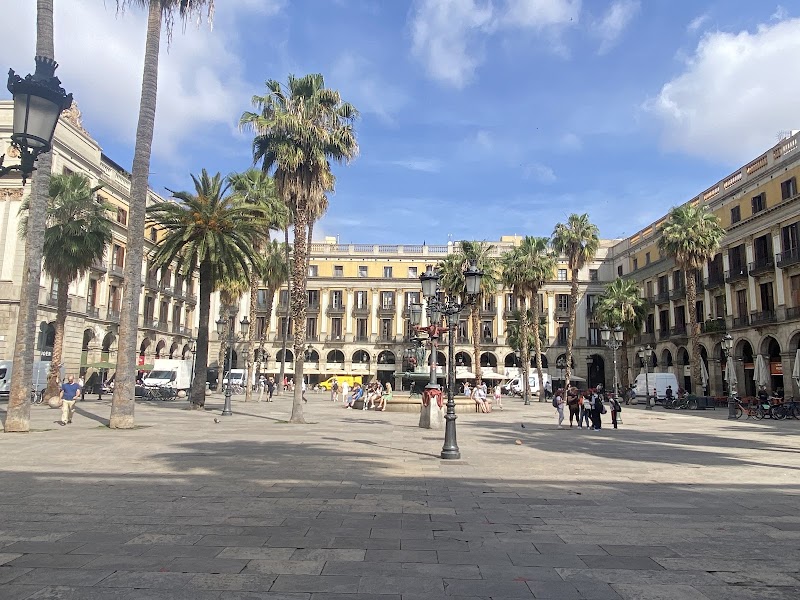
Take a look around you. Tall palm trees, elegant arcades, a gentle fountain at the center... This is Plasa ray-AL, one of Barcelona's most enchanting hidden courtyards. But the ground you're standing on has led a remarkable double life.
In the Middle Ages, this exact spot housed the Viladàlls brothel... the only one that could legally operate in the city. From a brothel to a place of prayer. After the brothel and the glass foundry that replaced it were gone, Caputchin monks were offered the land, having lost their home in the Spanish War of Succession. They built a convent here that stood for over a century.
Then came the upheavals of eighteen thirty-five. Many of Barcelona's religious buildings disappeared as a result of the confiscation of Church properties, and the former Caputchin convent was demolished, leaving a huge vacant plot behind. The city had grand plans. Architect Fransesc Molina designed a luxurious square with the aim of extolling the monarchy, and King Ferdinand the Seventh was to be immortalized as a statue on horseback right in the center. But that statue... never happened. In its place stands the fountain of the Three Graces, cast in Paris by the house of Durenne.
Now, look carefully at the two ornate lampposts flanking that fountain. Those are the work of a twenty-six-year-old Antoni Gaudí! They were his first commission for the city of Barcelona. The City Council commissioned Gaudí in eighteen seventy-eight, he presented his plans in January of eighteen seventy-nine, and the lampposts were installed by September of that year. Look at the top of each post. The most original element is a Caduceus with two snakes and a winged helmet, symbols of mercury, the Roman god of commerce... an activity with which Barcelona identified, thanks to its busy port nearby. Even as a young architect, Gaudí was already bold. He didn't propose a fixed payment for the project, as was common at the time, but rather the total price after installing the lampposts... clearly convinced he would spend less than the proposed quote of three thousand six hundred and five pesetas.
And those palm trees swaying above you? They were planted in eighteen eighty-three to fulfill the ideals of the local bourgeoisie, who wanted an exotic, distinguished atmosphere. Today, they serve another purpose entirely. Listen... can you hear that chattering? Those bright green birds are monk parakeets. They originated from South America and were brought to Europe as pets. The first of these parakeets found living wild in Barcelona was recorded in nineteen seventy-five. Escaped pets that built an empire! In the wild, their colonies can become quite large, with pairs occupying separate apartments in composite nests that can reach the size of a small automobile.
So here you are... in a courtyard that was once a brothel, then a convent, then almost a theater, and finally a royal square... with Gaudí's very first city masterwork glowing beside you, and South American parakeets screaming overhead. Only in Barcelona.
-
2. Carrer de Marlet — The Oldest Alley & Hebrew Inscription
Carrer de Marlet, Barcelona
-
3. Sinagoga Major — One of Europe's Oldest Synagogues
Carrer de Marlet 5, Barcelona
-
4. Plaça de Sant Jaume — Political Heart of Catalonia
Plaça de Sant Jaume 1, Barcelona
-
5. Pont del Bisbe — The Bridge with a Hidden Skull
Carrer del Bisbe, Barcelona
-
6. Palau de la Generalitat — Orange Trees Courtyard
Plaça de Sant Jaume 4, Barcelona
-
7. Roman Aqueduct Fragment on Carrer del Bisbe
Carrer de la Pietat 2, Barcelona
-
8. Temple d'August — Roman Columns in a Medieval Courtyard
Carrer del Paradís 10, Barcelona
-
9. Plaça del Rei — The Royal Courtyard
Plaça del Rei, Barcelona
-
10. Palau del Lloctinent — Lieutenant's Palace Courtyard
Carrer dels Comtes 2, Barcelona
-
11. Casa de l'Ardiaca — The Courtyard with Barcelona's Oldest Palm
Carrer de Santa Llúcia 1, Barcelona
-
12. Barcelona Cathedral Cloister — The 13 Geese
Pla de la Seu, Barcelona
-
13. Plaça de Sant Felip Neri — Civil War Bomb Scars
Plaça de Sant Felip Neri, Barcelona